
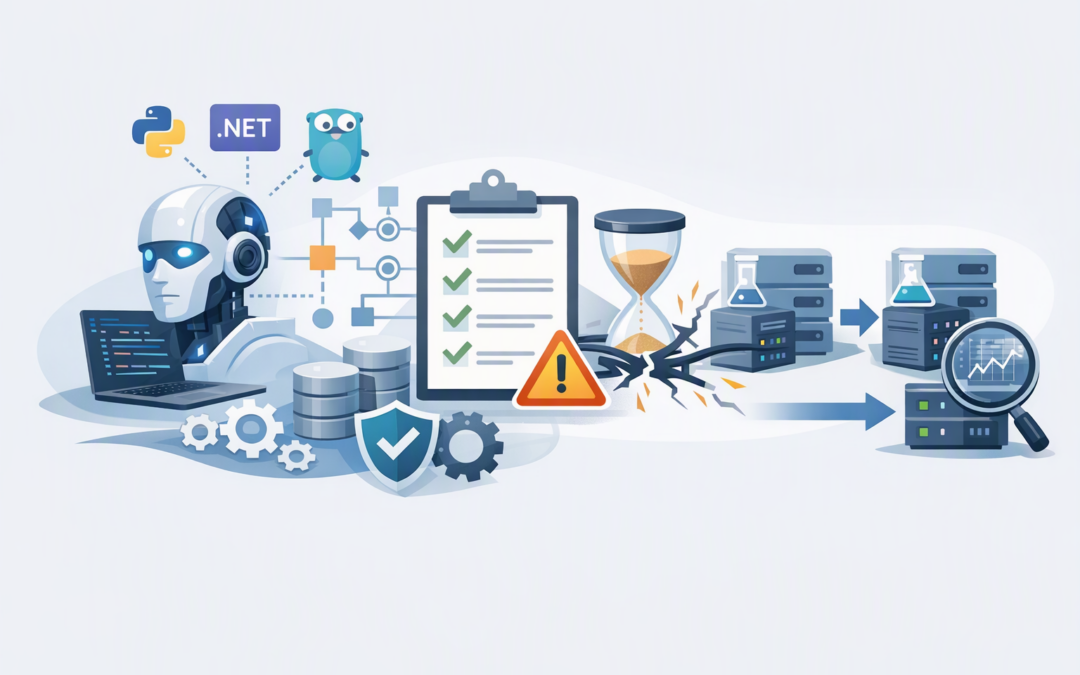
In this blog post Microsoft Agent Framework 2026 Release and Production Readiness we will explain why a platform can be officially production-ready while still changing almost every week—and what technology leaders should do about it.
This matters because an AI agent is not just another chatbot. It can search company data, call business systems, create files, trigger workflows and make decisions across multiple steps. When the framework underneath it changes, the impact can extend to security permissions, stored conversations, integrations and business processes.
What Microsoft Agent Framework actually does
Microsoft Agent Framework is an open-source software foundation for building and operating AI agents in Python, .NET and, increasingly, Go. It became generally available on 2 April 2026 after bringing together ideas and capabilities from Microsoft Semantic Kernel and AutoGen.
In plain English, the framework provides the plumbing between an AI model and the systems it needs to use. It helps development teams control how an agent thinks through a task, remembers information, calls approved tools and completes a multi-step process.
CPI Consulting helps organisations design, build and secure Azure AI solutions, from Azure OpenAI and Microsoft Foundry to agents, governance and production deployment.
Visit CPI ConsultingIts main building blocks include:
- Agents that use models such as Azure OpenAI, OpenAI or Anthropic Claude to interpret requests and decide what to do next.
- Workflows that give an agent a controlled sequence of steps instead of allowing completely open-ended behaviour.
- Memory and stored state that preserve conversations, progress and business context between interactions.
- Tool connections that let agents work with databases, applications and services through interfaces such as Model Context Protocol, or MCP.
- Operational controls for approvals, monitoring, error handling and recovery when a long-running process is interrupted.
The business benefit is that teams do not need to build all this infrastructure from scratch. The trade-off is that they inherit a fast-moving platform with many components and integrations.
The 2026 release pace is unusually fast
By the end of October 2026, the stable Python line had reached version 1.24, while the .NET line had reached 1.27. Python versions 1.20, 1.21, 1.22, 1.23 and 1.24 were released between 2 October and 30 October alone.
That pace is not automatically a warning sign. Frequent releases can deliver security improvements, better monitoring, reliability fixes and stronger control over what agents are allowed to do.
However, it changes the operating model. Your team cannot treat an Agent Framework upgrade like a routine application update that is installed automatically on Friday night.
Our earlier guide to Agent Framework version governance explains how to pin versions and control upgrades. The bigger leadership question is what this pace says about production readiness.
Generally available does not mean every feature is equally mature
The core framework is generally available, but its surrounding packages do not all carry the same level of stability. Some connectors and hosting options remain preview, alpha, beta or experimental features.
This distinction can easily disappear in a project plan. A team may say it is using a stable Microsoft framework while depending on three preview integrations and an experimental memory provider.
That does not mean the solution should be rejected. It means production approval should happen at the package and feature level—not simply because the main product has a 1.x version number.
Before approving an agent, ask for a short component register showing:
- The framework version being used.
- Every model, connector, tool and storage provider involved.
- Which components are stable and which are preview.
- Where conversations, files and workflow checkpoints are stored.
- What happens if an integration becomes unavailable.
The newest release is not always the safest release for you
Software version numbers can create a false sense of urgency. If version 1.24 appears, teams may assume that version 1.23 has immediately become unsafe or unsupported.
In practice, production readiness depends on whether a release has been tested against your agent, data and business process. A well-tested version that is one release behind can be safer than the latest version deployed without validation.
A sensible policy is to separate security fixes from feature upgrades. Urgent security updates may need an accelerated test cycle. New features can wait for the next planned maintenance window.
For an Australian view of this process, see our guide to release cadence for Australian teams.
Stored data is often the hidden upgrade risk
Many AI agents keep more than a simple chat history. They may store workflow checkpoints, tool results, approval decisions and the state of tasks that have not yet finished.
A release can change how that information is structured. New software may read the old format, while old software cannot always read records written by the new version. This can make a rushed rollback difficult.
October’s Python releases included changes affecting persisted content, MCP connections and Redis-based context storage. These are not abstract developer concerns. They can determine whether an agent resumes a customer request correctly or loses its place halfway through a process.
We covered these issues in more detail in our October 2026 changes overview.
A realistic mid-market scenario
Consider a 180-person professional services company using an agent to review incoming client documents, extract key details and create work items in its project system.
The agent appears low risk because it does not approve payments or provide final advice. However, it relies on stored sessions, document access, an MCP-connected tool and a workflow that may run for several minutes.
If the company accepts automatic dependency updates, a framework release could alter connection handling or stored-state compatibility. The result may be duplicated tasks, incomplete document processing or a rollback that cannot read sessions created after the update.
The cost is not limited to technical repair. Staff must manually review affected client matters, managers lose confidence in the automation, and the business may need to explain how sensitive documents were processed.
A practical production-readiness model
Technology leaders do not need to approve every software package personally. They do need evidence that a repeatable control process exists.
- Pin exact versions. Production should use an approved version rather than automatically downloading whatever was published most recently.
- Maintain a production-like test environment. It should use representative workflows, permissions and stored data without exposing real confidential information unnecessarily.
- Test business outcomes. Confirm that the agent produces correct results, requests approvals at the right time and cannot reach tools or data outside its role.
- Test stored-state compatibility. Check active sessions, workflow checkpoints and rollback behaviour before deployment.
- Release gradually. Start with internal users or a small percentage of work, monitor the results and expand only when the evidence supports it.
- Keep a rollback and data-recovery plan. A rollback must cover application code, package versions and stored information.
Version pinning can be as simple as requiring an exact package number in the deployment configuration:
# Python example
agent-framework==1.24.0

<!-- .NET example -->
<PackageReference Include="Microsoft.Agents.AI" Version="1.27.0" />
The important point is not the specific versions shown. It is that production changes only when an authorised person approves a tested release.
Production readiness is an operating capability
A framework can be generally available while your implementation remains unready. Production readiness comes from combining stable components with controlled permissions, monitoring, testing, recovery and clear ownership.
This also supports the Essential Eight, the Australian government’s cybersecurity framework that many organisations use to reduce common security risks. The Essential Eight is not an AI governance standard, but its focus on patching, application control, restricted access and recovery remains highly relevant.
For agents using A2A or MCP to communicate with other systems, our A2A and MCP governance guide provides additional questions for access, identity and tool approval.
What technology leaders should take away
Microsoft Agent Framework is mature enough for well-governed production use, but its rapid release cadence rules out a set-and-forget approach. The safest organisations will not avoid updates; they will create a controlled path for adopting them.
CloudProInc brings more than 20 years of enterprise IT experience to this work. As a Melbourne-based Microsoft Partner and Wiz Security Integrator, we help organisations connect AI delivery with Azure, Microsoft 365, cybersecurity and practical operational controls.
If you are not sure whether your AI agent is genuinely production-ready—or simply working in a demonstration—we are happy to review the architecture, dependencies and upgrade process with you. No strings attached.