
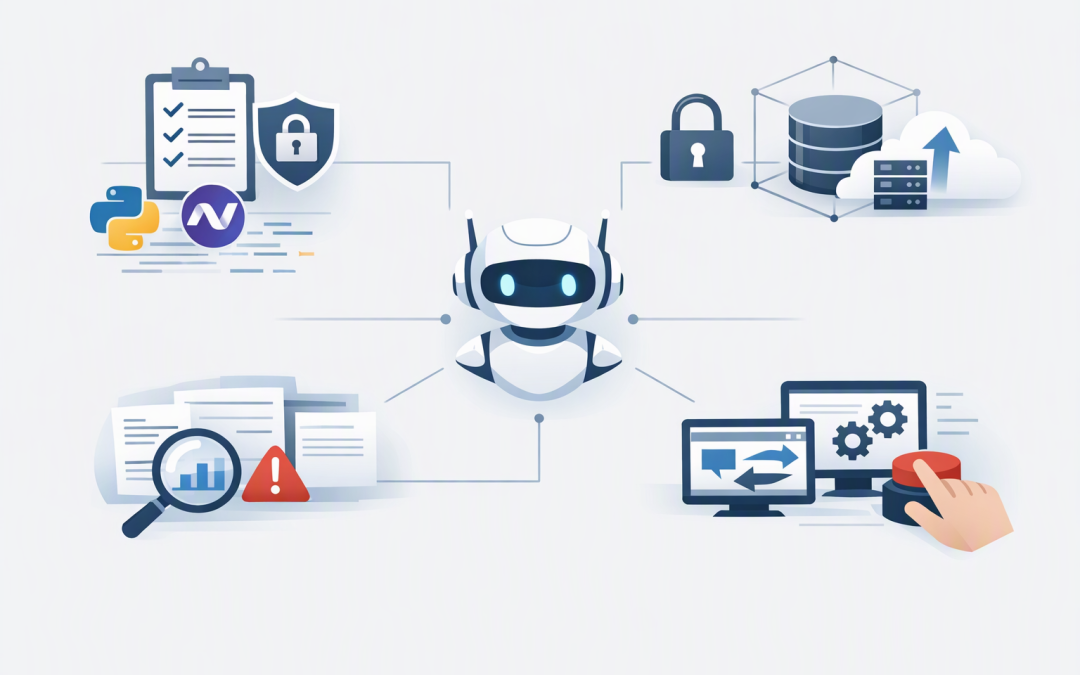
In this blog post Microsoft Agent Framework Python 1.21 and .NET 1.24 Readiness we will explain what the October releases mean for organisations trying to move AI agents beyond pilot projects. Many businesses now have an agent that works in a demonstration, but they are still unsure whether it can safely handle real data, real approvals and real business consequences.
Microsoft Agent Framework provides the building blocks for AI agents that can answer questions, use business tools and complete multi-step work. Python and .NET are the two main software development environments supported by the framework, allowing organisations to use the language that best fits their applications and internal skills.
Python 1.21 was released on 8 October 2026, following .NET 1.24 on 7 October. Microsoft released .NET 1.25 on 15 October, so .NET 1.24 is no longer the newest version. However, the 1.21 and 1.24 release cycle remains important because it shows where Microsoft is concentrating its production work: policy enforcement, session isolation, provider consistency and operational control.
Production readiness is not the same as a successful demonstration
A demonstration usually involves one user, a small amount of test data and somebody watching for problems. Production may involve hundreds of employees, sensitive customer records and agents running when no developer is present.
CPI Consulting helps organisations design, build and secure Azure AI solutions, from Azure OpenAI and Microsoft Foundry to agents, governance and production deployment.
Visit CPI ConsultingThe question is therefore not simply whether the framework can produce a useful response. Technology leaders need to know what happens when a request fails, a user lacks permission, a policy blocks content or an agent calls the wrong tool.
This builds on our earlier review of Microsoft Agent Framework releases for enterprise AI. The October versions add useful capabilities, but they do not remove the need for disciplined testing and governance.
What Python 1.21 changes for business risk
Stronger compliance checks for streamed answers
AI systems often stream an answer a few words at a time so the user does not have to wait for the complete response. This feels faster, but it creates a policy challenge because sensitive information may begin appearing before the entire answer has been checked.
Python 1.21 improves Microsoft Purview integration for streamed responses. Purview is Microsoft’s service for applying data protection, compliance and information-handling policies. The framework can buffer the complete response for policy evaluation rather than assessing isolated fragments without full context.
For a legal, healthcare or financial services organisation, that can reduce the risk of an agent revealing restricted information. It does not make the agent automatically compliant, but it provides a better technical foundation for enforcing approved rules.
Better visibility into tool use
An agent becomes more useful when it can use tools, such as looking up a customer, creating a support ticket or preparing an invoice. Tool access also increases risk because a convincing answer is no longer the only possible outcome—the agent may change something in a live system.
Python 1.21 exposes more information about rewritten tool arguments and adds guidance around tool results. In plain English, development and security teams gain a clearer view of what the agent was instructed to do and what information it actually sent to the connected system.
That supports better audit records, troubleshooting and approval controls. If an agent attempts an incorrect action, the organisation has more evidence for understanding why.
Improved separation between agent sessions
The release also isolates provider-owned session information when one agent is used as a tool by another. A session is the working context associated with a particular conversation or task.
This separation matters in shared business systems. Information from one customer case, employee request or business process should not unintentionally affect another.
The business outcome is reduced cross-session risk and more predictable behaviour when multiple agents work together. It also reinforces the governance practices discussed in our production guide for A2A and MCP governance. A2A allows agents to communicate with other agents, while MCP is a common method for connecting agents to tools and data.
What .NET 1.24 means for Microsoft-focused organisations
For businesses already running Microsoft applications, .NET is often the natural production choice. It fits established Azure hosting, identity, monitoring and software delivery practices, reducing the number of new platforms the IT team must support.
The significance of .NET 1.24 is less about one headline feature and more about the continued strengthening of the framework’s production path. The core packages support agents and workflows, while related packages cover areas such as hosting, Microsoft Foundry, declarative workflows and connections to other services.
However, package maturity is mixed. Some components are stable, while some connectors and hosting options remain marked preview, release candidate or alpha. Those labels mean the software may still change and should not automatically be approved for a critical business process.
This is why version reviews must happen package by package. Installing one stable core package does not make every connector in the same project production-ready. Our guide to building production agents with Microsoft Agent Framework and .NET explains the wider architecture decisions involved.
A realistic production scenario
Consider a 200-person professional services company introducing an agent to prepare client onboarding files. The agent reads submitted forms, checks required documents and creates tasks for the operations team.
The pilot saves 20 minutes per client, so management wants to release it immediately. But the production review finds that the agent can see every client folder, tool actions are not centrally logged and a failed workflow starts again from the beginning.
The underlying AI is not the main problem. Access, auditability and recovery are.
The safer approach is to restrict the agent to the specific client record, require approval before updating a business system, record every tool request and preserve task state so interrupted work can resume. That last capability is covered in our guide to durable AI agents for IT leaders.
This may delay launch by several weeks, but it can prevent privacy incidents, duplicated work and expensive manual cleanup later.
What technology leaders should do now
- Pin every package version. Do not allow an automated build to install an untested update simply because it is newer.
- Create a package maturity register. Record which components are stable, preview or experimental and identify the business processes that depend on them.
- Test complete workflows. Include failed tool calls, expired logins, blocked content, interrupted sessions and unavailable AI services.
- Apply least-privilege access. Give each agent only the data and actions required for its job, not broad access for convenience.
- Set cost and activity limits. Control the number of reasoning steps, tool calls and retries so a looping agent cannot generate an unexpected cloud bill.
- Maintain a rollback plan. Keep the previous approved version available and document how to disable the agent without stopping the underlying business process.
Version pinning can be simple, but it must be deliberate. For example:
# Python release being validated
agent-framework==1.21.0
<!-- .NET release being validated -->
<PackageReference Include="Microsoft.Agents.AI" Version="1.24.0" />These examples show controlled testing, not a recommendation to ignore later releases. Moving to .NET 1.25 or another future version should be a planned change with regression testing, security review and a clear reason for upgrading.
Do these releases make Agent Framework production-ready
They make it more production-capable, particularly through stronger policy handling, clearer tool activity and better session isolation. They do not make every agent, connector or workflow safe by default.
Australian organisations should also map their controls to the Essential Eight, the Australian Government’s cybersecurity framework that many organisations are now required or expected to follow. Agent access, privileged accounts, application updates, monitoring and recovery should sit inside the company’s wider security program rather than becoming a separate AI experiment.
CloudProInc combines more than 20 years of enterprise IT experience with hands-on expertise across Azure, Microsoft 365, Microsoft Defender, Microsoft Agent Framework, OpenAI and Anthropic Claude. As a Melbourne-based Microsoft Partner and Wiz Security Integrator, we help organisations assess the complete operating environment—not just whether the demonstration works.
If you are unsure whether your current AI agent is ready for employees, customers or sensitive business data, we are happy to review the architecture, package choices and production controls with you—no strings attached.