
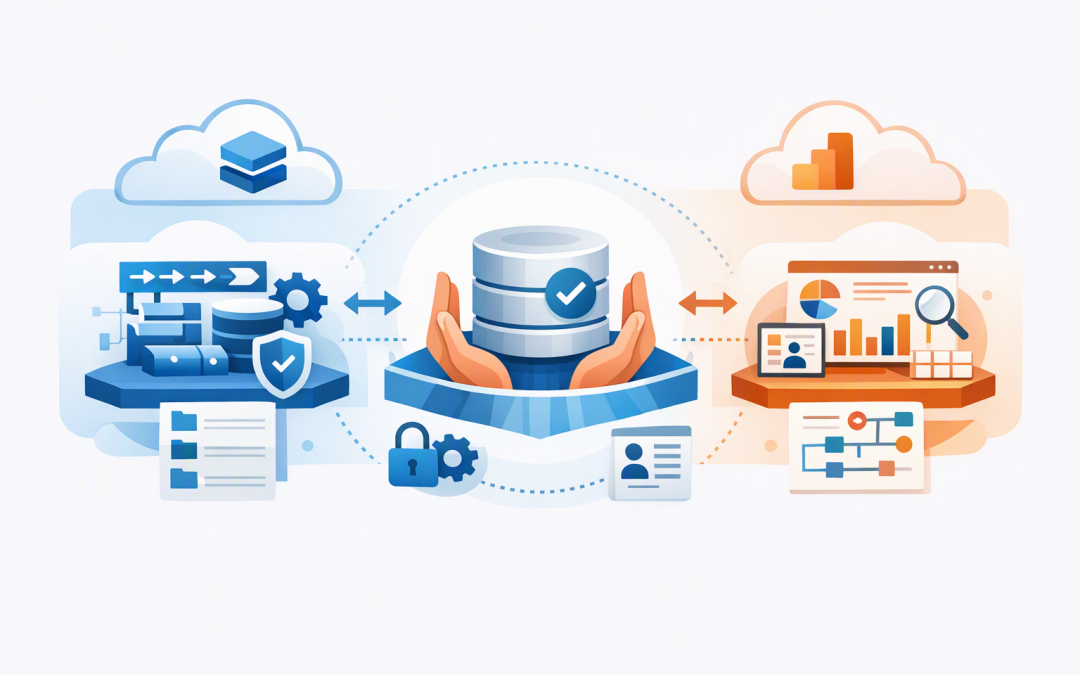
In this blog post Fabric and Azure Databricks Together Who Owns What in Practice we will explain how to use both platforms without duplicating work, weakening security or paying twice for the same capability.
This problem often begins quietly. One team builds data pipelines in Azure Databricks, another creates similar processes in Microsoft Fabric, and business units publish their own Power BI reports. Before long, nobody is certain which data is authoritative, who controls access or why platform costs keep rising.
The answer is not to declare one platform the winner. Fabric and Azure Databricks can work well together, but only when each has a clearly defined job and every important dataset has one accountable owner.
What the two platforms do at a high level
Microsoft Fabric is an integrated data and analytics platform. It brings together data movement, engineering, warehousing, real-time analytics and Power BI reporting, with OneLake acting as its shared data storage layer.
CPI Consulting helps organisations design, build and secure Azure AI solutions, from Azure OpenAI and Microsoft Foundry to agents, governance and production deployment.
Visit CPI ConsultingAzure Databricks is a data engineering, analytics and artificial intelligence platform. It is commonly used for large-scale data processing, complex transformations, machine learning and workloads requiring specialised engineering tools.
Both platforms can process data, run notebooks, build pipelines and support AI. That overlap creates flexibility, but it also creates the risk of two teams building and operating the same thing.
Recent integration options make coexistence easier. Fabric can expose selected data registered in the Azure Databricks Unity Catalog, which is Databricks’ system for organising data and controlling access, as a read-only mirrored catalogue. Only the catalogue structure is mirrored; the underlying data can remain where it is and be accessed through shortcuts. Databricks can also read data held in OneLake without creating another copy.
This removes some unnecessary data movement. It does not remove the need for an operating model.
The core rule is one owner for every data product
A data product is a trusted, reusable set of business information, such as a customer profitability model, stock forecast or monthly finance dataset. Each data product needs one platform of record, one team responsible for its quality and one approved path for changing it.
Without that rule, a sales table may be cleaned in Databricks, adjusted again in Fabric and modified a third time inside a Power BI report. Three versions of revenue can then reach the executive meeting.
The following ownership split works well for many mid-sized and enterprise organisations.
Azure Databricks should own complex data engineering and AI workloads
Databricks is usually the better owner when the work involves high data volumes, advanced engineering, complex processing or machine learning. This is particularly true when an established data engineering team already uses Databricks and Unity Catalog.
Databricks commonly owns
- Large-scale ingestion and transformation of raw data.
- Complex data quality and matching processes.
- Streaming and high-volume processing.
- Machine learning model development and operation.
- Reusable engineering libraries and data science environments.
- Technical governance for data registered in Unity Catalog.
For example, an insurer combining millions of policy, payment and claims records may use Databricks to clean the records, identify relationships and produce a trusted claims dataset. Fabric can then make that approved dataset easier for analysts and Power BI users to consume.
This approach protects previous Databricks investment rather than rebuilding working pipelines simply because Fabric is now available. Before expanding that investment, CIOs should still validate workload scale, adoption and operating costs, as discussed in our guide to checking the business case for Azure Databricks.
Fabric should own business analytics and controlled self-service
Fabric is often the natural owner of the last mile between trusted data and business decisions. It gives analysts a more integrated route from governed information to Power BI reports, dashboards and business-friendly data models.
Fabric commonly owns
- Power BI reports, dashboards and shared business measures.
- Semantic models, which define business terms such as revenue, margin and active customer.
- Department-level analytics with appropriate central controls.
- Lightweight data movement and transformation.
- Data products created primarily from Microsoft 365, Power Platform or business application data.
- OneLake-based data that is mainly consumed by Fabric workloads.
Fabric can use Direct Lake, a Power BI mode that reads lake data directly rather than repeatedly importing another copy. Mirrored Databricks catalogues can provide a read-only SQL analytics endpoint and support Power BI reporting while Databricks remains responsible for the underlying tables.
The business outcome is faster reporting without allowing every analyst to create another uncontrolled data pipeline.
Choose the system of record before choosing the connection
The most important decision is not whether to use a shortcut, mirror or connector. It is where the authoritative data lives and which platform is allowed to change it.
If Databricks creates and governs a customer risk table, keep Databricks as its system of record and expose it to Fabric as read-only. If a finance reporting dataset is created and maintained in Fabric, keep OneLake as its system of record and allow Databricks to read it when advanced analysis is required.
Avoid allowing both platforms to update the same table. Dual ownership creates difficult questions about processing order, recovery, audit history and which version should be trusted after a failure.
Use these practical rules
- Assign one platform of record to every production dataset.
- Give write access only to the platform and team that owns it.
- Use read-only sharing wherever possible.
- Record the owner, purpose, refresh target and approved users.
- Review duplicated storage, processing and licences each quarter.
Security ownership must be duplicated deliberately
This is where coexistence projects can create serious risk. Unity Catalog permissions do not automatically become Fabric permissions when Databricks data is exposed in Fabric. Access controls must be configured in Fabric as well.
In plain English, a restriction protecting sensitive payroll or customer data in Databricks may not protect that information once it is made available through a Fabric workspace. The Fabric team must recreate and test the appropriate controls rather than assuming they travelled with the data.
For Australian organisations, this matters for privacy obligations and the Essential Eight, the Australian Government’s cybersecurity framework that many organisations are expected or required to follow. Additional platforms mean additional identities, administrator accounts, access reviews and security settings to manage.
Security ownership should therefore be explicit. The Databricks team protects source data and Databricks identities. The Fabric team protects workspaces, OneLake access and Power BI distribution. A central security owner verifies that the controls work together and that excessive access is not created at the connection point.
One orchestrator should control each end-to-end process
Fabric Data Factory, which schedules and moves data, can trigger Azure Databricks jobs. Databricks also has its own job scheduling capabilities. Either can work, but one should control each end-to-end process.
If Fabric starts a Databricks transformation, Fabric should track whether it completed before refreshing the related business report. If Databricks owns the complete engineering chain, avoid creating a second Fabric schedule that can start the same work independently.
This reduces failed refreshes, duplicate processing charges and the familiar support problem where each team believes the other platform caused the incident.
What coexistence looks like in practice
Consider a 200-person distribution company with an established Databricks environment and growing demand for Power BI reporting. Its data engineers process sales, inventory and supplier information in Databricks, while analysts regularly export data or create separate Fabric pipelines.
A clearer model keeps raw processing, quality controls and forecasting in Databricks. Approved sales and inventory tables are shared read-only with Fabric, where the analytics team owns business definitions, Power BI models and executive dashboards.
The company can then retire duplicate pipelines, reduce reconciliation work and give managers one approved view of performance. More importantly, support responsibilities become clear when data is late, incorrect or unavailable.
Build the operating model before expanding AI
Trusted AI depends on trusted data ownership. An AI agent should not have to choose between a Fabric version and a Databricks version of the same customer record.
Before connecting OpenAI, Claude or Microsoft AI services to business data, define the authoritative dataset, approved access path and responsible owner. Our article on grounding AI agents in trusted Fabric data explains how shared definitions can improve answers and reduce the risk of an agent acting on inconsistent information.
A coexistence review should answer seven questions
- Which platform is the system of record for each critical dataset?
- Who can change the data and who can only read it?
- Which team owns business definitions and reporting measures?
- Have security restrictions been recreated and tested across both platforms?
- Which system schedules and monitors each process?
- Are you paying twice to store or process the same information?
- Who is accountable when a report is wrong or late?
Fabric and Azure Databricks can be a strong combination. Databricks can handle specialised engineering and AI workloads, while Fabric makes trusted information accessible through business analytics and Power BI. The value comes from collaboration, not capability overlap.
CloudProInc brings more than 20 years of enterprise IT experience to Azure, Microsoft Fabric, Databricks, Microsoft 365, AI and cybersecurity projects. As a Melbourne-based Microsoft Partner and Wiz Security Integrator, we focus on practical architecture that reduces cost and risk rather than adding another layer of complexity.
If you are not sure whether Fabric and Databricks are complementing each other or quietly duplicating cost and responsibility, we are happy to review the current model with you — no strings attached.