
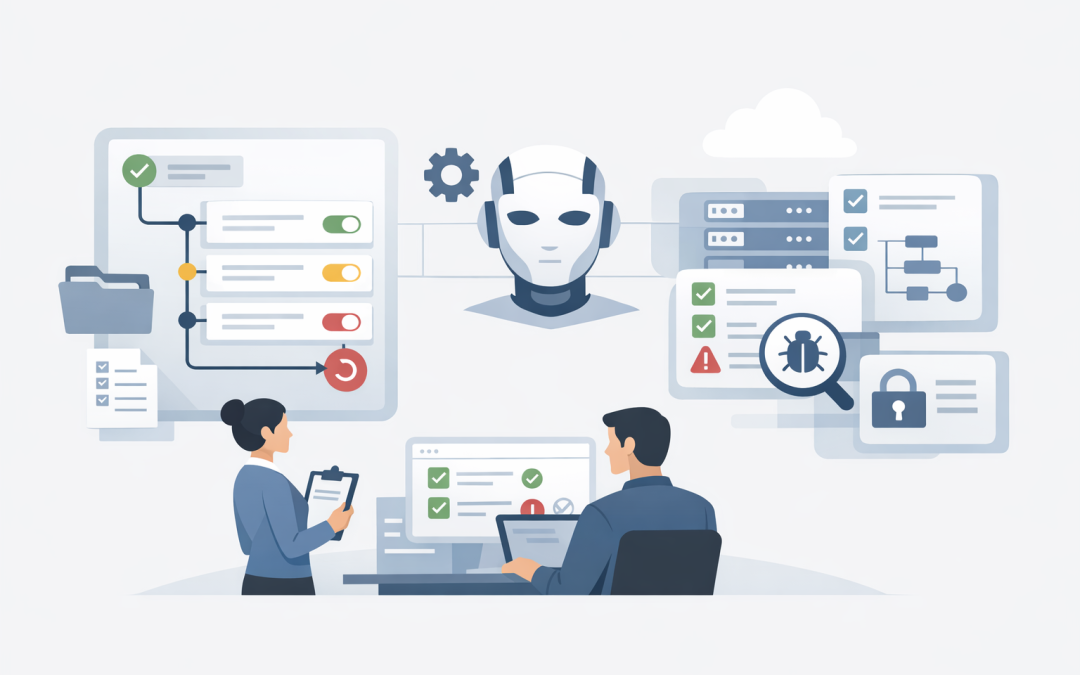
In this blog post Why Mistral Studio Version Control Is a Big Step for Enterprise AI we will explain how Mistral’s new controls can stop business AI from becoming an unmanageable collection of prompts, files and undocumented changes.
This is a common problem. An AI assistant works well during its pilot, but six months later nobody can confidently say which instructions it is following, who last changed them or why its answers have started behaving differently.
Mistral announced version control for prompts and skills in Studio on 9 July 2026. The update provides a central place where these important AI instructions can be versioned, owned and traced instead of being scattered across code, documents, notebooks and chat messages.
What Mistral Studio is changing
A prompt is the set of instructions that tells an AI model how to behave. It might specify the tone of a customer response, the information to extract from an invoice or the conditions that require a support request to be escalated.
CPI Consulting helps organisations design, build and secure Azure AI solutions, from Azure OpenAI and Microsoft Foundry to agents, governance and production deployment.
Visit CPI ConsultingA skill goes further. It packages a repeatable method, checklist or procedure that an AI assistant can apply when a particular task appears. A contract review skill, for example, could tell the AI what clauses to find, which risks to flag and how to format the final report.
Mistral Studio now allows teams to save and manage these assets with a history of their changes. Each update creates a new version rather than silently overwriting the previous one. Earlier versions remain available for review and rollback if a change causes problems.
Think of it as document version history built specifically for AI behaviour. It brings some of the discipline used in software development to the instructions that control AI applications, without requiring every business expert to become a software developer.
Why unmanaged prompts create business risk
Prompts often begin as experiments. Someone writes an instruction, tests it in a chatbot and adjusts the wording until the response looks right.
The risk begins when that experiment quietly becomes part of a real business process. The prompt may now influence customer communications, financial summaries, employee advice or decisions about which cases need human review.
If the instruction is later copied into several applications, teams can end up with different versions of the same business rule. One assistant may use the current refund policy while another follows wording copied six months earlier.
When something goes wrong, the investigation becomes unnecessarily difficult. IT must work out which prompt was running, what changed and whether the previous version can be restored.
This is not simply a technical inconvenience. It can mean longer incidents, inconsistent customer service, additional manual checking and reduced confidence in the entire AI program.
Version control reduces the cost of AI mistakes
Mistral Studio keeps previous versions instead of replacing them. Teams can add notes explaining what changed, test a new version and, where workspace aliases are used, promote an approved version to a name such as “stable.”
An alias is simply a reliable label that an application can follow. The application points to the approved version rather than requiring developers to rewrite it every time the prompt improves.
If the new version produces poor results, the team can return to the previous approved version. That can turn a lengthy troubleshooting exercise into a controlled rollback.
The business outcome is reduced downtime. It also lowers the risk of an AI mistake continuing unnoticed because nobody knows how to restore the last working configuration.
Business experts can improve AI without waiting for every deployment
Traditional code version control remains important, but it is not always a practical workspace for legal, finance, customer service or operations teams. These people often understand the required policy and wording better than the developers building the application.
Mistral Studio allows authorised AI builders to edit and test prompts or skills without waiting for a full software deployment for every experiment. Once the change has been checked, it can move through the organisation’s approval process before production use.
This removes a common bottleneck. Developers can focus on integrations, security and reliability, while subject-matter experts improve the instructions that reflect how the business actually operates.
It is similar to the principle discussed in our article on using AGENTS.md to make AI tools follow team standards. AI becomes more useful when important knowledge is written down, shared and consistently applied.
Clear ownership strengthens AI governance
Version control is only useful if somebody is accountable for each asset. A customer service prompt should have a business owner who understands customer policy, along with a technical owner responsible for how it is used.
Mistral’s approach treats prompts and skills as production assets with ownership, fixed versions and audit history. This creates a clearer record of who changed an instruction and when it changed.
For Australian organisations, this can support broader governance and incident-response processes. It may also provide useful evidence when demonstrating change control under internal security policies or the Essential Eight, the Australian Government’s cybersecurity framework that many organisations use to reduce common cyber risks.
Version control does not automatically create Essential Eight compliance, nor does it solve every requirement under Australian privacy legislation. You still need appropriate access controls, data-handling rules, testing and human oversight.
However, it is much easier to govern an AI system when you can identify the exact instructions influencing its behaviour.
A practical 200-person company scenario
Consider a 200-person services company using an AI assistant to draft customer support responses. The original prompt was written by IT, but customer service managers have since copied and modified it for different teams.
A policy change is introduced, yet one version of the assistant continues recommending an outdated process. Customers receive inconsistent answers, and support staff begin checking every AI-generated response manually.
With controlled versions, the company could identify the affected prompt, assign an owner and create an updated version without deleting the previous one. The team could test it against historical support cases, approve it and promote it as the stable version.
If the updated prompt increased escalations or produced longer responses, the company could roll back while it investigated. The immediate outcomes would be fewer inconsistent answers, less manual checking and a shorter recovery time.
Version control does not replace testing
A neatly versioned prompt can still be inaccurate, unsafe or expensive to run. Businesses therefore need to test each version against realistic examples before approving it.
A useful test set might include common requests, unusual cases, sensitive information, unclear questions and situations where the AI must hand the task to a person. Results should be checked for accuracy, tone, policy compliance and unnecessary processing cost.
This is part of the wider production approach covered in what Microsoft’s new AI stack means for safer AI projects. Prompts, models, data, security and monitoring need to work as one controlled system.
Five steps to put prompt versioning into practice
- Inventory your prompts and skills. Find the instructions currently stored in applications, documents, code repositories and employee accounts.
- Prioritise high-risk use cases. Start with AI that communicates with customers, handles sensitive data or influences financial, legal or operational decisions.
- Assign an owner. Give every production prompt and skill both a business owner and a technical owner.
- Create an approval path. Define how a version moves from draft to testing and then to approved production use.
- Measure the outcome. Track error rates, escalations, employee review time, customer satisfaction and operating cost before and after changes.
What this means for your AI strategy
Mistral Studio’s update reflects a broader shift in enterprise AI. The important question is no longer just which model produces the best demonstration. Organisations also need to know how instructions are controlled, tested, secured and improved over time.
This matters even if your business currently uses OpenAI, Anthropic Claude or Microsoft Azure rather than Mistral. Multi-model environments are becoming more common, as we discussed in our guide to standardising development AI safely. The same governance principles should apply across every platform.
CloudProInc approaches these decisions from a practical, platform-independent perspective. As a Melbourne-based Microsoft Partner and Wiz Security Integrator with more than 20 years of enterprise IT experience, we help organisations connect AI experimentation with security, cloud management and measurable business outcomes.
If you are not sure which prompts are running inside your current AI tools, or whether anyone is controlling their changes, it may be time for a simple governance review. We are happy to take a practical look at your setup and identify the highest-risk gaps, with no strings attached.