
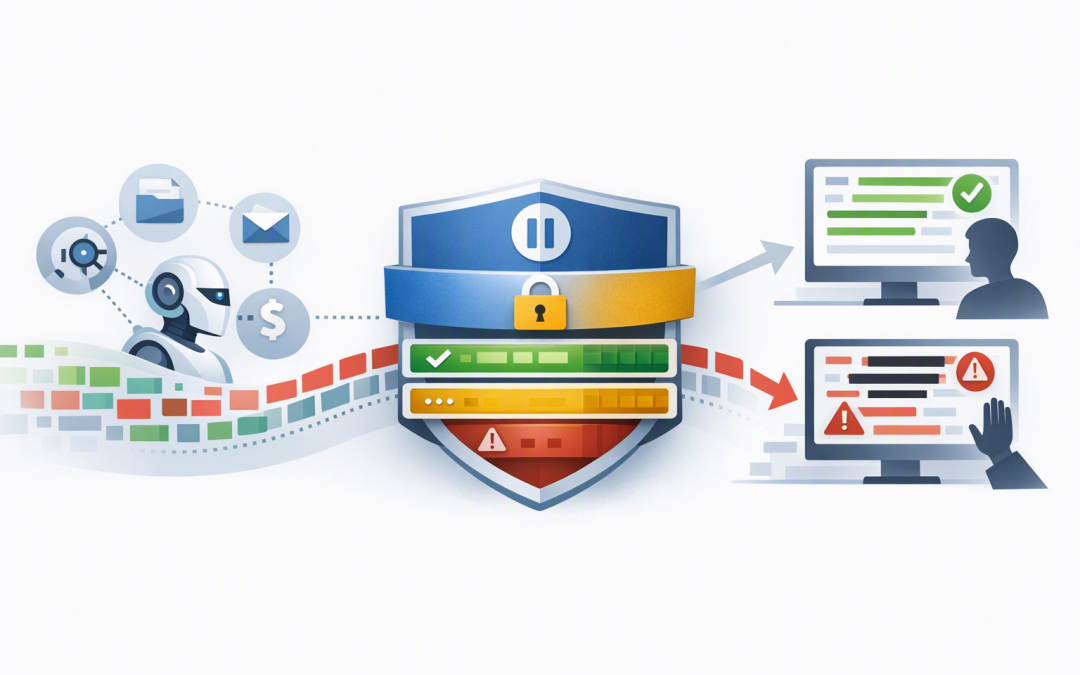
In this blog post Why Production AI Agents Need Policy Enforcement While Streaming we will explain why checking an AI request once, before processing starts, is not enough to protect a production system.
The risk appears after the prompt has been approved. An agent may retrieve a confidential document, call a business system or begin revealing sensitive information while its answer is already appearing on an employee’s screen.
At a high level, policy enforcement is the security checkpoint between the AI agent and the outside world. It continuously decides what information can be displayed, which actions can proceed and when the agent must stop or ask for human approval.
Why prompt-time checks create a false sense of safety
A prompt-time check reviews what the user asks before sending the request to the AI model. It can block obvious problems such as malicious instructions, prohibited topics or requests from unauthorised users.
That is useful, but the user’s request is only the beginning of an agent workflow. Once work starts, the agent may search Microsoft 365, query a customer database, read an Azure-hosted application or use another connected tool.
Consider an employee asking, “Summarise the open issues affecting our largest customers.” The request itself looks harmless. However, the agent might retrieve contract values, private customer correspondence, payment disputes or legally sensitive notes while preparing the answer.
A prompt check cannot assess information that has not yet been retrieved. Production controls must therefore remain active throughout the interaction.
Streaming changes when information is exposed
Streaming means sending an AI response to the user in small updates while it is still being generated. These updates may contain pieces of text, progress messages, tool requests or other events.
This makes an agent feel faster because employees do not have to stare at an empty screen. We covered that user experience benefit in why streaming responses make OpenAI agents feel faster.
The security trade-off is timing. If the application sends every piece directly to the browser, sensitive content may reach the user before a final output check runs.
Stopping the response afterwards does not remove information that has already been displayed, copied or captured. This is why production enforcement must sit before the release point, not simply at the start or end of the request.
The technology behind continuous policy enforcement
The main technology is a policy enforcement layer, often implemented as middleware. Middleware is software placed between the agent, its connected tools and the user interface so that every important event passes through a controlled checkpoint.
The layer maintains a rolling buffer rather than releasing each fragment immediately. It collects enough text to understand the context, evaluates it against company rules and then releases, removes or blocks the content.
Context matters because sensitive information can be split across several updates. One update might contain part of a customer identifier and the next might complete it. Inspecting each fragment separately could miss the risk.
A simplified streaming flow looks like this:
confirm the user's identity and permissions
check the initial request

for each event produced by the agent:
 if the event requests a tool action:
 check whether the user and agent may perform it
 require approval if the action is sensitive

 if the event contains response text:
 add it to a rolling buffer
 evaluate the content and its context

 if policy allows it:
 release the approved section
 else:
 stop, redact or replace the section
 record the policy decision

record the completed interaction for audit
The exact implementation will depend on the agent platform. OpenAI, Anthropic Claude and Microsoft-based agent systems expose different streaming events, but the business requirement remains the same: nothing important should bypass the control layer.
Policies must cover actions as well as words
An agent can create risk without displaying sensitive text. It may attempt to send an email, update a customer record, export a file or call an external service.
Each tool request needs its own policy decision. The system should verify the user’s identity, the agent’s permissions, the data involved, the destination and whether human approval is required.
For example, an accounts agent may be allowed to draft a supplier payment request but not approve or submit it. Keeping that separation reduces fraud risk without removing the productivity benefit of AI.
This action-level enforcement belongs within the broader secure control plane for enterprise AI agents, which manages identity, permissions, spending, approvals and accountability.
Choose the right release model for the risk
Not every response needs identical handling. A low-risk internal knowledge assistant and an agent working with payroll records should not have the same release rules.
- Immediate streaming: Suitable only for low-risk content where each update can be checked safely before release.
- Buffered streaming: Holds a sentence or short section, checks it and then releases it. Users still see progress, but with a small safety delay.
- Full-response review: Holds the entire answer until all policy checks finish. This is slower but often appropriate for legal, financial, health, human resources or highly confidential information.
- Human approval: Pauses the workflow when the agent encounters a sensitive action or uncertain policy decision.
Some enterprise policy integrations deliberately buffer a complete response before releasing anything. This provides stronger protection but removes much of the perceived speed benefit, which is why businesses should decide whether streaming is appropriate for each AI workflow.
A practical scenario for a 200-person business
Imagine a 200-person professional services company introducing an agent that prepares client account summaries. The agent can search emails, project files, meeting notes and billing records.
The company initially checks only the employee’s prompt. During testing, the agent starts streaming a useful summary but includes comments about an unresolved payment dispute and advice prepared by the legal team.
A better design checks the employee’s access before retrieval, respects document sensitivity labels, scans each buffered section and blocks legal content from being released. The employee receives the operational summary while restricted details remain protected.
The business outcome is not simply “better AI security.” It is a usable agent that saves employees time without increasing the likelihood of a privacy incident, client complaint or compliance investigation.
Five controls to require before production
- Identity-aware policies. Decisions should reflect who is asking, their role and what information they are permitted to access.
- Rolling context checks. Inspect accumulated text rather than isolated words or fragments.
- Tool-level approval. Check every action before an agent changes data, communicates externally or triggers a financial process.
- Safe interruption. If a check fails, stop the workflow cleanly and preserve its state. A controlled process can later pause and resume without repeating completed work.
- Audit evidence. Record what the agent accessed, what policy was applied, what was released and why an action was blocked.
Microsoft Purview, which applies data protection and compliance rules, can form part of this design for Microsoft environments. Our companion guide explains practical patterns for guarding streaming AI agents with Microsoft Purview policies.
Policy enforcement supports Australian governance
Continuous AI controls do not replace the Essential Eight, the Australian Government’s baseline cybersecurity framework. They extend the same principles of controlled access, reduced privileges, monitoring and recoverability into AI-powered workflows.
They also help organisations demonstrate responsible handling of personal and confidential information under Australian privacy requirements. For CIOs and CTOs, that evidence may be as important as the policy itself.
Fast AI still needs a controlled release point
Streaming can improve employee confidence and adoption, but speed should not mean releasing content before the business knows it is safe. Prompt checks are the front door; production agents also need controls around retrieved data, generated output and every action they attempt.
CloudProInc combines more than 20 years of enterprise IT experience with hands-on work across Azure, Microsoft 365, OpenAI, Claude, Microsoft Defender, Wiz and Microsoft Purview. As a Melbourne-based Microsoft Partner and Wiz Security Integrator, we help organisations build practical AI controls without turning every useful workflow into a slow approval process.
If you are not sure whether your streaming agent can stop sensitive content before employees see it, we are happy to review the design and identify the gaps — no strings attached.