
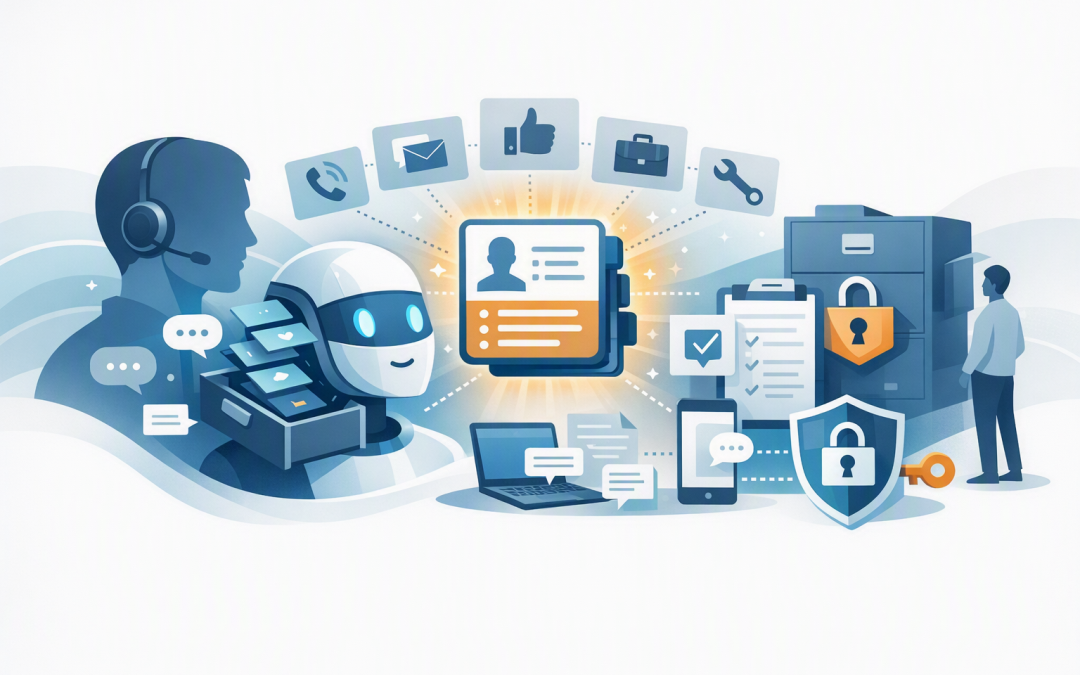
In this blog post How AI Memory Delivers Personal and Consistent Customer Service we will explain how businesses can use customer context to provide better service without creating a privacy headache. If customers repeatedly explain their history, preferences and previous problems, your service may feel disconnected even when your team is working hard.


AI memory gives an AI assistant or agent access to useful information from earlier interactions. Instead of treating every conversation as the first one, it can recognise relevant preferences, understand what has already happened and help the customer continue from where they left off.
The business outcome is straightforward: customers spend less time repeating themselves, employees spend less time searching for information, and service becomes more consistent across email, chat, phone and self-service channels.
What AI memory actually means
An AI model does not automatically remember every customer forever. In a well-designed system, memory is a controlled layer around the model, whether the business uses OpenAI, Anthropic Claude or a model available through Microsoft Foundry.
When a customer interacts with the agent, the system can identify useful facts, store approved information and retrieve only the context relevant to the next request. That context is supplied to the AI before it prepares a response.
For example, a stored memory might say that a customer prefers email updates, operates three Melbourne locations and has already completed a particular troubleshooting step. It should not contain an uncontrolled copy of every conversation the customer has ever had.
Some systems use embeddings, which turn the meaning of text into a set of numbers. This allows the system to find related information even when the customer uses different words. A request about “staff access problems”, for example, may retrieve a previous note about “employee login issues”.
Microsoft Foundry now provides managed long-term memory capabilities that can extract, store, retrieve, update and delete useful information. Microsoft currently describes this capability as a preview, so organisations should assess its production readiness, support conditions and governance requirements before relying on it for critical customer services.
Personal service should not depend on one employee
Many businesses already provide personalised service, but the knowledge often sits in an account manager’s inbox or memory. When that person is unavailable, the customer experience changes immediately.
AI memory can make approved customer context available to the right employees and service channels. A customer should not receive one answer through live chat and a contradictory answer by email the following day.
This is where memory supports consistency rather than simply adding a customer’s name to a response. The agent can remember communication preferences, previous service actions and unresolved issues, while using current business systems for authoritative information such as pricing, contracts and account status.
Five ways AI memory can improve customer experience
1. Customers do not need to repeat their story
Few things frustrate customers more than explaining the same problem to three different people. An AI agent with controlled memory can summarise the issue, record what has been attempted and carry that context into the next interaction.
This shortens service times and reduces customer effort. It also helps employees avoid repeating steps that have already failed.
2. Responses can match genuine customer preferences
Useful personalisation is often simple. A customer may prefer concise email updates, require purchase orders on invoices or want technical matters directed to a nominated contact.
Remembering these preferences can make service feel attentive without becoming intrusive. The important test is whether the customer would reasonably expect the business to retain and use that information.
For a deeper framework, see when an AI agent should remember a customer and when it should forget.
3. Employees receive a clearer starting point
AI memory is not only for customer-facing chatbots. It can also prepare a short briefing for an employee before a call or support interaction.
Instead of searching through months of emails and service tickets, the employee could see the customer’s current objective, recent issues and preferred next step. This reduces preparation time while helping the employee have a more informed conversation.
4. Service can remain consistent as the business grows
Personal service becomes harder when a company adds employees, locations and customer channels. Informal knowledge no longer travels reliably between teams.
A properly governed memory system creates a repeatable way to carry forward relevant context. It can help a growing service team maintain quality without expecting every employee to know every customer personally.
5. The next action can become more useful
Memory can help an agent move beyond generic answers. If a customer has already rejected a proposed appointment time or tried a standard fix, the agent can offer a more appropriate next step.
However, remembered context should guide a response rather than make unchecked decisions. High-impact actions involving payments, complaints, cancellations or sensitive information should still include clear approval and escalation rules.
A practical customer service scenario
Consider a 180-person professional services company with customers contacting it through email, a website assistant and account managers. Its customer information is spread across Microsoft 365, a customer relationship management system and several shared mailboxes.
Without managed memory, customers repeat project details whenever they change channels. Employees spend several minutes reconstructing each customer’s history, and different teams sometimes provide inconsistent answers.
A controlled AI memory layer could retain a short summary of the customer’s active objective, communication preference and unresolved service issue. When the customer returns, the agent retrieves those relevant memories and checks live account details in the company’s business system.
The likely outcome is shorter handling time, fewer repeated questions and a smoother handover between the AI agent and a person. Importantly, the business does not need to store every word of every conversation to achieve that result.
Memory must be separate from your source of truth
AI memory should not quietly replace your customer relationship management, billing or service management systems. Those platforms should remain the official source for addresses, contract terms, account balances and other records that must be accurate.
Memory is better suited to selected preferences, useful interaction summaries and temporary context. Before using a remembered fact, the agent may need to confirm it against a current system or ask the customer to verify it.
This distinction matters because memories can become outdated. The Australian Privacy Principles require covered organisations to take reasonable steps regarding the quality and security of personal information, including ensuring information is relevant and up to date for its intended use.
Build privacy and security into the design
Customer memory involves personal information, so retention cannot be an afterthought. Australian organisations should define what is collected, why it is needed, how long it remains useful and how a customer can access, correct or delete it.
A privacy impact assessment is a sensible starting point. It helps identify privacy risks before customer information is connected to an AI system.
- Collect less: retain only information that has a clear service purpose.
- Separate customers: ensure one customer can never retrieve another customer’s memories.
- Control employee access: show information only to people who need it for their role.
- Set expiry rules: automatically remove memories when they are no longer useful.
- Keep an audit trail: record when important memories are created, changed, retrieved or deleted.
- Protect sensitive actions: require human approval for decisions with financial, legal or customer impact.
The risks of remembering every customer conversation forever deserve particular attention. More stored information does not automatically produce better service; it often creates higher costs and a larger security exposure.
The Essential Eight, the Australian Government’s recommended cybersecurity baseline, can help protect the systems surrounding an AI service. It should be combined with identity controls, encryption, privacy processes and monitoring through tools such as Microsoft Defender, which detects security threats, and Wiz, which identifies risks across cloud environments.
Start with one measurable customer journey
Do not begin by trying to give an AI agent a complete memory of every customer. Choose one journey where forgotten context causes a visible business problem, such as repeated support calls, slow onboarding or inconsistent account handovers.
- Identify the information employees repeatedly need.
- Separate stable preferences from temporary conversation details.
- Confirm which system remains the official source of each fact.
- Define consent, access, correction, deletion and expiry rules.
- Measure handling time, repeat contacts, escalations and customer satisfaction.
It is also worth modelling the operating cost before rollout. Stored conversations, repeated searches and larger AI requests can increase consumption. Our guide to how AI conversation memory affects cost, security and service explains why selective memory is usually more effective than unlimited retention.
Better memory should create better service
The goal is not to build an AI agent that knows everything about every customer. It is to give employees and service channels the right context at the right moment, while keeping customers informed and in control.
CloudProInc combines more than 20 years of enterprise IT experience with practical work across Microsoft Azure, Microsoft 365, OpenAI, Claude, Microsoft Defender and Wiz. As a Melbourne-based Microsoft Partner and Wiz Security Integrator, we help organisations design AI services that are useful, secure and manageable rather than impressive demonstrations that create problems later.
If customers are repeating themselves or your teams are struggling to provide consistent service, we are happy to assess where controlled AI memory could make a measurable difference — no strings attached.
Discover more from CPI Consulting
Subscribe to get the latest posts sent to your email.