
In this blog post Agent Harness Explained for Building Reliable Microsoft AI Agents we will show you how to move beyond an impressive AI demonstration without giving software uncontrolled access to your business. Many organisations can build an AI chatbot in days, but making it complete real work safely is where projects often stall.
Free eBook: Microsoft Agent 365
The Control Plane for AI Agents
AI agents are rapidly becoming part of everyday work. But as agents scale across teams, platforms, and vendors, organizations need visibility, governance, and security to manage them safely at enterprise scale.
Discover how Microsoft Agent 365 helps organizations observe, govern, and secure AI agents with the same confidence and control used to manage users.
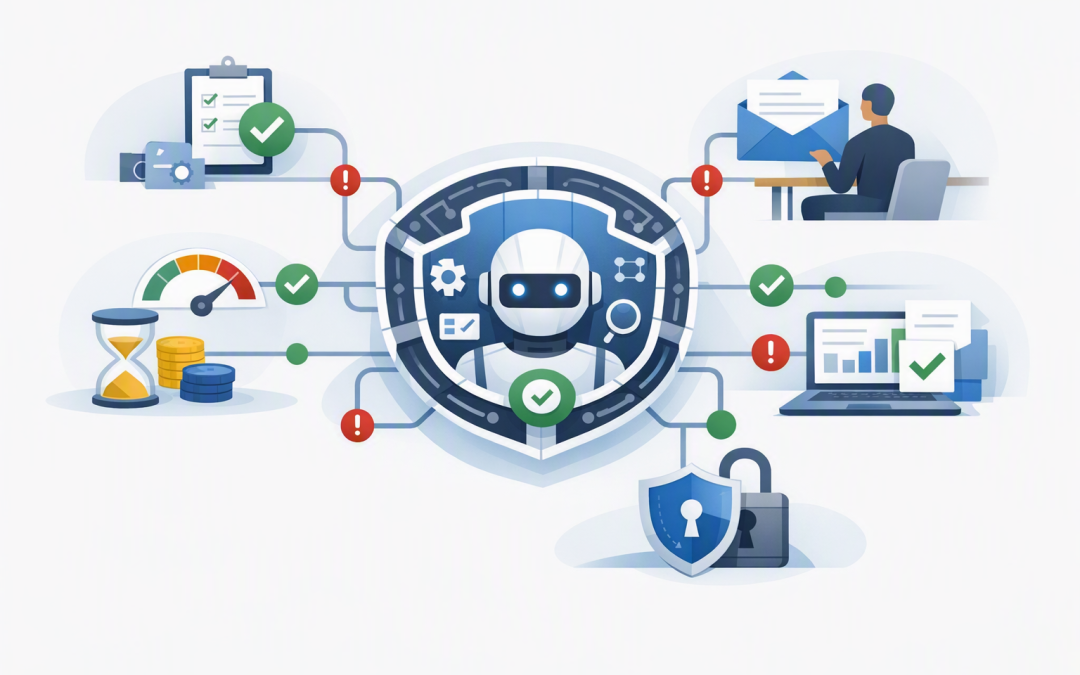
Download the Free eBookAt a high level, an agent harness is the operating structure around an AI model. It gives the model a controlled way to plan tasks, use approved tools, remember progress, request permission and record what happened.
The model provides the intelligence, while the harness provides the rules and working environment. Microsoft Agent Framework now includes a ready-made Harness for long, multi-step tasks, with support for capabilities such as planning, task lists, memory, tool approvals, context management and monitoring.
Why an AI model is not enough
A language model can read a request and generate a useful response. On its own, however, it does not know which company systems it may access, when it should stop or which decisions require human approval.
Imagine asking an AI model to review overdue invoices. It might understand the request, but it still needs a secure way to retrieve invoice data, apply your business rules, prepare a summary and perhaps create follow-up tasks.
The harness connects those steps. It can also prevent the agent from emailing a customer, changing a financial record or exposing sensitive data without the right permission.
Our earlier article, Understanding the Agent Harness Behind Reliable AI Workflows, explores these control layers in more detail. Here, we will focus on how to choose and build a practical first Microsoft agent.
The technology behind a Microsoft agent harness
Microsoft Agent Framework is a software toolkit for creating AI agents using .NET, Python and Go. It can connect agents to models hosted through Microsoft Foundry and Azure OpenAI, as well as other supported model providers.
The Harness combines several parts that development teams would otherwise need to assemble themselves:
- The AI model: The reasoning engine that interprets requests and decides what to do next.
- The chat client: The secure connection between the application and the selected model.
- Tools: Approved business functions such as searching SharePoint, reading a database, creating a service ticket or checking an invoice.
- Sessions and memory: The record of the current task, including its plan, completed steps and relevant information.
- Approval controls: Rules that determine which actions can happen automatically and which require a person to confirm them.
- Monitoring: Logs and performance information showing what the agent attempted, which tools it used and where problems occurred.
The important point for decision-makers is that the harness does not replace the model. It surrounds the model with the practical controls required to use it inside a business.
Start with one narrow business problem
The safest first project is not a general-purpose agent that can access every system. It is a narrow process with a clear beginning, a measurable outcome and limited consequences if something goes wrong.
Good starting points include:
- Summarising service desk tickets and suggesting priorities.
- Reviewing a controlled folder of documents for missing information.
- Preparing a weekly operational report from approved data.
- Researching suppliers and producing a comparison for human review.
- Drafting Microsoft 365 support responses without sending them automatically.
Define what “finished” means before development starts. For example, an invoice-review agent may be finished when it produces a list of overdue accounts, explains the reason each item was flagged and provides draft follow-up actions.
This protects the budget as well as the business. A tightly defined agent is easier to test, cheaper to run and more likely to deliver a measurable productivity improvement.
Map every tool and permission before writing code
An agent becomes useful when it can call tools, but every new tool also increases risk. A tool is simply a function the agent can request, such as “retrieve customer record” or “create support ticket”.
For each tool, ask four questions:
- What information can it read?
- What information can it change?
- Which employee would normally be allowed to perform this action?
- What is the business impact if the tool is used incorrectly?
Access should follow the principle of least privilege, meaning the agent receives only the minimum permissions needed for its job. It should not inherit broad administrator access simply because that is easier during development.
This is also where Australian security expectations matter. The Essential Eight, the Australian Government’s cybersecurity framework that many organisations are expected or required to follow, should remain part of the surrounding security design. An agent harness can support controlled access and logging, but it does not make an organisation compliant by itself.
Build human approval into important decisions
Not every action needs approval. Reading an approved product list may be low risk, while changing a customer account, running code or sending an external email deserves closer control.
A useful first design normally allows the agent to collect information, analyse it and prepare a recommendation automatically. A person then approves consequential actions.
Microsoft’s Harness supports tool approval rules, including standing approvals for known safe actions. That lets teams reduce unnecessary prompts without giving the agent unrestricted freedom.
For practical approval patterns, see How Agent Harness Keeps Azure AI Workflows Under Human Control.
What a basic Microsoft Harness looks like
For a .NET team, the initial structure can be surprisingly small. The following simplified example creates a harness agent, starts a session and sends it a task:
using Microsoft.Agents.AI;

// chatClient connects to your approved AI model.
AIAgent operationsAgent = chatClient.AsHarnessAgent();

// The session keeps the plan, tasks and history together.
AgentSession session = await operationsAgent.CreateSessionAsync();

string request =
 "Review the approved operations files and prepare an exception report.";

await foreach (var update in
 operationsAgent.RunStreamingAsync(request, session))
{
 Console.Write(update);
}
The small amount of code is not the whole solution. The real work is defining instructions, connecting approved tools, securing identities, setting limits and deciding how results will be tested.
Technical teams can continue with Build Production AI Agents with Microsoft Agent Framework and .NET.
A practical business scenario
Consider a 180-person professional services company where two employees spend six hours each week gathering project updates, checking spreadsheets and preparing a management report.
An agent could read files from an approved location, identify missing updates, prepare the report and flag exceptions. Employees would still review the findings before the report was distributed.
At an illustrative employment cost of $70 per hour, recovering 12 hours across 48 working weeks represents about $40,000 of annual capacity. The value is not necessarily reducing headcount; it may mean faster reporting, fewer errors and more time for work requiring judgement.
Set limits, monitoring and success measures
Agents can become stuck, repeat actions or consume more model capacity than expected. Every pilot should therefore have limits on task duration, tool calls, data access and spending.
Autonomous loops should always have a maximum number of attempts because an agent may fail to recognise that its task is complete. Microsoft Agent Framework supports bounded looping, where an agent can retry work until a completion rule is met or a fixed limit is reached.
Track business measures alongside technical ones:
- Hours saved per week.
- Percentage of outputs accepted without major correction.
- Number of tasks requiring human intervention.
- Average model and infrastructure cost per completed task.
- Security events, failed tool calls and inappropriate access attempts.
Microsoft Defender, which detects threats across Microsoft environments, and Wiz, which identifies cloud security exposures, can form part of the wider security picture. As a Microsoft Partner and Wiz Security Integrator, CloudProInc looks at the complete environment rather than treating the agent as an isolated application.
Do not confuse a working demonstration with production
A successful pilot proves that the idea has value. It does not prove that the agent is ready for company-wide use.
Production operation requires identity controls, audit records, recovery procedures, testing, cost alerts and a clear owner. Our guide to moving from an Agent Harness prototype to secure production operations covers that next stage.
Avoid adding multiple agents too early. Start with one agent and one business process. If separate specialist agents are genuinely needed later, A2A and Microsoft Agent Framework can help them work together securely.
Your practical starting point
Choose one repetitive process, define the expected outcome and list the exact tools and information the agent needs. Add human approval before important actions, then run a controlled pilot with clear cost, quality and security measures.
CloudProInc brings more than 20 years of enterprise IT experience across Azure, Microsoft 365, Microsoft Intune, Windows 365, OpenAI, Claude, Defender and Wiz. We provide hands-on advice from Melbourne for organisations across Australia and internationally.
If you are unsure which process is suitable for your first Microsoft AI agent, or whether your existing prototype has the right controls, we are happy to take a practical look with you — no strings attached.
Discover more from CPI Consulting
Subscribe to get the latest posts sent to your email.