
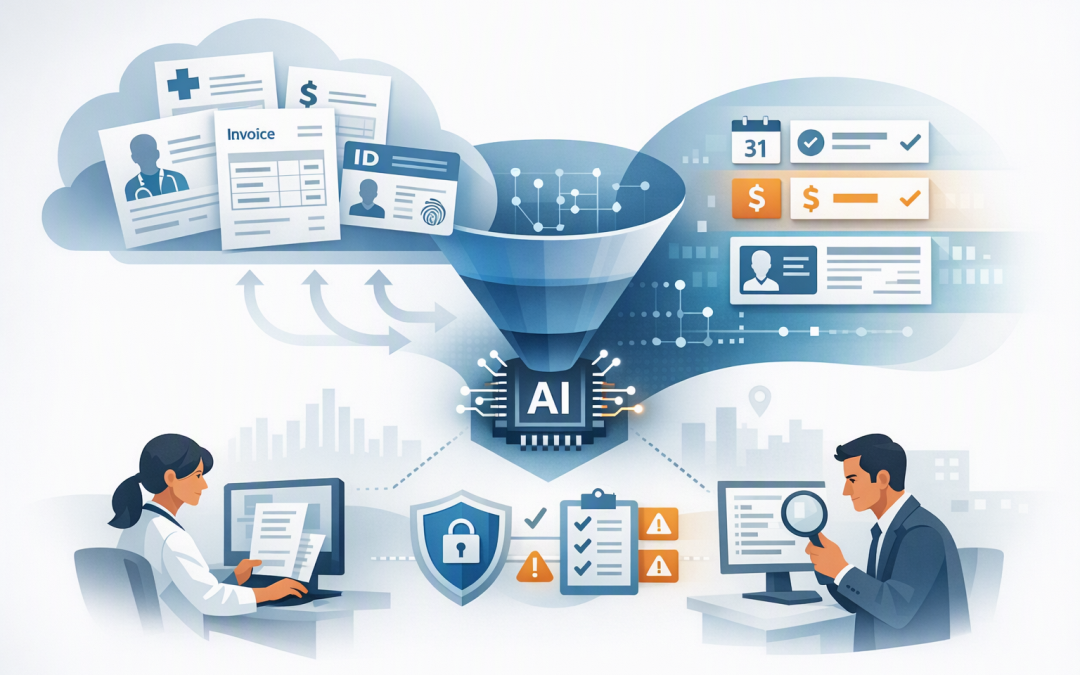
In this blog post How Azure Prebuilt Analyzers Reduce Healthcare and Finance Risk we will explain how organisations can process sensitive documents faster without turning every file into a manual data-entry job. If your staff are copying information from referrals, invoices, bank statements or identity documents into another system, the cost and error rate are probably higher than they appear.
Azure Content Understanding is a Microsoft service that reads documents, images, audio and video, then turns the content into organised data that business systems can use. Its prebuilt analyzers are ready-made document readers designed for common formats such as invoices, receipts, identity documents, bank statements and health insurance cards.
The practical benefit is straightforward. Instead of building a document processing system from scratch, you can begin with Microsoft’s understanding of a document type, test it against your files and customise only what your workflow requires.
What a prebuilt analyzer actually does
Traditional optical character recognition, usually called OCR, identifies words on a page. That is useful, but it does not necessarily understand whether a number is an invoice total, a patient identifier or an account balance.
CPI Consulting helps organisations design, build and secure Azure AI solutions, from Azure OpenAI and Microsoft Foundry to agents, governance and production deployment.
Visit CPI ConsultingA prebuilt analyzer goes further. It combines text recognition, page layout analysis and AI models with a defined schema, which is simply an agreed list of fields and data types that the system should return.
For an invoice, those fields might include the supplier, invoice number, due date, tax, line items and total. For a health insurance card, they could include the member name, policy identifier and coverage information.
The result is structured data that can be sent to a finance platform, patient administration system, workflow tool or database. A simplified response might look like this:
{
 "documentType": "invoice",
 "supplier": "Example Medical Supplies",
 "invoiceNumber": "INV-10482",
 "invoiceDate": "2026-09-30",
 "total": 4280.50,
 "confidence": 0.97,
 "reviewRequired": false
}
The real output can also identify where a value appeared in the original file. This makes it easier for a reviewer to verify the result rather than searching through several pages.
Where healthcare organisations can use it
Healthcare administration still depends heavily on PDFs, scanned forms, referral letters, identity records and emailed attachments. Staff may need to read each file, locate the relevant details and enter them into a clinical or administrative system.
Azure provides a prebuilt analyzer for US health insurance cards. However, Australian healthcare providers should not assume it will understand local Medicare, private health insurance or provider documents without testing.
For Australian documents, a custom analyzer will often be required. This starts with Azure’s general document-reading capabilities and adds the exact fields your organisation needs, such as patient details, referring practitioner, provider number, requested service and referral date.
The safest healthcare use cases are normally administrative rather than clinical. Good starting points include sorting incoming referrals, checking whether required fields are present and preparing information for staff review.
Document AI should not independently diagnose a patient, decide eligibility for care or update a clinical record without appropriate controls. The business outcome should be less repetitive administration while qualified staff retain responsibility for important decisions.
Where financial services can move faster
Financial services teams usually have more prebuilt options. Azure Content Understanding supports document families including invoices, receipts, payment cards, bank statements, cheques, pay slips, tax documents, mortgage files, identity documents and contracts.
This creates opportunities across accounts payable, lending, customer onboarding, expense management and compliance reviews. A lender, for example, could extract applicant and transaction details before routing exceptions to an assessor.
Locale remains important. Several bank statement, payroll, mortgage and tax analyzers are designed for US documents, so an Australian bank statement or tax form may require a custom schema.
This is where a short evaluation prevents an expensive mistake. Test real documents from different institutions, including poor scans, handwritten notes, unusual layouts and incomplete files, before committing to a production design.
The business case is about review time
Consider an illustrative 200-person specialist lender processing 8,000 supporting documents each month. If employees spend an average of four minutes opening each file, finding the right fields and entering them elsewhere, that represents more than 530 hours of monthly effort.
If document AI removes full manual keying from only half of those files, around 267 hours could be redirected to customer service, exception handling and higher-value assessment work. The exact saving depends on document quality and workflow design, but it gives leaders a measurable starting point.
Automation should not mean accepting every result. Confidence scores indicate how certain the analyzer is, while grounding connects an extracted value to its source in the document.
High-confidence, low-risk documents may move automatically. Uncertain values, large transactions or sensitive patient details can be sent to a person for review. We cover this control model further in how Azure Document AI earns trust with confidence and grounding.
Prebuilt does not mean production ready
A prebuilt analyzer reduces development effort, but it does not automatically make a workflow secure, compliant or accurate. Healthcare and financial documents contain information that could cause serious harm if exposed or incorrectly processed.
Australian organisations should consider the Privacy Act 1988, the Australian Privacy Principles and the Notifiable Data Breaches scheme. Health information is particularly sensitive, and an AI project should include data minimisation, retention rules, access controls and a privacy impact assessment.
The Azure environment should also use private network connections, managed identities that let systems authenticate without stored passwords, role-based access and detailed logging. The surrounding devices and administrator accounts should align with Essential Eight, the Australian government’s cybersecurity framework for reducing common attacks.
Microsoft Defender, which detects suspicious activity across cloud services and endpoints, and Wiz, which identifies cloud security weaknesses and risky connections, can add visibility around the wider environment. They complement application controls rather than replacing them.
Before production, confirm where information is stored and processed, which people can access it, how long results are retained and what happens when the service is uncertain. These controls should be designed before sensitive files are uploaded, not added after the pilot.
A practical way to test the opportunity
Start with one document type and one measurable outcome. Do not begin with every referral, finance form and customer record in the organisation.
- Select 100 to 300 representative files, including difficult examples.
- List the fields employees currently enter by hand.
- Test the closest prebuilt analyzer before building a custom one.
- Define which results require human review.
- Measure accuracy, processing cost, exception rates and minutes saved.
- Complete security and privacy reviews before connecting live systems.
Our guide to building a secure Azure Content Understanding pilot in 30 days provides a practical framework. If the extracted information will later support an AI assistant or automated agent, also review how Content Understanding makes document data agent-ready.
Start with the workflow rather than the AI
Azure Content Understanding can reduce document handling costs, improve data consistency and help staff find important information faster. The strongest results come from choosing a narrow workflow, testing local documents and keeping people involved where the consequences of an error are high.
CloudPro Inc brings more than 20 years of enterprise IT experience as a Microsoft Partner and Wiz Security Integrator. Our Melbourne-based team helps organisations across Australia design practical Azure and AI solutions without the overhead of a large, faceless managed service provider.
If you are unsure whether healthcare or financial document processing is worth automating, we are happy to review the workflow, identify a sensible pilot and explain the likely costs and risks—no strings attached.