
In this blog post How CIOs Turn AI Pilots into Governed Microsoft Foundry Programs we will show how to move from promising demonstrations to reliable AI services without losing control of security, cost or accountability.
The warning signs are familiar. Different teams are running AI experiments, each pilot has its own data and access arrangements, and nobody can clearly explain which projects are delivering value. What started as innovation quickly becomes another collection of technology for IT to support.
The answer is not to stop experimenting. It is to treat AI agents as a managed business program, with shared controls, measurable outcomes and clear decisions about which pilots deserve production investment.
What Microsoft Foundry actually does
Microsoft Foundry is a platform for building, testing, deploying and monitoring AI applications and agents. An agent is an AI-powered service that can understand a request, find relevant information and use approved business tools to complete a task.
CPI Consulting helps organisations design, build and secure Azure AI solutions, from Azure OpenAI and Microsoft Foundry to agents, governance and production deployment.
Visit CPI ConsultingFor example, an agent might review a customer request, check an approved knowledge base and prepare a response. A more capable agent could also update a service ticket, schedule an appointment or create a draft order.
The technology behind a Foundry agent has several practical layers:
- The model, such as an OpenAI or other supported model, interprets requests and generates responses.
- Instructions and business knowledge tell the agent how to behave and which approved information it can use.
- Tools let the agent search data or perform business actions.
- Microsoft Entra identity gives the agent its own controlled digital identity rather than relying on shared passwords.
- Foundry Agent Service provides the managed environment used to run, scale and publish the agent.
- Tracing and evaluation record what happened and measure whether the result was safe, accurate and useful.
This combination is what makes Foundry suitable for production. It provides more than an AI model; it provides the operational structure needed to manage agents as business services.
Stop approving technology and start approving outcomes
Many pilot proposals begin with a model or feature. A production program should begin with a business problem, an accountable owner and a measurable result.
Before funding a pilot, ask five questions:
- What business process are we improving?
- Who owns the result after the pilot ends?
- How will we measure time saved, cost avoided or risk reduced?
- What information and business systems will the agent need?
- What happens if the agent produces the wrong result?
“Build an AI customer service agent” is not a useful objective. “Reduce average ticket handling time by 20% without increasing complaint rates” gives the team something it can test.
This also gives CIOs a defensible way to stop weak projects. A pilot that cannot demonstrate an outcome should not receive ongoing production funding simply because the demonstration looked impressive.
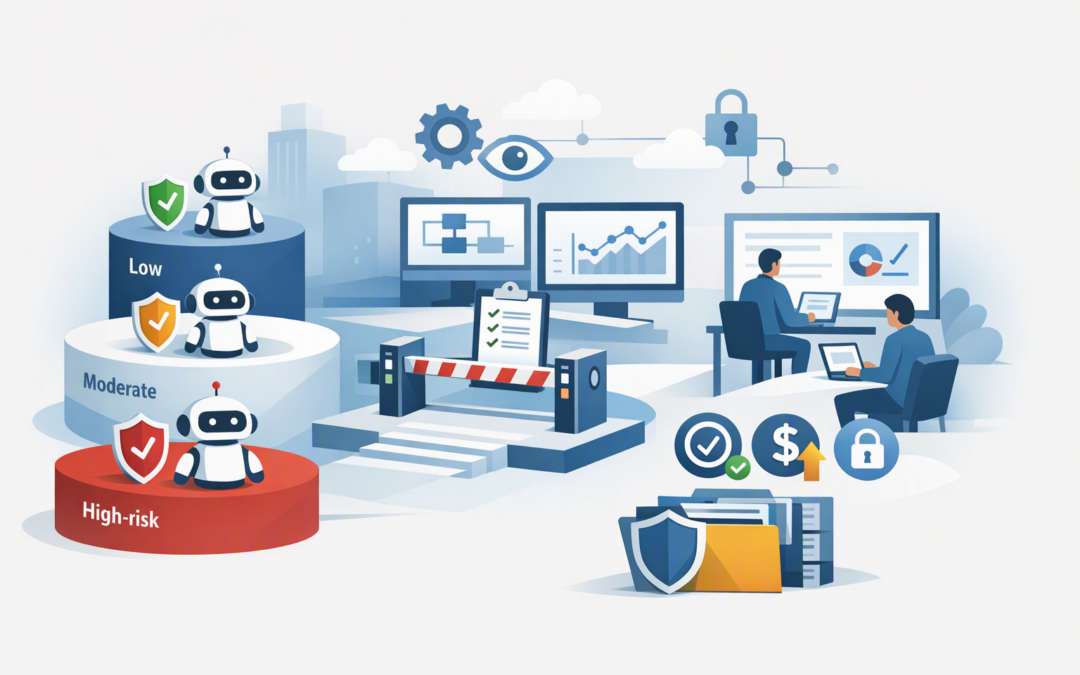
Give every agent a risk tier
Not all agents require the same controls. An internal agent that summarises public policies is very different from one that can approve refunds or access employee records.
A simple three-tier model works well for many mid-sized organisations:
- Low risk: The agent provides information from non-sensitive sources and cannot change business records.
- Moderate risk: The agent uses internal information or prepares actions, but a person reviews the result before anything happens.
- High risk: The agent handles sensitive information, makes customer-impacting decisions or performs actions with limited human review.
The risk tier should determine identity permissions, testing requirements, monitoring, approval processes and how quickly the agent can be changed.
Our earlier boundary map for governing Microsoft Foundry agents explains how to define what an agent can see, decide and do. At the program level, those boundaries should become standard release requirements rather than optional design choices.
Create one production gate for every AI project
A successful pilot should not move directly into general use. It should pass a production gate covering business value, security, privacy, reliability, cost and support readiness.
That gate should confirm:
- A named business owner accepts responsibility for the outcome.
- The agent uses its own identity with only the permissions it needs.
- Sensitive data is identified, minimised and protected.
- High-impact actions require human approval where appropriate.
- Quality and safety tests have defined passing scores.
- Usage limits, budgets and cost alerts are configured.
- Logs and alerts are connected to the operational support process.
- A rollback and shutdown procedure has been tested.
This builds on our production readiness model for Microsoft Foundry agents. The important next step is applying the same gate consistently across every department.
Record the decision in a standard format
The following example is not Microsoft configuration syntax. It shows the information each agent should have recorded before approval:
agent_name: Customer Service Assistant
business_owner: Head of Customer Operations
risk_tier: Moderate
approved_data: Customer knowledge base and open support ticket
allowed_actions: Draft response and recommend ticket category
human_approval: Required before sending or updating records
monthly_budget: AUD 2,000
quality_threshold: 90 percent approved responses
rollback_owner: IT Operations Manager
A short record like this makes responsibility visible. It also helps security, privacy, finance and operations teams review the same facts instead of maintaining separate spreadsheets.
Measure behaviour after launch, not just uptime
Traditional software monitoring asks whether the system is online. AI monitoring must also ask whether the system is still producing useful and safe results.
Microsoft Foundry can trace agent activity, including requests, responses, tool calls, delays, errors and usage. Its evaluation capabilities can measure areas such as response quality, whether answers are supported by approved information, correct tool use and task completion.
CIO dashboards should translate those technical signals into business measures:
- Cost per completed task
- Hours of employee capacity returned
- Percentage of outputs requiring correction
- Failed or blocked business actions
- Customer or employee satisfaction
- Security and privacy exceptions
Tracing may contain prompts, responses and other sensitive information, so access and retention must be controlled. Monitoring should not create a second, poorly governed copy of confidential business data.
Apply Australian security and privacy expectations
AI does not sit outside your existing compliance responsibilities. If an agent handles personal information, the Australian Privacy Principles and guidance from the Office of the Australian Information Commissioner remain relevant.
Higher-risk use cases may require a privacy impact assessment before launch. The business should understand what personal information is collected, why it is needed, where it is processed, who can access it and when it will be deleted.
Agents should also operate within your Essential Eight program, the Australian Government’s framework for reducing common cybersecurity risks. Multi-factor authentication, restricted administrator access, patching, application control and tested recovery arrangements remain important when AI is added to business systems.
Meeting the Essential Eight does not automatically make an agent safe. However, ignoring those controls creates gaps attackers can use to compromise the agent, its tools or the information behind it.
A business case based on capacity, not novelty
Consider an illustrative 220-person professional services company with six AI pilots. Each pilot appears useful, but only two address high-volume work and have a clear owner.
The company selects a service desk agent and a document review agent for production. Together, they are expected to return 450 staff hours per quarter. At an internal labour cost of $65 per hour, that represents $29,250 in quarterly capacity before operating costs.
The remaining pilots are paused rather than quietly accumulating support and model charges. This is the financial advantage of program governance: investment follows measurable value instead of internal enthusiasm.
A practical 90-day plan for CIOs
- Days 1–30: Inventory every AI pilot, owner, data source, tool connection and current cost.
- Days 31–45: Assign risk tiers and select the two or three use cases with the strongest measurable outcomes.
- Days 46–60: Define one production gate covering identity, data, testing, monitoring, budget and rollback.
- Days 61–75: Deploy controlled versions, collect evidence and resolve operational gaps.
- Days 76–90: Review business results, approve wider use and close pilots that cannot justify further investment.
If agents need custom workflows or coordination with other agents, our guides to Microsoft Agent Framework and production programs using Foundry and A2A explain the underlying architecture in more detail.
The goal is controlled progress
AI governance should not become a committee that blocks every idea. Its purpose is to help good ideas reach production faster because the difficult questions about access, privacy, cost and accountability have already been answered.
CloudProInc brings more than 20 years of enterprise IT experience to this work. As a Melbourne-based Microsoft Partner and Wiz Security Integrator, we help organisations connect Microsoft Foundry with Azure, Microsoft 365, Intune, Defender and practical cybersecurity controls.
If your business has several AI pilots but no clear path to production, we are happy to help map what should move forward, what needs stronger controls and what should be stopped — no strings attached.