
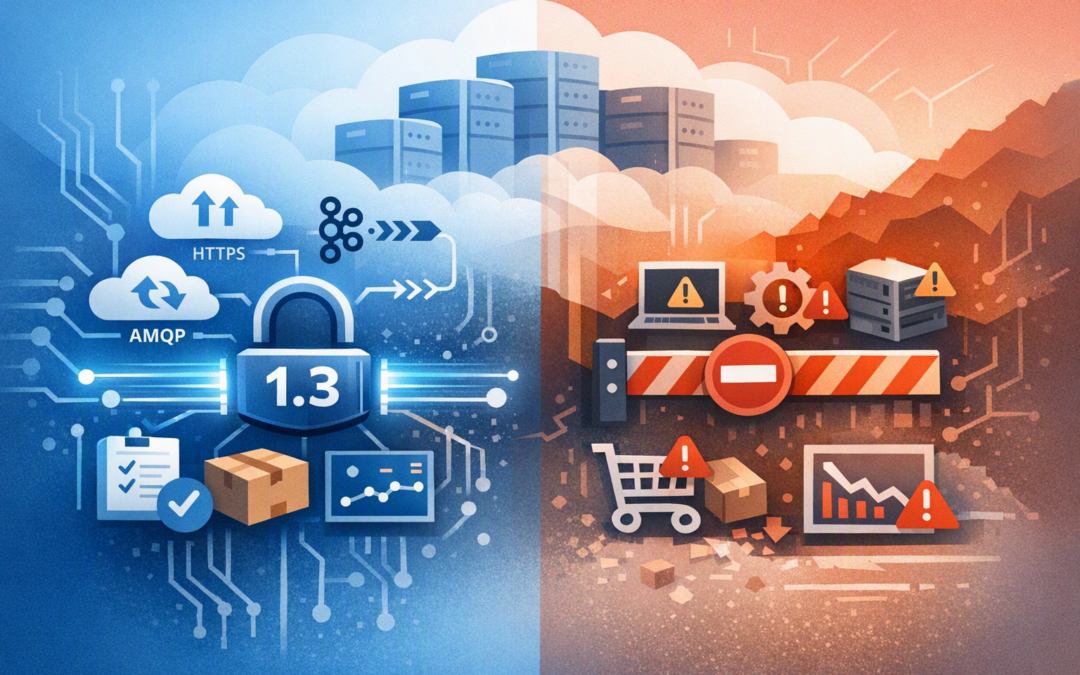
In this blog post How to Enforce Event Hubs TLS 1.3 Without Breaking Data Producers we will explain how to improve streaming security without suddenly stopping orders, telemetry, customer activity or operational data from reaching your systems.
The danger is not TLS 1.3 itself. The danger is changing a security setting before anyone has identified every application, device and vendor platform sending data into Azure Event Hubs.
Azure Event Hubs is a managed service that receives large volumes of data in real time. Businesses use it to collect information from applications, websites, factory equipment, connected devices and cloud platforms before sending that data to analytics, automation or AI systems.
TLS, or Transport Layer Security, protects that information while it travels across a network. TLS 1.3 is a newer version of the protocol, designed to remove older security options and establish protected connections more efficiently.
CPI Consulting helps organisations design, build and secure Azure AI solutions, from Azure OpenAI and Microsoft Foundry to agents, governance and production deployment.
Visit CPI ConsultingWhat changes when you require TLS 1.3
Event Hubs can receive data through AMQP, Kafka and HTTPS. These are simply different communication methods used by applications and devices to send events into the service.
When an Event Hubs namespace is configured with TLS 1.3 as its minimum version, any producer that cannot establish a TLS 1.3 connection is rejected. The namespace is the main Event Hubs container that holds your event streams and their security settings.
The producer may have valid credentials and permission to send data. It can still fail before authentication because its operating system, software runtime or connection library does not support the required protocol.
This distinction matters. Supporting TLS 1.3 allows compatible clients to negotiate it, while enforcing TLS 1.3 blocks everything that attempts to use TLS 1.2.
Why a simple security change can become an outage
Most organisations know about their main customer application and data platform. They are less likely to remember the warehouse scanner installed six years ago, the vendor-managed reporting service or the script running on an old virtual machine.
Common sources of trouble include:
- Older Java applications using outdated AMQP connection libraries.
- Legacy operating systems without reliable TLS 1.3 support.
- Kafka producers that have not been updated for several years.
- Vendor-managed platforms where the TLS version is outside your control.
- Containers and appliances built with old encryption libraries.
- Serverless functions or integration tools using retired software packages.
Private networking does not remove this compatibility risk. A private endpoint keeps traffic away from the public internet, but the producer still needs to complete a supported TLS connection.
A safer six-step rollout plan
1. Build a producer inventory
Start by listing every system that sends data to the namespace. Record its owner, protocol, software library, operating system, business purpose and support contact.
Do not limit the exercise to applications managed by your internal development team. Include software suppliers, outsourced platforms, industrial devices and integrations created for one-off projects.
The business outcome is visibility. You cannot manage the outage risk of a producer nobody remembers exists.
2. Rank each data feed by business impact
A failed test feed is inconvenient. A failed payment, safety or inventory feed could stop operations or leave management working with incomplete information.
Classify producers as critical, important or low impact. For each critical feed, document how quickly the business would notice missing events and whether the producer retries failed transmissions.
This also provides a useful opportunity to review event size and streaming design. If individual events are becoming unusually large, our guide to Azure Event Hubs large messages explains when increasing limits may only delay a wider architecture problem.
3. Upgrade clients before changing the namespace
Confirm that each producer’s operating system, runtime and connection library support TLS 1.3. Updating only the application package may not be enough if the underlying operating system remains too old.
Pay particular attention to older Java applications using AMQP, the messaging protocol used by many Event Hubs software development kits. Outdated Proton-J dependencies have historically caused TLS 1.3 compatibility problems and should be upgraded and tested.
Avoid forcing a specific protocol version in application code unless there is a clear reason. Modern supported clients should normally use secure operating system defaults, making future security changes easier to manage.
4. Test with real traffic patterns
A connection test proves only that a producer can connect. It does not prove that it can reconnect after a network interruption, handle throttling or resend events without creating duplicates.
Use a non-production namespace or a temporary migration namespace configured for TLS 1.3. Replay representative traffic and check connection stability, event counts, processing delays and application logs.
For critical producers, run a controlled canary test. Move one application instance or a small share of traffic first, then expand only after the results are stable.
5. Make the setting repeatable
Once testing is complete, manage the minimum version through infrastructure as code. This means storing the Azure configuration in a controlled deployment file rather than relying on someone to remember a portal setting.
A simplified Bicep example looks like this:
resource eventHubsNamespace 'Microsoft.EventHub/namespaces@2024-01-01' = {
 name: namespaceName
 location: location
 sku: {
 name: 'Standard'
 tier: 'Standard'
 capacity: 1
 }
 properties: {
 minimumTlsVersion: '1.3'
 publicNetworkAccess: 'Enabled'
 }
}
Treat this as part of the namespace’s complete approved configuration. Have the change reviewed, deploy it through your normal release process and retain evidence for audit purposes.
Azure Policy, which checks Azure resources against company rules, can also identify namespaces that do not meet your chosen TLS standard. Start with reporting rather than automatic enforcement so unexpected environments are found before they are changed.
6. Monitor the cutover and keep a rollback path
Schedule enforcement during a supported change window. Watch connection counts, incoming events, error rates, processing lag and the logs from critical producers.
Agree on rollback conditions before starting. For example, lower the minimum back to TLS 1.2 if a critical data feed cannot reconnect within the approved recovery period.
A rollback is not a failed project. It is a controlled response that protects operations while the incompatible producer is upgraded.
An example of the hidden-producer problem
Consider a 200-person logistics company using Event Hubs for vehicle telemetry, warehouse scans and delivery updates. Its development team confirms that the main applications support TLS 1.3, so the namespace setting appears safe to change.
The inventory process then uncovers a third-party depot system running an older Java connector. An immediate switch would have stopped scan events from two warehouses, leaving operations staff with incomplete stock information.
By testing that connector separately, the company can upgrade it first and enforce TLS 1.3 later. The same security outcome is achieved without an avoidable operational incident.
TLS 1.3 is one control, not the whole security plan
TLS 1.3 protects data while it travels. It does not decide who should have access, protect stored data by itself or prevent an authorised application from sending sensitive information to the wrong stream.
Strong Event Hubs security should also include Microsoft Entra identity, restricted permissions, private networking where appropriate, central monitoring and regular client updates. For partner-facing APIs that need to verify the connecting organisation, our Azure Front Door mutual TLS playbook explains the separate role of certificate-based client identity.
For Australian organisations, enforcing modern encryption supports a broader Essential Eight program, the Australian Government’s cybersecurity framework that many organisations are now expected to follow. It does not create Essential Eight compliance on its own, but it strengthens secure configuration, patching discipline and audit evidence.
The practical decision for technology leaders
Requiring TLS 1.3 can reduce exposure to older encryption methods and demonstrate that streaming integrations are being actively maintained. The value disappears, however, if a rushed change interrupts the data your business depends on.
The safest approach is straightforward: discover every producer, prioritise business-critical feeds, upgrade clients, test with realistic traffic, enforce through controlled deployment and monitor the result.
CloudPro Inc brings more than 20 years of enterprise IT experience to Azure and cybersecurity projects. As a Melbourne-based Microsoft Partner and Wiz Security Integrator, we focus on practical changes that reduce risk without turning routine security work into a business disruption.
If you are unsure which systems connect to your Event Hubs environment, or whether they are ready for TLS 1.3, we are happy to review the setup and help you plan a safe path forward — no strings attached.