
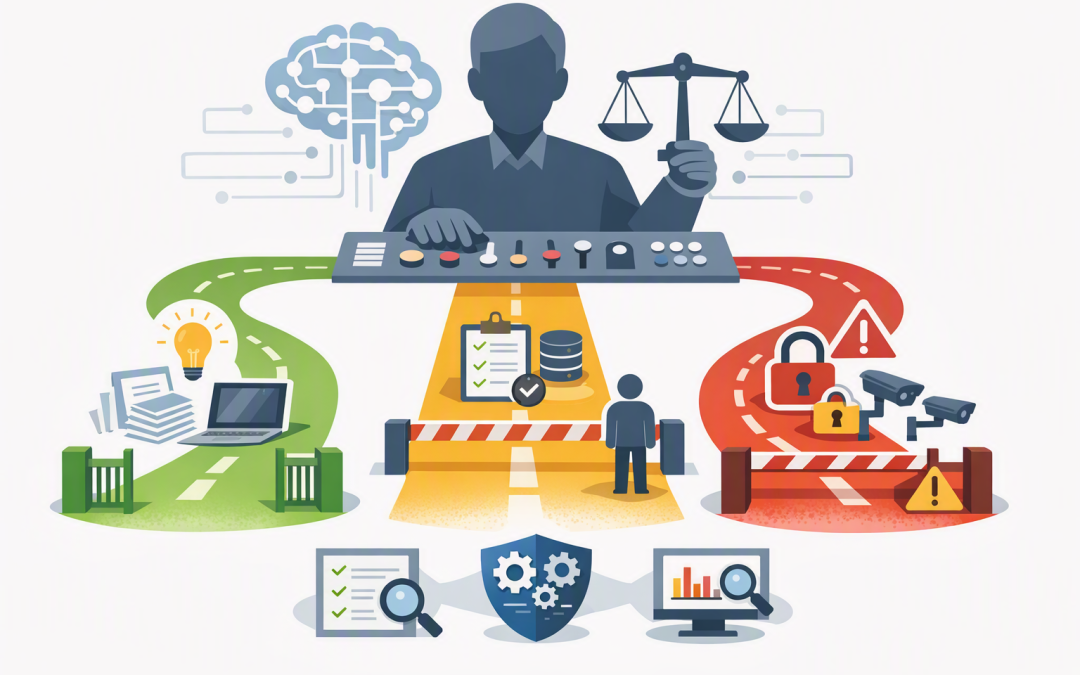
In this blog post How to Build an AI Governance Framework Without Slowing Innovation we will explain how to control AI risk without creating an approval process that frustrates employees and delays every useful idea.


Many businesses already have staff using ChatGPT, Microsoft Copilot, Claude and other AI tools. The problem is that nobody has a complete view of what information is being entered, which outputs are influencing decisions or who is accountable when something goes wrong.
The usual response is to write a long AI policy and require senior approval for everything. That may look responsible, but it often pushes employees towards unapproved tools and creates more risk, not less.
What an AI governance framework actually does
AI governance is the set of rules, responsibilities and controls that determines how your organisation selects, builds, uses and monitors artificial intelligence. Good governance makes safe projects easier to approve while applying stronger checks to higher-risk uses.
To understand what needs governing, it helps to understand the technology. Generative AI systems use models such as OpenAI or Anthropic Claude to create content, analyse information and answer questions based on patterns learned from large amounts of data.
The model is only one part of the system. A business AI solution may also connect to Microsoft 365 documents, customer records, internal databases and software tools. An AI agent can go further by completing actions, such as updating a record, creating a service ticket or sending a response.
Your framework therefore needs to govern the complete system: the model, the business data it can access, the instructions it receives, the actions it can take and the people responsible for its results.
Start with business risk rather than AI technology
Not every AI use needs the same approval process. Asking an approved tool to improve the wording of an internal meeting agenda is very different from using AI to assess job applicants, provide financial advice or automatically respond to customers.
A practical framework divides use cases into clear risk levels:
- Low risk: Drafting, brainstorming and summarising information that is not sensitive. These uses can usually follow a fast, pre-approved path.
- Medium risk: Working with internal business information or producing content that employees will use to make decisions. These uses need an identified owner, approved data access and human review.
- High risk: Handling sensitive personal information, making decisions that affect people or taking actions without direct supervision. These uses require privacy, legal, security and executive review.
This approach protects the business without making the marketing team complete a six-week risk assessment every time it wants help drafting a campaign outline.
Build the framework around five practical controls
1. Create a simple register of AI use cases
You cannot govern AI systems you do not know exist. Start with a basic register showing the business purpose, tool, data involved, responsible owner, users and risk rating for each use case.
Keep the intake process short. A manager should be able to submit an idea in ten minutes, with questions such as:
- What business problem will this solve?
- What information will the AI access?
- Will the output affect customers, employees or financial decisions?
- Can the system take actions in another application?
- Who will check its output and own the result?
The register gives leaders visibility while reducing duplicated projects, uncontrolled subscriptions and unexpected costs.
2. Give every use case a business owner
IT can secure the platform, but it cannot decide whether an AI-generated customer response is commercially appropriate. Each use case needs a business owner who understands the process and is accountable for how the output is used.
Security, privacy, legal and IT teams should provide specialist checks based on risk. They should not become the permanent owners of every AI project.
For a more detailed accountability structure, see who should own AI governance and accountability in your business.
3. Set clear data boundaries
The fastest way for an AI experiment to become a serious business problem is for employees to enter customer details, contracts, source code or confidential financial information into an unapproved public tool.
Your framework should state which tools are approved, what information can be used and which data must never be entered. It should also cover retention, data location, access permissions and whether the provider can use submitted information to improve its models.
Australian organisations must consider existing privacy, consumer, employment and sector-specific obligations when using AI. The Australian Government’s current Guidance for AI Adoption also promotes practical, risk-based governance rather than treating every use case as equally dangerous.
Security foundations still matter. The Essential Eight, the Australian Government’s baseline cybersecurity framework, can help protect identities, devices and systems surrounding AI. Tools such as Microsoft Intune, which manages and secures company devices, and Microsoft Defender, which detects threats, can enforce those foundations.
4. Test outcomes before granting wider access
AI can produce confident answers that are incomplete, inaccurate or based on the wrong context. Testing should reflect the damage an error could cause rather than relying on a generic checklist.
For a low-risk writing assistant, a small group of users may be enough. A system that prepares customer advice should be tested against realistic scenarios, reviewed for privacy and bias, and prevented from publishing anything without human approval.
Define success in business terms. Measure time saved, error rates, employee adoption, operating cost and the number of outputs requiring correction.
Testing evidence should also be retained. Our guide on building an AI audit framework executives can trust explains how to turn technical records into useful oversight.
5. Monitor AI after launch
Approval is not the finish line. Models change, business data changes and employees may begin using a tool for purposes that were never considered during the original review.
Set review dates based on risk. Low-risk tools may need an annual check, while customer-facing systems and AI agents may need continuous monitoring, monthly reviews and a documented shutdown process.
Where possible, use technology to enforce policy. Microsoft Foundry can provide central visibility and controls for models and AI applications, while security platforms such as Wiz can identify cloud risks and poorly protected data connections.
This is more reliable than expecting every employee to remember a policy document. Our overview of Microsoft AI Foundry governance and AI risk controls explores this approach in more detail.
Give employees a safe path to experiment
Governance fails when the approved path is slower than the unofficial one. Give teams access to a secure AI environment where they can test ideas using non-sensitive or masked data without submitting a full business case.
Publish a short list of approved tools, permitted activities and prohibited information. Provide basic training that uses examples from your own business rather than generic warnings about AI.
Employees should also know where to report inaccurate outputs, privacy concerns or unexpected system behaviour. Reporting a problem should improve the framework, not result in automatic blame.
A practical scenario for a 200-person business
Consider a 200-person professional services firm where employees were using several public AI tools under individual subscriptions. Management initially planned to block them all until a formal policy could be completed.
A more practical approach would be to approve one enterprise AI platform, create a use-case register and introduce three risk levels. Drafting and research could enter a fast lane, while client advice and automated actions would receive additional review.
The likely business outcome is fewer uncontrolled subscriptions, less confidential information entering public systems and faster approval of useful ideas. Leaders also gain a clear view of where AI is saving time and where it may be creating unacceptable risk.
Keep governance proportionate and useful
The best AI governance framework is not the longest. It is the one employees understand, managers can apply and executives can use to make informed decisions.
Start with a register, clear ownership, risk levels, data boundaries and measurable reviews. Then automate controls as adoption grows.
CloudProInc combines more than 20 years of enterprise IT experience with practical expertise across Azure, Microsoft 365, OpenAI, Claude, Defender and Wiz. As a Melbourne-based Microsoft Partner and Wiz Security Integrator, we help organisations put workable controls around AI without turning governance into a barrier.
If you are not sure whether your current AI use is safely controlled—or whether your approval process is slowing down valuable ideas—we are happy to take a practical look with you, with no strings attached.
Discover more from CPI Consulting
Subscribe to get the latest posts sent to your email.