
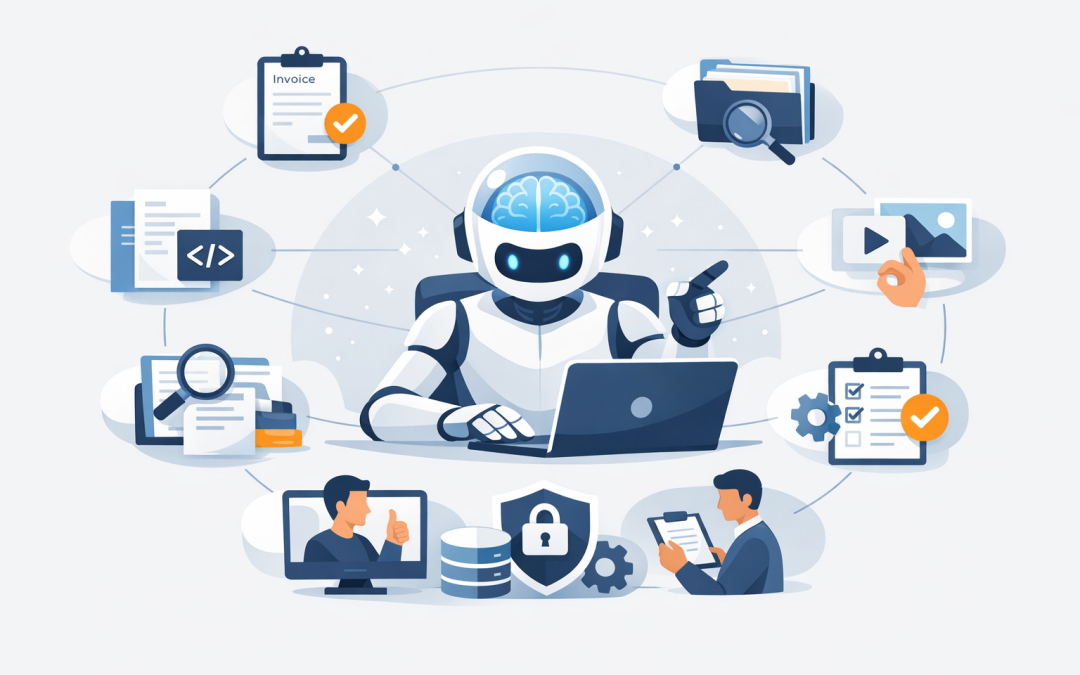
In this blog post How Meta Muse Spark 1.1 Could Cut the Cost of Business AI Agents we will explain what Meta’s new model can do, where it could create business value, and what CIOs should check before approving a pilot.
Many businesses already have an AI pilot that can summarise a document or draft an email. The problem comes when they ask it to complete a real process involving several systems, decisions and approvals. Costs rise, reliability falls, and the promising demonstration becomes another tool employees stop using.
Released on 9 July 2026, Meta Muse Spark 1.1 is designed to address more of that practical work. It is not simply a chatbot that produces better answers. It is an AI model built to plan tasks, use approved tools, work with large amounts of information and take several steps towards an outcome.
What Meta Muse Spark 1.1 actually is
Muse Spark 1.1 is a large language model, meaning it has been trained to understand and generate language, interpret different types of content and reason through instructions. Meta has made it available to developers through an API, which is a controlled connection that allows a business application to send work to the model.
The important change is its stronger support for agentic AI. An AI agent does more than answer a question. It can create a plan, select an approved business tool, check the result and continue to the next step.
For example, a standard chatbot might explain why an invoice needs attention. An agent could potentially read the invoice, compare it with a purchase order, check the supplier record and prepare an exception for a manager to approve.
This does not mean the model should receive unrestricted access to company systems. Agentic AI is most useful when every tool, permission and approval point is deliberately designed around a specific business process.
The technology behind the new capabilities
Tool and function calling
Muse Spark 1.1 can request actions through functions defined by a developer. In plain English, this gives the model a menu of approved tasks, such as looking up an order, creating a support ticket or retrieving a policy document.
The application remains responsible for executing the action. This separation matters because it gives the business an opportunity to check the request, confirm the user’s permissions and require human approval before anything important happens.
Large working context
The model supports a context window of roughly one million tokens. Tokens are small pieces of text, and a larger window means the model can work with far more information during one task.
That may include lengthy contracts, policy libraries, project documents or substantial software code. It can reduce the need to break information into many disconnected requests, although businesses still need a reliable way to identify which information is current and trustworthy.
For more on connecting agents to controlled business knowledge, see our guide to designing agentic retrieval with Azure AI Search knowledge sources.
Multimodal understanding
Muse Spark 1.1 can interpret more than typed text. It can work with inputs such as images, audio, video and PDF documents, while producing text-based responses and actions.
This could help a field service agent review equipment photos, a procurement team extract details from supplier documents, or a customer service workflow interpret screenshots and call recordings. The business outcome is less manual data entry and faster handling of information that does not arrive in a neat spreadsheet.
Computer and software work
Meta has also focused on coding and computer-use tasks. Coding support can help internal technology teams create, test and maintain software more quickly, while computer-use capabilities can allow an agent to interact with software interfaces when a direct system connection is unavailable.
Computer use needs particular caution. An agent clicking through a finance, customer or administration system can make mistakes at scale, so read-only access and human approval should be the starting position.
Where businesses could see practical value
Reducing the cost of routine processes
Muse Spark 1.1 enters the market with relatively low usage pricing compared with several leading models. That does not automatically make it the cheapest option because total cost also includes integration, testing, monitoring and human review.
However, stronger price competition is good news for businesses. It makes tasks such as document checking, ticket classification and internal research more economical at higher volumes.
Giving employees one path through several systems
Employees often lose time moving between Microsoft 365, finance software, customer records and internal knowledge bases. An agent can provide a simpler front door while approved connections handle the work behind the scenes.
Muse Spark 1.1’s tool-calling capabilities make it a potential model for these workflows. Standards such as MCP, which gives AI a consistent way to connect with tools and data, can make these systems easier to govern. We explain this architecture further in using A2A and MCP together for safer business AI systems.
Creating another credible model option
Businesses do not need to use one AI model for every job. Muse Spark 1.1 may be suitable for a coding workflow, while OpenAI or Anthropic Claude may perform better for another process.
This model-by-model approach can improve quality, control costs and reduce dependence on one provider. It is easier when the organisation has a shared AI layer for identity, monitoring and data controls, rather than allowing every team to create separate vendor accounts.
A realistic business scenario
Consider an Australian distributor with 180 employees. Its customer service team receives warranty requests through emails, PDFs, photographs and an online form. Staff manually collect the information, check product records and send incomplete claims back to customers.
A controlled agent could read each submission, identify the product, check warranty rules, retrieve the relevant order and prepare a recommended response. Straightforward claims could move to a staff member for one-click approval, while uncertain cases would be escalated with the source information attached.
If each claim currently takes 15 minutes and the team handles 1,000 claims a month, saving even five minutes per claim would return more than 80 staff hours every month. The goal is not to remove people from the process. It is to stop skilled employees spending their day copying information between systems.
The risks CIOs should not overlook
Meta’s original Muse Spark announcement raised important questions about data governance, vendor dependence and enterprise readiness. Those questions remain relevant, and we covered them in three questions every CIO should ask about Meta Muse Spark.
Muse Spark 1.1’s greater ability to take action makes the controls around it even more important. Australian organisations should assess:
- Data handling — What information is sent to Meta, where is it processed, and is it retained or used beyond your request?
- Access control — Can the agent only see the same information as the employee using it?
- Approval rules — Which actions require a person to confirm them before execution?
- Audit records — Can you reconstruct what the agent accessed, decided and changed?
- Failure controls — What happens when the model is uncertain, unavailable or wrong?
These checks should sit alongside the Australian Privacy Principles and the Essential Eight, the Australian government’s baseline cybersecurity framework. The Essential Eight is not a complete AI governance framework, but controls such as restricted administrative access, application management and timely security updates remain critical when agents can interact with company systems.
How to test Muse Spark 1.1 without creating unnecessary risk
- Choose one measurable process. Start with a repetitive task where you know the current time, cost and error rate.
- Use low-risk data first. Avoid sensitive customer, health, financial or employee information during early testing.
- Begin with read-only access. Let the agent gather information and prepare recommendations before allowing it to make changes.
- Compare multiple models. Test Muse Spark 1.1 against OpenAI, Claude or models available through Microsoft’s AI platform using the same tasks.
- Measure the full cost. Include development, monitoring, review time and failed tasks rather than looking only at API pricing.
- Plan for replacement. Keep business rules and system connections separate from the model so you can change providers later.
Our overview of Microsoft’s AI stack for safer and faster projects explains how businesses can create this separation while retaining central security and management controls.
The real question is whether it improves the process
Muse Spark 1.1 is an important step because it gives businesses another capable and potentially cost-effective model for agentic work. Its support for tools, large information sets, mixed document types and software tasks could make AI agents practical for more mid-sized organisations.
But a better model does not repair a poorly defined process. The strongest results will come from combining the right model with clean business information, limited permissions, clear approval points and measurable outcomes.
CloudProInc brings more than 20 years of enterprise IT experience to this work. As a Melbourne-based Microsoft Partner and Wiz Security Integrator, we help organisations connect AI services such as OpenAI, Claude and emerging models with Azure, Microsoft 365, Defender and properly secured business data.
If you are unsure whether Muse Spark 1.1 belongs in your AI plans, we are happy to help you assess a real process and compare the available options. No oversized project and no vendor hype—just a practical look at the value, cost and risk.
Discover more from CPI Consulting
Subscribe to get the latest posts sent to your email.