
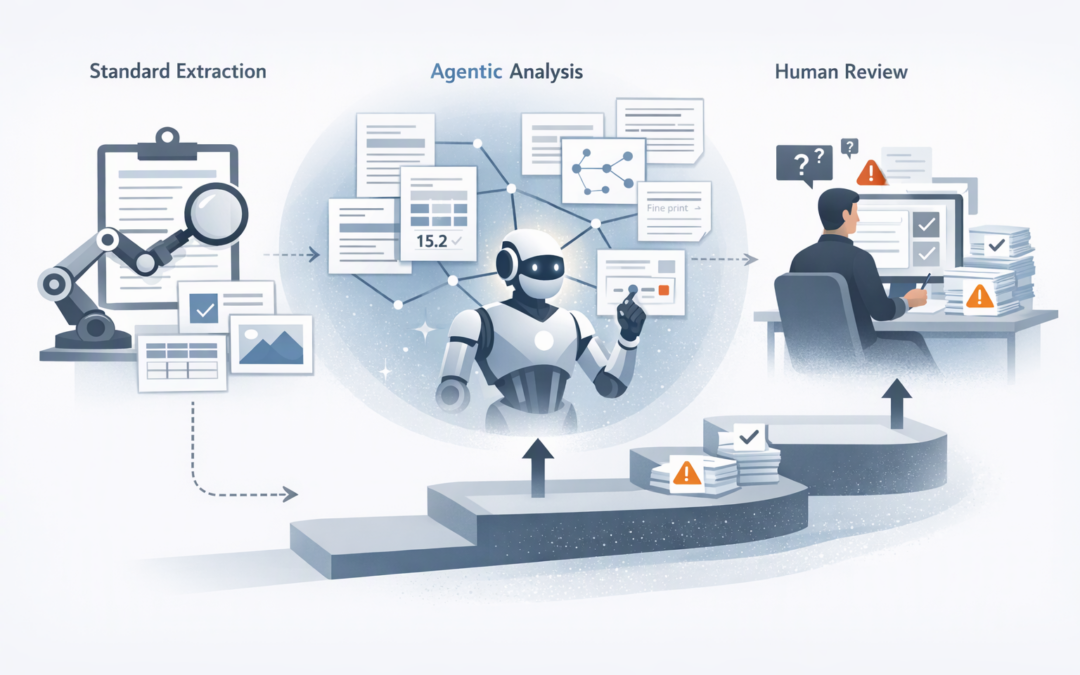
In this blog post Azure Agentic Document Processing When One Pass Is Not Enough we will explain why complex documents often need more than a single extraction step, how Azure Content Understanding handles them, and where the extra processing can deliver a measurable business return.
The problem usually appears after a document automation project has passed its first demonstration. The system can read invoice numbers, names and dates, but it struggles when the correct answer depends on information spread across several pages, a calculation, an amendment or an exception hidden in the fine print.
That is where agentic document processing becomes useful. Instead of treating a file as a collection of isolated fields, it gathers evidence from across the document and builds a structured answer. It can compare sections, interpret tables and diagrams, perform calculations and check whether information meets defined business rules.
What Azure Content Understanding actually does
Azure Content Understanding is a Microsoft service that turns unstructured content such as PDFs, forms, images, audio and video into organised data. For documents, it combines text recognition, page layout analysis, visual interpretation and generative AI.
CPI Consulting helps organisations design, build and secure Azure AI solutions, from Azure OpenAI and Microsoft Foundry to agents, governance and production deployment.
Visit CPI ConsultingAn organisation creates an analyser, which is simply a reusable set of instructions describing what information the business needs. The analyser might be asked to return a supplier name, contract expiry date, total liability, approval status and an explanation of any exceptions.
A standard analyser is often enough when the required value appears clearly in one place. Agentic mode is designed for situations where the answer must be constructed from multiple pieces of evidence.
For example, an agreement may list a three-year term on page two, an extension option on page nine and a later amendment that replaces the original commencement date. Extracting the first date found is easy. Determining the actual expiry date requires reasoning across the complete file.
We covered the broader difference between extraction and reasoning in Document AI Beyond OCR When Azure Agentic Mode Delivers Value. The next question is how to design a process that uses deeper analysis only when it is justified.
Why a one-pass mindset creates business risk
1. The first answer may not be the current answer
Contracts, policies and project documents often contain amendments, superseded clauses and exceptions. A system that extracts a field without understanding these relationships can return an answer that looks credible but is no longer valid.
This can lead to missed renewals, incorrect payments or decisions based on outdated terms. The cost is rarely the extraction error itself. It is the commercial decision made after someone trusts that error.
2. Some fields do not exist until they are calculated
Many useful business answers are not printed directly on the page. A finance team may need the difference between an approved amount and several progress claims, while an operations team may need to calculate whether service levels stayed within agreed limits.
Agentic processing can gather the required values, apply the stated calculation and return the result in a predictable structure. This reduces spreadsheet work while keeping the original evidence available for review.
3. Validation needs context
Basic extraction might identify a purchase order number and invoice total. It does not automatically establish whether the supplier is approved, whether the total matches the line items, or whether the invoice complies with the contract.
An agentic analyser can be instructed to evaluate these relationships. It can return a status such as approved, exception found or manual review required, along with the supporting fields.
4. Important evidence is not always plain text
Business documents frequently place critical information inside tables, charts, diagrams, checkboxes and scanned pages. Reading the words without understanding their position or visual relationship can change their meaning.
Azure Content Understanding can include these visual elements in its analysis. This is particularly useful for financial reports, engineering packs, insurance claims and compliance evidence where page structure carries business meaning.
How agentic mode works behind the scenes
The process starts with a field schema, which is a structured list of the answers you want returned. Each field should have a clear description, expected format and business purpose.
The service then reads the file, identifies its text and visual structure, and searches for evidence relevant to each requested field. With agentic mode enabled, it can connect evidence from different sections, calculate derived values and validate results against conditions in the field descriptions.
A simplified configuration looks like this:
{
 "description": "Review a supplier contract for commercial risk",
 "config": {
 "workflow": "agentic"
 },
 "fieldSchema": {
 "fields": {
 "effectiveExpiryDate": {
 "type": "date",
 "description": "Calculate the current expiry date after applying amendments and extension clauses."
 },
 "requiresReview": {
 "type": "boolean",
 "description": "Return true when dates conflict or the supporting evidence is unclear."
 }
 }
 }
}
The technical configuration is the easy part. The more important work is agreeing on what each field means, which exceptions matter and what the system is allowed to do with the result.
Once the output is structured, it can support a workflow, business application or AI assistant. Our guide to making document data agent-ready explains how to prepare this information without creating another uncontrolled data store.
A practical business scenario
Consider a 200-person facilities company processing 600 supplier and subcontractor document packs each month. Each pack can contain an agreement, pricing schedule, insurance certificate and one or more amendments.
A standard extraction process can capture company names, policy numbers and expiry dates. The difficulty begins when an amendment changes a rate, an insurance certificate excludes a required activity, or two documents show conflicting expiry dates.
Rather than sending every pack through the most expensive workflow, the company can use a tiered approach. Straightforward documents follow standard extraction. Packs containing amendments, conflicting values or unusual layouts are routed to agentic analysis.
If this approach saves an average of 15 minutes across 600 packs, the business recovers 150 staff hours each month. More importantly, reviewers spend their time on genuine exceptions instead of repeatedly checking predictable documents.
Do not use agentic mode for every document
Deeper reasoning generally requires more processing time and AI capacity than straightforward extraction. Using it for every invoice, receipt or standard form can increase costs without improving the outcome.
A sensible design separates documents into three paths:
- Standard extraction: Use for predictable documents where values appear clearly in known locations.
- Agentic analysis: Use when the answer requires calculations, comparisons, amendments, visual interpretation or multi-step validation.
- Human review: Use for low-confidence results, missing evidence and decisions with significant legal, financial or safety consequences.
Confidence scores can help control this routing. A confidence score is an indication of how certain the system is about a result. Grounding information can also show the page and area from which the supporting evidence came.
These controls are covered in more detail in Reliable Azure Document Workflows with Confidence and Human Review.
What technology leaders should check before a pilot
- Choose one costly decision. Start with a process where staff currently compare pages, calculate values or check several conditions.
- Define the business rules. Document what counts as valid, what creates an exception and when a person must approve the outcome.
- Test difficult files. Include poor scans, amendments, conflicting figures and unusual layouts rather than using only perfect samples.
- Measure the complete cost. Compare Azure processing costs with staff review time, error handling and the financial impact of incorrect decisions.
- Secure the information. Apply access controls, logging, retention rules and privacy safeguards appropriate to the Australian Privacy Act and your contractual obligations.
The Essential Eight, the Australian Government’s cybersecurity framework that many organisations use as a security baseline, should also inform the surrounding environment. Document AI does not replace controls such as restricted administrator access, patching and multi-factor authentication.
Agentic mode currently uses a preview Azure API, while the broader Content Understanding service has a generally available release. Preview features should be tested carefully and should not be treated as having the same production commitments as generally available services. A contained pilot is the right place to prove accuracy, cost and operational controls.
Our 30-day secure Azure Content Understanding pilot provides a practical starting structure.
The goal is better decisions, not more AI
Agentic document processing is valuable when a document must be understood rather than simply read. It can reduce repetitive checking, identify contradictions earlier and provide structured evidence for faster business decisions.
The strongest design is rarely agentic processing everywhere. It is a controlled workflow that uses standard extraction for simple work, deeper reasoning for complex cases and human judgement where the consequences demand it.
CloudProInc combines more than 20 years of enterprise IT experience with hands-on Azure and AI delivery. As a Microsoft Partner and Wiz Security Integrator based in Melbourne, we help organisations across Australia and internationally test these workflows without losing sight of security, governance or operating cost.
If you are unsure whether complex document reviews are consuming more time and money than they should, we are happy to look at one workflow with you and identify where agentic processing may—or may not—make sense. No strings attached.