
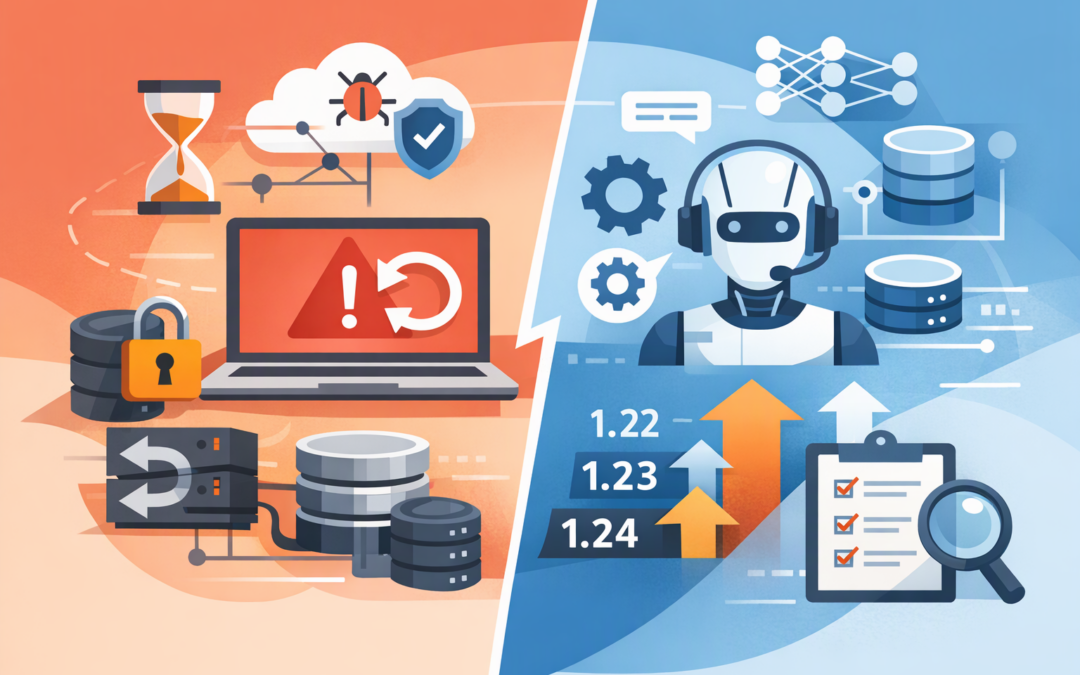
In this blog post Microsoft Agent Framework October 2026 Changes That Matter Now we will explain which updates affect security, operating risk, compatibility and the cost of running AI agents in production.
If your team has built an AI agent that connects to company data, completes tasks or calls business systems, October’s release notes deserve attention. The changes were not simply developer improvements. Some affect stored conversations, user access, tool approvals, integrations and whether an older version can safely be restored after an upgrade.
What Microsoft Agent Framework does
Microsoft Agent Framework is the software layer used to build and operate AI agents in Python or .NET. An AI agent is an application that can interpret a request, decide what steps to take and use approved tools to complete a task.
For example, an agent might search Microsoft 365, read a policy, create a service ticket and ask a manager to approve the next action. The framework manages the agent’s instructions, tools, memory, workflow and connections to models such as Azure OpenAI, OpenAI or Anthropic Claude.
CPI Consulting helps organisations design, build and secure Azure AI solutions, from Azure OpenAI and Microsoft Foundry to agents, governance and production deployment.
Visit CPI ConsultingThis is different from a basic chatbot. Once an agent can access files, update records or trigger business processes, the framework becomes part of your security and operational environment.
October was a busy month for production teams
During October 2026, Microsoft released Python versions 1.20 through 1.24 and .NET versions 1.23 through 1.27. Python and .NET follow separate release schedules, so organisations using both cannot assume that features and fixes arrive at the same time.
We covered the individual releases in our detailed explanation of the October Agent Framework changes. For decision-makers, the bigger message is that upgrades now need the same controls applied to other important business applications.
1 Stored agent data can affect your rollback plan
One of the most important October changes involved the way some Python releases store agent content and streamed responses. Version 1.22 can read records created by earlier releases, but older runtimes may not be able to read certain records written by 1.22 or later.
In plain English, upgrading can change the format of stored conversations, session data or workflow checkpoints. A checkpoint is a saved position that lets a long-running agent resume after an interruption or human approval.
This creates a business continuity risk. If a new version writes updated records and your team then rolls back to an older version, the older application may not understand them.
The correct approach is to identify where agent state is stored, back it up, test a copy and isolate old and new environments during deployment. Avoid running mixed versions against the same affected data store unless compatibility has been confirmed.
2 Connections to business tools changed
Python 1.23 moved Model Context Protocol integrations to the MCP 2.x client lifecycle. MCP is a standard that lets an AI agent connect to approved tools and data sources without building a completely different integration for each one.
The updated lifecycle improves how connections negotiate capabilities, handle multi-step requests, cache responses and manage subscriptions. However, applications that created or managed MCP connections in older ways may require code changes.
This matters because integration problems rarely stay inside the IT department. They appear as failed customer requests, incomplete service tickets, missing data or employees repeating work manually.
October also strengthened controls around information passed between agents using Agent-to-Agent, or A2A, connections. Selected information can be forwarded, but sending and receiving systems must explicitly allow it. That default is sensible because one agent should not automatically inherit every piece of context held by another.
For a deeper governance checklist, see our production guide for A2A and MCP governance.
3 User ownership and approvals became more explicit
October introduced stricter requirements for AG-UI endpoints. AG-UI is a protocol used to connect an agent running in the background with the interface used by an employee or customer.
Shared and authenticated services must now define how sessions, saved state, approvals and checkpoints belong to a particular user or security scope. Marking an application as single-user is intended only for local or genuinely single-user environments.
This addresses a serious production concern. Logging a user in is not enough if the application cannot reliably separate that person’s agent session and approval history from everyone else’s.
The releases also made approval behaviour clearer for local MCP tools. Your security team should confirm which actions require human approval, which can run automatically and what happens when no explicit policy has been configured.
These controls support the intent of the Essential Eight, the Australian Government’s cybersecurity framework, particularly around limiting access and controlling applications. They do not create Essential Eight compliance by themselves, but they can provide useful evidence of controlled access and change management.
4 Security-sensitive settings are becoming harder to overlook
Microsoft renamed an option that passes extra commands into Docker-based shell tools so that the word “unsafe” appears in its name. Docker provides isolated environments for running code, but extra commands can weaken that isolation if they come from an untrusted source.
The business lesson is simple. An AI model should never be able to invent its own infrastructure permissions, container settings or unrestricted command options.
Any agent that can run code, access files or call administrative tools needs a documented permission model. It should also have limits on what it can access, an approval process for high-risk actions and logs that show what happened.
5 Your underlying platform may also need an upgrade
Python 1.24 established Python 3.11 or later as the supported baseline. Python 3.10 installation was still possible in that release, but compatibility was no longer guaranteed and later installation support was scheduled for removal.
This can create hidden work for organisations running agents on older servers, containers or development environments. The Agent Framework package may be only one part of the upgrade; automated build pipelines, security scanners and hosting platforms may also need updating.
Version pinning helps prevent an approved build from changing without warning:
# Example only — validate versions in a test environment
agent-framework==1.24.0
# Supported Python baseline
python>=3.11
Pinning means selecting a specific tested version rather than automatically accepting every new release. It reduces surprise, but it must be combined with a regular process for reviewing security and reliability updates.
6 Monitoring and reliability continued to improve
The October releases added better telemetry, connection cleanup, timeouts and workflow handling. Telemetry means the logs, measurements and traces used to understand what an agent did and where it failed.
For executives, better telemetry means faster incident investigation and less time spent guessing why an agent produced a poor result. It can also help identify excessive model usage, repeated tool calls and workflows that consume more money than expected.
Python 1.24 also added experimental options for reducing loaded context and unloading skills during a run. These may lower memory and model costs for long tasks, but experimental features should remain outside critical production processes until they have been tested against your own workloads.
A practical scenario
Consider a 200-person professional services company with an internal agent connected to Microsoft 365, its ticketing platform and a finance system. The agent stores conversation history and pauses when financial approval is required.
An automatic October upgrade could introduce three problems at once: older workers may not read newly stored state, the MCP tool connection may require a lifecycle change, and the user interface may need a clearer ownership rule for approvals.
A controlled upgrade would test cloned session data, validate every connected tool, confirm that one user cannot access another user’s state and perform a rollback rehearsal before production data is changed. That work might take several days, but it is far cheaper than losing workflow history or investigating an access-control incident.
What technology leaders should ask now
- Which Agent Framework versions are we running? Record Python and .NET versions separately.
- Are versions pinned? Production should not change because a build downloaded the newest package.
- Where is agent state stored? Include conversations, sessions, checkpoints, approvals and memory stores.
- Can we safely roll back? Test this after the new version has written data, not just before deployment.
- Which tools can act without approval? Pay particular attention to file access, shell tools and business system updates.
- Can monitoring identify the user, tool and action? Logs should support investigation without exposing sensitive prompts or business data.
Our guidance on Agent Framework version governance provides a repeatable approach for pinning, testing and approving releases.
The decision is not simply whether to upgrade
October’s changes improve security, interoperability and production reliability. They also show why AI agents should no longer be managed like disposable experiments.
The right question is whether your organisation can upgrade without breaking stored state, weakening access controls or creating an expensive recovery exercise. That requires ownership, testing and a clear record of what each agent is allowed to do.
CloudPro Inc is a Melbourne-based Microsoft Partner and Wiz Security Integrator with more than 20 years of enterprise IT experience across Azure, Microsoft 365, OpenAI, Claude and cybersecurity. If you are unsure whether your Agent Framework environment is ready for the October changes, we are happy to review the setup and highlight the practical risks — no strings attached.