
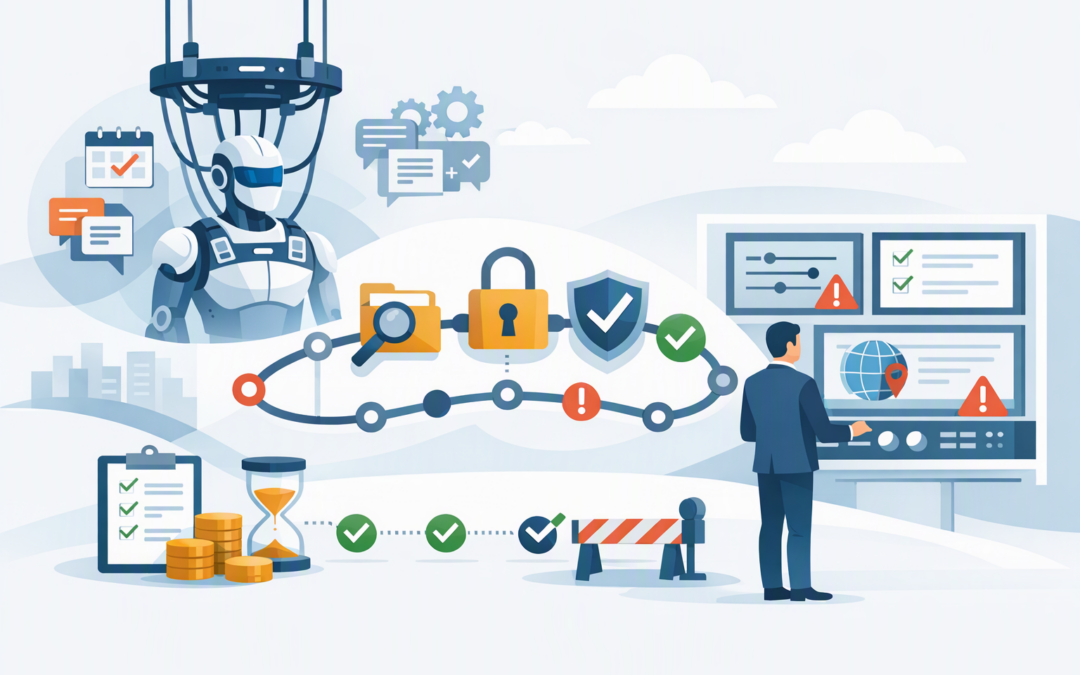
In this blog post Microsoft Copilot Harness in Foundry What Australian CIOs Need we will explain why Microsoft’s new managed agent technology matters, where it could improve productivity, and what CIOs should check before trusting it with business data or actions.
Many organisations have built an AI assistant that can answer questions but struggles when asked to complete real work. It loses track of multi-step tasks, selects the wrong tool, stops when a system fails, or needs so much custom code that the promised savings disappear.
The Microsoft Copilot harness, introduced in Microsoft Foundry Agent Service as a public preview on 28 October 2026, is designed to address that gap. It provides the operating layer that helps an AI agent plan work, use tools, manage context and continue towards a defined outcome.
What is the Microsoft Copilot harness?
A large language model such as OpenAI or Claude provides the intelligence behind an agent. The harness is the structure around that intelligence that helps it behave like a useful worker rather than a chatbot.
CPI Consulting helps organisations design, build and secure Azure AI solutions, from Azure OpenAI and Microsoft Foundry to agents, governance and production deployment.
Visit CPI ConsultingThink of the model as a capable new employee. The harness provides their procedures, approved tools, workspace, task list, security boundaries and rules for when they must ask a manager for approval.
Within Foundry Agent Service, the harness can manage:
- Planning so the agent can break a larger request into smaller steps.
- Context so it can retain the relevant information as work progresses.
- Tool selection so it can choose an approved business system or function.
- Skills which are reusable procedures, such as how to review a contract or process an invoice.
- Files and commands within a controlled execution environment.
- Recovery so a temporary tool failure does not automatically end the task.
Microsoft operates this runtime and its execution environment. Your team defines the agent’s goal, instructions, knowledge, tools and permissions without having to build and maintain the entire orchestration layer.
Why this matters to CIOs
It could reduce the cost of building capable agents
Until now, teams wanting an agent to complete complex work often had to build their own planning loops, tool integrations, memory handling and retry logic. That creates development cost before the organisation has proven that the use case delivers value.
A managed harness could shorten that path. Your team can spend more time designing the business process and less time maintaining the underlying agent machinery.
This does not make implementation free or automatic. Data preparation, security controls, testing and integration still require serious work. However, it may remove a large amount of plumbing that each development team would otherwise rebuild.
It moves AI from answering to doing
The biggest productivity opportunity is not generating another summary. It is completing a sequence of low-risk steps that currently consumes hours of employee time.
For example, an agent could gather approved information for a tender, compare it with the buyer’s requirements, identify missing evidence, prepare a compliance matrix and create a first draft. A person would still review the final response, but they would start from organised work rather than a blank page.
This builds on the shift covered in our guide to moving from Copilot Chat to governed AI agents. The harness makes longer and more complicated tasks practical, but governance remains essential.
Model choice becomes less disruptive
The harness separates much of the agent’s operating logic from the model itself. In principle, this makes it easier to test supported OpenAI and Anthropic models without rebuilding the entire agent.
That matters because the best model today may not offer the best price, speed or accuracy six months from now. CIOs should still test each model against their own business process because changing models can alter output quality and cost.
The Foundry preview also has limits. Bring-your-own-model support is not currently available for the Copilot harness, and only eligible reasoning and tool-calling models can be used.
A practical business scenario
Consider a 180-person professional services company submitting four major tenders each month. Each response requires a senior employee to locate project examples, check insurance documents, confirm staff qualifications and assemble material from several systems.
If that preparation takes six hours per tender, the business is using 288 skilled hours each year before writing the final response. If a governed agent reduces preparation to 90 minutes, the company recovers more than 200 hours annually.
The harness could coordinate the steps, while Foundry connections give the agent controlled access to approved sources. A human approval step would remain mandatory before information leaves the organisation.
The difficult part is rarely the AI model. It is safely connecting the agent to SharePoint, a CRM, a service desk or another business platform. Our article on connecting Microsoft Foundry agents to business systems explains the controls required around those integrations.
The risks Australian CIOs should not overlook
Public preview is not production approval
The Copilot harness in Foundry Agent Service is currently a public preview without a production service-level agreement. Microsoft does not recommend preview features for production workloads.
Use this period for controlled trials with test data or low-risk internal work. Do not place a customer-facing, safety-critical or financially sensitive process on it simply because the demonstration looks impressive.
More autonomy creates a larger security impact
An agent that can only draft text has limited reach. An agent that can access files, run commands and update business systems can cause much more damage if it receives a bad instruction or excessive permissions.
Each agent should have its own identity and only the minimum access required. High-impact actions such as sending external messages, approving payments, deleting records or changing security settings should require human approval.
This supports the intent of Essential Eight, the Australian Government’s cybersecurity framework that many organisations use to reduce common attack paths. However, using Microsoft Foundry does not automatically make an agent compliant with Essential Eight or Australian privacy obligations.
Data residency must be verified
Foundry Agent Service retains information such as conversations, responses and uploaded files. Microsoft provides different setup options, including one where agent data can be stored in Azure resources controlled by the customer.
Australian organisations should confirm the available region, where each selected model processes information, what tools receive data, and how long records are retained. Do not assume that deploying part of the solution in Australia means every model and connection processes data locally.
Consumption costs need guardrails
A multi-step agent may make several model calls, search files, invoke tools and retry failed steps for one user request. That can deliver a strong result, but it can also turn a cheap-looking demonstration into an unpredictable monthly bill.
Measure the full cost per completed business task, not just the price of one AI response. Include model usage, tools, search, storage, execution time, monitoring and the employee effort required to review the result.
Five actions CIOs should take now
- Select one bounded process. Choose repetitive work with clear inputs, outputs and an accountable process owner.
- Map every permission. Document what the agent can read, create, change and send.
- Add approval points. Require people to approve irreversible, external or financially significant actions.
- Measure business outcomes. Track time saved, completion quality, failure rates, review effort and total cost per task.
- Create a production gate. Do not move beyond testing until regional availability, support commitments, security controls and recovery procedures meet your requirements.
Because the harness and related agent components will change quickly, teams should also adopt the versioning and testing practices outlined in our Microsoft Agent Framework release cadence guide.
The bottom line
The Microsoft Copilot harness could remove a significant amount of custom engineering from advanced AI agent projects. Its real value is not better chat. It is helping agents complete multi-step business work while operating inside defined tools, procedures and security boundaries.
For Australian CIOs, the sensible approach is controlled experimentation rather than immediate production deployment. Start with a measurable process, restrict access, keep people responsible for important decisions and validate the entire data path.
CloudProInc combines more than 20 years of enterprise IT experience with hands-on expertise across Microsoft Foundry, Azure, Microsoft 365, OpenAI, Claude and cybersecurity. As a Melbourne-based Microsoft Partner and Wiz Security Integrator, we help organisations test AI opportunities without losing sight of cost, security or governance.
If you are unsure whether the Copilot harness fits your AI roadmap, or whether an existing agent has the right controls, we are happy to take a practical look with you — no strings attached.