
In this blog post What Microsoft Agent Framework 1.x Means for Your AI Roadmap we will explain how Microsoft’s rapid release cycle should change the way you plan, fund and manage business AI agents.
If your organisation is building an AI agent today, there is a good chance the underlying framework will change before the agent reaches production. That does not make the technology a poor investment, but it does mean a traditional “build it once and review it next year” roadmap is no longer realistic.
Microsoft Agent Framework is the software foundation used to create AI agents and workflows in Python and .NET. In plain English, it connects an AI model to business data, tools, approval steps and other agents so it can complete useful work rather than simply answer questions.
The framework can support anything from an internal policy assistant to a multi-step agent that reads a request, checks Microsoft 365 data, updates a business system and sends the result for human approval. It works with services including Microsoft Foundry, Azure OpenAI, OpenAI and Anthropic, while supporting common ways for agents to connect with tools and with each other.
CPI Consulting helps organisations design, build and secure Azure AI solutions, from Azure OpenAI and Microsoft Foundry to agents, governance and production deployment.
Visit CPI ConsultingVersion 1.x is stable but it is not standing still
Microsoft Agent Framework reached version 1.0 for Python and .NET in April 2026. This was an important milestone because it moved the core framework into a production-ready phase with more stable programming interfaces and long-term support commitments.
However, “stable” does not mean “finished”. By late October 2026, the Python track had reached version 1.23 and the .NET track had reached version 1.26. Releases have often arrived within days or weeks of one another, with fixes, new integrations, workflow improvements and operational changes moving on separate tracks.
For technology leaders, the message is simple: your roadmap cannot assume the framework will remain unchanged between project approval, development and launch.
We have previously covered the practical mechanics of version governance and safe production upgrades. The wider roadmap question is how to keep delivering business value when the technology underneath your agents is moving this quickly.
Separate your business roadmap from Microsoft’s release roadmap
Your AI roadmap should be driven by business outcomes, not Microsoft’s version numbers. A new framework release is not, by itself, a reason to delay a useful customer service agent or rebuild an employee support tool.
Start with outcomes such as reducing service desk demand by 20%, cutting contract review time from two days to two hours, or helping employees find approved policies without searching through SharePoint folders.
Then maintain a separate technical roadmap covering framework versions, AI models, hosting, security controls and integrations. The two roadmaps should meet at planned review points, but Microsoft’s weekly development activity should not continually rewrite your business priorities.
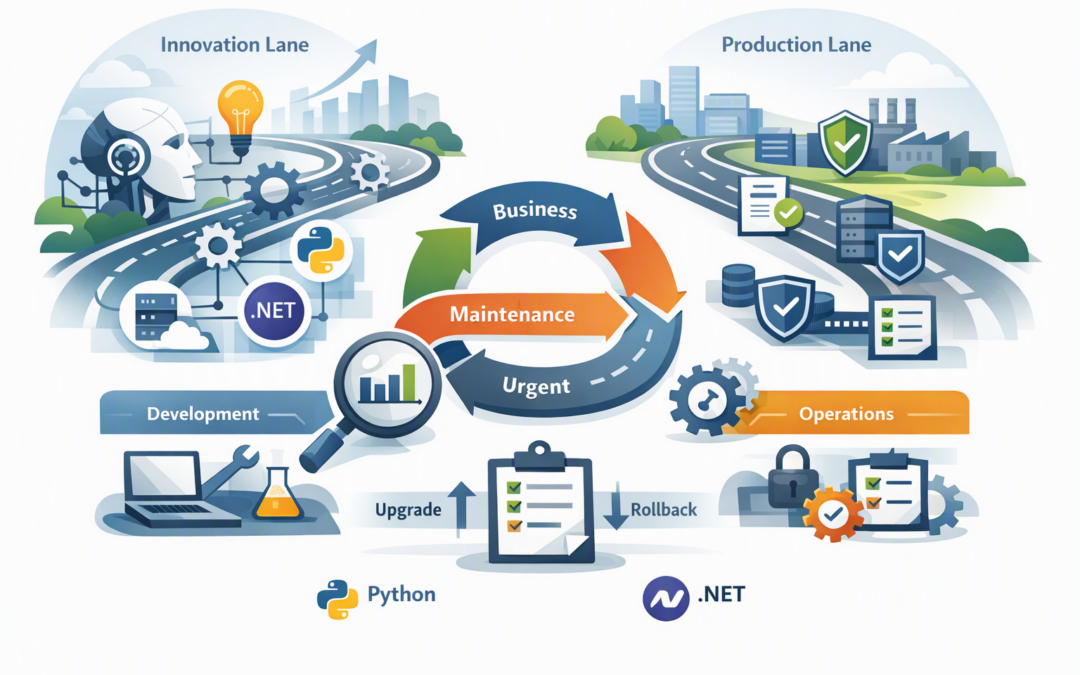
Use three decision categories
- Business releases add capabilities that employees or customers can see.
- Maintenance releases update the framework, dependencies, monitoring or hosting without changing the business process.
- Urgent releases address a security exposure, data risk or production fault that cannot wait for the next planned window.
This separation gives executives a clearer view of where the AI budget is going. It also stops routine maintenance from being presented as a constant stream of new AI projects.
Plan for two speeds of adoption
Not every agent should adopt new framework capabilities at the same speed. A low-risk internal experiment can move quickly, while an agent handling customer data, financial approvals or employee records needs stronger controls.
A practical roadmap uses two lanes:
- Innovation lane: Trial new releases and features in a controlled environment using test data. Nothing in this lane should have broad access to production systems.
- Production lane: Use approved versions that have passed security, integration, performance and business testing. Updates move into this lane only when there is a clear benefit or risk-based reason.
This approach lets your team explore improvements without turning employees or customers into testers. It is particularly important when an agent can read email, search Microsoft 365, call external tools or take action in a business application.
Budget for ongoing engineering rather than a one-off build
The hidden cost in many agent projects is not the AI model. It is the work required to keep integrations, permissions, stored conversations, workflow state and monitoring reliable as the surrounding technology changes.
Consider a 180-person professional services company planning an agent to prepare client briefing packs. The initial prototype might take only a few weeks, but the production service must also manage access to SharePoint, client separation, human approvals, audit records and failures halfway through a task.
If the project budget covers only the prototype, the company may end up with an impressive demonstration that cannot be trusted with real client information. A better roadmap reserves ongoing capacity for maintenance, testing and controlled upgrades from the beginning.
As a planning guide, many organisations should reserve 10–15% of their agent engineering capacity for framework updates, dependency maintenance and operational improvements. High-risk or heavily integrated agents may require more.
Do not force Python and .NET onto the same timetable
Microsoft Agent Framework supports both Python and .NET, but their release numbers and feature timing do not always match. Python is often attractive for AI experimentation, while .NET may fit more naturally into existing Microsoft business applications and internal development standards.
Your roadmap should record which language each agent uses and why. It should also identify shared dependencies, such as identity, logging, stored state and connections to Microsoft 365 or Azure.
A simple roadmap control might look like this:
agent_portfolio:
 finance_assistant:
 runtime: dotnet
 approved_framework: 1.26.0
 upgrade_window: monthly
 business_owner: finance

 research_assistant:
 runtime: python
 approved_framework: 1.23.0
 upgrade_window: fortnightly
 business_owner: strategy

controls:
 production_versions_pinned: true
 rollback_plan_required: true
 security_review_required: true
Pinning means selecting a specific software version rather than automatically accepting the newest release. The exact versions will change, but making ownership and upgrade windows visible prevents accidental updates from becoming production incidents.
For more detail on the different runtime tracks, see our review of the Python and .NET Agent Framework roadmap.
Make security and compliance roadmap items
An AI agent may have more access than an ordinary employee because it can search thousands of documents and call several systems in seconds. Framework updates therefore need to be reviewed as security changes, not just developer housekeeping.
For Australian organisations, this connects directly with the Essential 8, the Australian Government’s cybersecurity framework that many organisations use or are required to follow. Application control, timely patching, restricted administrative access and strong identity protection all matter when agents can take action across your environment.
Your roadmap should include regular reviews of:
- What information each agent can access.
- Which actions require human approval.
- How agent activity is recorded and reviewed.
- Whether stored conversations contain personal or confidential information.
- How quickly security-related framework updates can be tested and deployed.
Agents using MCP, which is a standard way for AI systems to connect to external tools, or A2A, which allows agents to communicate with other agents, require additional governance. Our production guide to A2A and MCP governance explains those controls in more depth.
A practical 90-day roadmap
- Days 1–30: List every planned and operating agent, its business owner, framework version, data access, integrations and risk level.
- Days 31–60: Establish approved production versions, a testing environment, upgrade windows and clear rollback procedures.
- Days 61–90: Prioritise upgrades according to business value, security risk and operational pain rather than chasing every new feature.
The goal is not to run the latest release at all times. It is to know what you are running, why you are running it and how quickly you can change it when the business benefit or risk justifies the work.
Your roadmap should create control rather than delay
Microsoft Agent Framework’s fast 1.x cadence is a sign of an active platform with expanding production capabilities. It can give your organisation better workflows, broader model choice and stronger operational controls, but only if upgrades are treated as part of the product lifecycle.
CloudPro Inc combines more than 20 years of enterprise IT experience with hands-on work across Azure, Microsoft 365, OpenAI, Claude, Microsoft Defender and Wiz. As a Melbourne-based Microsoft Partner and Wiz Security Integrator, we help organisations turn promising agent prototypes into services that are supportable, secure and tied to measurable business outcomes.
If you are unsure whether your current agent roadmap allows for Microsoft’s release pace, we are happy to review it with you and identify the practical gaps — no strings attached.