
In this blog post Can Gemini Parallel Web Grounding Reduce Enterprise Hallucinations we will explain how Google Cloud’s new grounding option works, where it can improve AI accuracy, and why businesses still need controls around the answers it produces.


The problem will be familiar to many technology leaders. An AI assistant produces a confident, well-written answer, but one of its facts is outdated, a cited policy no longer applies, or the model has filled an information gap with something that simply sounds plausible.
Parallel Web Search grounding is designed to reduce that risk. It gives Gemini access to current public web information before it answers, rather than relying only on what the model learned during training.
What has Google actually added?
Google Cloud has added Parallel Web Systems as a grounding provider within the Gemini Enterprise Agent Platform. It is available through the Gemini API, Agent Studio and Google Cloud Marketplace, although the service is currently offered as a preview rather than a fully mature, generally available product.
The word “Parallel” can be confusing here. It is the name of the search technology provider, not simply a feature that opens several Google searches at the same time.
Parallel operates a web index and search service built specifically for AI agents. Instead of returning a page of links intended for a person to browse, it returns structured, compressed information that Gemini can more easily analyse.
How web grounding works in plain English
A normal AI model predicts a useful response from patterns in its training data. It may know a great deal, but it does not automatically know what changed yesterday, whether a regulation was recently updated, or if a product has been withdrawn.
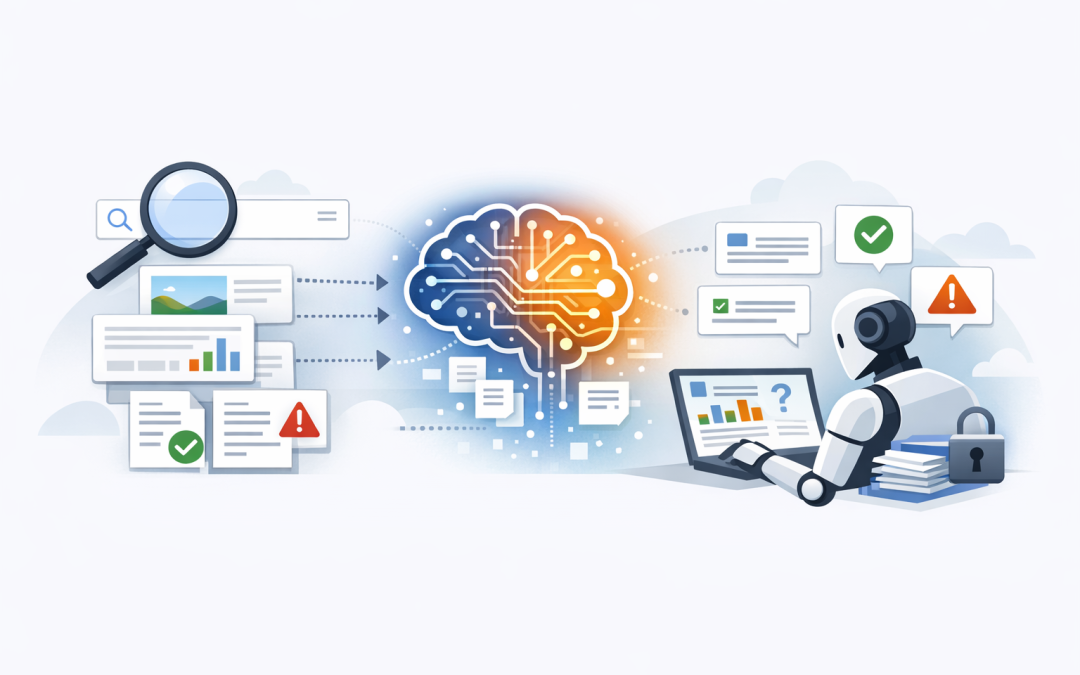
Grounding adds a research step before the answer is generated. The basic process looks like this:
- The user asks Gemini a question.
- Gemini decides what current information it needs.
- Parallel searches its index of public web pages.
- Relevant extracts are returned in a format designed for AI processing.
- Gemini builds its answer using those extracts.
- The response can include citations showing which sources supported its claims.
For complex questions, Gemini can break the request into smaller research tasks. For example, an executive might ask it to compare three suppliers, check recent security incidents and identify changes in their pricing. The system can search for each part before combining the findings.
This is a form of retrieval-augmented generation, often shortened to RAG. In plain English, the AI retrieves relevant information first and then uses that information to write its answer.
Can it reduce enterprise hallucinations?
Yes, particularly when the question depends on recent public information. Web grounding can stop Gemini from relying on an old training cut-off or inventing an answer about an event that happened after the model was trained.
It can be useful for supplier research, market monitoring, news summaries, public company analysis, product comparisons and regulatory scanning. These are all tasks where yesterday’s correct answer may be wrong today.
It can also improve auditability. If an AI-generated report links each important claim to its supporting material, an employee can check the evidence instead of accepting a polished paragraph on trust.
This builds on the broader principle discussed in our guide to improving accuracy with Azure AI groundedness. The model matters, but the quality and control of the information supplied to it often matter just as much.
Why grounding does not eliminate the risk
A source can still be wrong
Grounding can prove that a statement came from a web page. It cannot automatically prove that the page itself is accurate, independent or current.
Imagine an AI assistant comparing cybersecurity vendors. If most of its evidence comes from vendor marketing pages, its answer may be well cited but still biased. A citation improves traceability; it does not turn every source into a fact.
The public web is not your company’s truth
Parallel Web Search connects Gemini to public web information. It does not automatically understand your contracts, internal policies, customer records, approved price lists or risk appetite.
A useful enterprise assistant will often need two separate grounding layers: controlled access to internal company information and carefully selected access to the public web. Mixing those sources without clear labels can create new confusion.
Web content can be manipulated
Attackers can publish misleading material or hide instructions inside web pages in an attempt to influence AI agents. This is sometimes called prompt injection, meaning that untrusted content tries to tell the AI what to do.
This becomes more serious when an AI agent can take actions rather than merely draft text. An agent that can update records, contact suppliers or approve workflow steps needs stronger safeguards than an assistant that only produces a research summary.
More research can mean more cost and delay
Every search adds processing time and may add usage charges. If grounding is switched on for every simple question, businesses can end up paying for searches that provide little additional value.
This is similar to the issue covered in why cheaper, faster AI can increase business risk. Low per-request pricing does not guarantee a cost-effective system when thousands of unnecessary requests are running each day.
A practical enterprise scenario
Consider a 200-person financial services business building an AI assistant for its risk team. The assistant is asked to summarise recent announcements about a supplier and recommend whether the supplier requires additional review.
Without grounding, Gemini may rely on older knowledge and miss a recent data breach. With Parallel Web Search, it can retrieve current reporting and produce a cited summary.
But the AI should not make the final risk decision. The business still needs rules covering acceptable sources, conflicting reports, confidence thresholds and human approval. It may also need to compare public information with the supplier’s contract, security questionnaire and internal risk rating.
The outcome is not “AI that never makes mistakes.” The realistic outcome is faster research, clearer evidence and fewer unsupported claims, while an accountable employee remains responsible for the decision.
Five controls to put in place before deployment
- Start with a narrow use case. Supplier monitoring is easier to test and govern than a general assistant that answers every business question.
- Set a source policy. Decide which government, industry, news and vendor sources are acceptable. Require multiple sources for high-impact claims.
- Separate public and internal data. Make it clear whether an answer came from the web, company records or both.
- Require evidence and a safe fallback. If reliable information cannot be found, the system should say so rather than guessing.
- Test with real business questions. Measure factual accuracy, citation quality, cost, response time and the number of answers requiring correction.
Privacy and security also need attention. Google Cloud offers a zero-data-retention option for certain Parallel configurations, but businesses should confirm the exact commercial setup, data flows and service terms before sending sensitive prompts.
For Australian organisations, this review should sit alongside Privacy Act obligations and the Essential Eight, the Australian Government’s cybersecurity framework that many organisations use or are required to follow. The Essential Eight does not measure AI accuracy, but its controls around access, applications, patching and administrator privileges remain important in the surrounding environment.
The business case depends on the workflow
Parallel Web Search grounding is a useful addition to Gemini, especially for research-heavy agents that depend on fresh public information. It can reduce stale answers, make claims easier to verify and save employees from manually opening dozens of web pages.
It should not be treated as an “accuracy on” switch. The strongest results come from combining a capable model with trusted sources, internal data controls, security testing, cost limits and human accountability.
CloudProInc helps organisations assess AI platforms across Google, Microsoft, OpenAI and Anthropic without assuming that one model is right for every workload. With more than 20 years of enterprise IT experience, our Melbourne-based team focuses on practical deployments that improve productivity without creating unmanaged security or compliance risk.
If you are not sure whether web grounding would make your AI project safer or simply more complicated, we are happy to review the proposed workflow and controls with you — no strings attached.