
In this blog post What Microsoft’s New AI Stack Means for Safer Faster AI Projects we will explain what Microsoft means by Agent Framework, Foundry, MCP and Aspire, how the pieces fit together, and what this actually means for cost, risk and speed in a real business.


If you have been trying to keep up with Microsoft AI lately, you are not alone. Many CIOs and CTOs are hearing new terms every few months and wondering whether this is genuine progress or just another layer of complexity their team will have to manage.
At a high level, Microsoft’s new AI stack is an attempt to solve a real problem. Building one clever chatbot is easy enough. Building an AI system that can securely use company data, connect to business tools, run reliably, and survive security and compliance review is much harder.
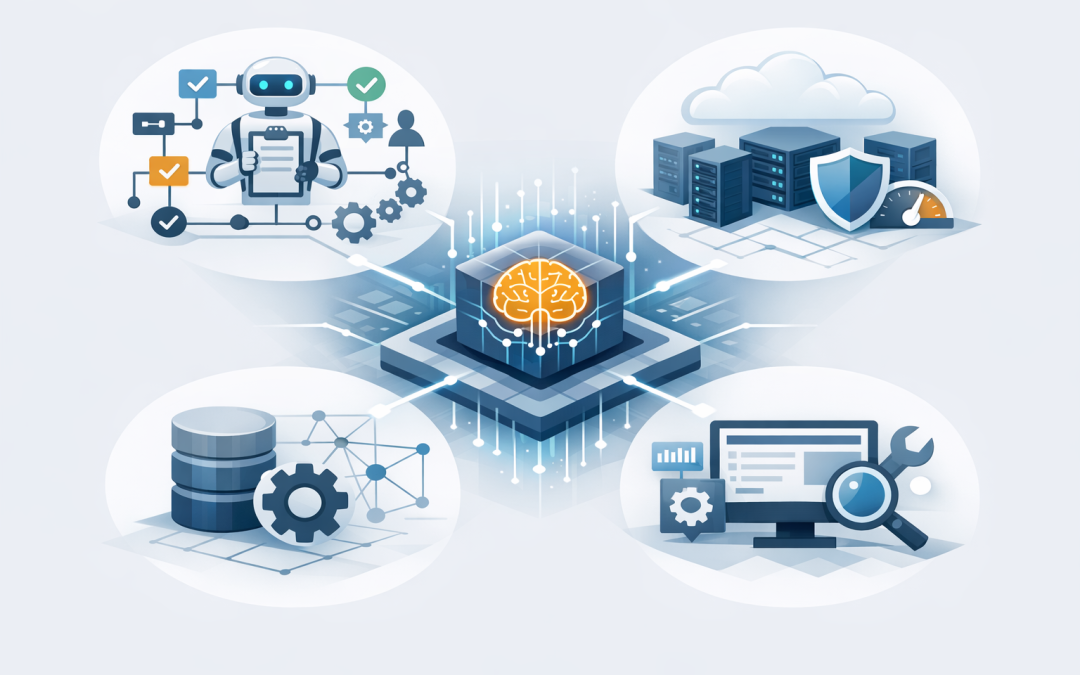
The simple version is this. Agent Framework is how developers build the AI worker. Microsoft Foundry is the managed platform where models, agents and governance live. MCP, short for Model Context Protocol, is the standard way that AI connects to tools and data. .NET Aspire is what helps teams run all the moving parts together and see what is going on.
Why this matters to business leaders
The risk for mid-sized businesses is not that AI arrives too slowly. It is that teams rush into disconnected pilots, buy multiple tools, and end up with something expensive, hard to secure, and impossible to scale.
That is why this stack matters. Done well, it gives your team a clearer path from experiment to production, with better control over data access, approvals, monitoring and cost.
The technology behind it in plain English
An AI agent is more than a chatbot. It is an AI-powered worker that can take an instruction, decide what steps are needed, use approved tools, and return an outcome.
That sounds powerful, but it also creates new risks. If the agent can reach the wrong system, call the wrong tool, or act without guardrails, you do not have productivity. You have a new operational and security problem.
Microsoft’s stack breaks that problem into four layers so teams can manage it properly.
User request
↓
Agent Framework decides the steps
↓
Foundry provides the model, hosting and governance
↓
MCP connects approved tools and data sources
↓
Aspire runs the services together and shows what is happening
For decision-makers, that separation is the real story. It means you can improve one layer without rebuilding everything else.
Agent Framework is the brain and workflow layer
Microsoft Agent Framework is the newest part of the stack and, as of February 2026, it has reached Release Candidate status for both .NET and Python. In plain English, that means Microsoft is treating it as the main future path for building AI agents in its ecosystem.
It combines ideas from Microsoft’s earlier AI development tools, including Semantic Kernel and AutoGen, into one framework. That matters because many teams were previously forced to choose between something flexible for experiments and something more structured for production.
The practical value is not just that it can create an agent. It can also coordinate multi-step work, handle handoffs between specialised agents, keep track of state between steps, and support approval points where a human needs to sign off.
Business outcome: faster delivery with fewer rewrites. Your developers are less likely to build a proof of concept one way and then throw it away when security, audit or operations get involved.
One important point Microsoft makes, and it is a good one, is that not every task needs an agent. If the process is fixed and predictable, a normal workflow is often better. That is useful advice for executives, because it stops AI projects becoming overengineered from day one.
Microsoft Foundry is the control centre
Microsoft Foundry is the platform layer behind the scenes. If you knew it by its earlier name, Azure AI Foundry, the branding has now shifted to Microsoft Foundry.
Think of Foundry as the place where your team gets access to models, manages projects, applies security and access controls, monitors usage, evaluates quality, and hosts agents in a more enterprise-ready way. It is designed to bring agents, models and tools under one management layer instead of scattering them across separate services.
Why does that matter commercially? Because AI projects rarely fail because the model is weak. They fail because nobody can answer basic business questions such as who has access, what data is being used, what it costs, or how quality is being measured.
Foundry addresses that by giving teams one place to manage those decisions. For Australian organisations, that is especially relevant when privacy, auditability and security reviews are involved. It does not replace your broader cyber controls, but it does make AI governance far more manageable.
Business outcome: lower risk and better governance. You are less likely to end up with shadow AI tools, unmanaged API keys, or a pilot that cannot pass internal review.
MCP is the universal plug for AI tools and data
MCP stands for Model Context Protocol. The easiest way to understand it is to think of it as a standard plug that lets AI systems connect to external tools and data sources in a consistent way.
Before standards like this, every AI app needed its own custom connector for every system. That creates cost, duplication and security headaches. With MCP, the AI can discover approved tools and use them through a common pattern.
That might mean connecting an agent to your document library, CRM, ticketing platform, internal knowledge base or database. Instead of wiring each one differently for each AI app, MCP gives developers a cleaner and more reusable path.
This is also where governance becomes important. Microsoft’s newer MCP support includes approval flows, authentication options and tighter control over which tools can actually be called. On Windows, Microsoft is also building managed ways for apps and administrators to discover and control MCP connectors.
Business outcome: lower integration cost and better security control. Your team spends less time building one-off connectors, and your business gets a clearer way to approve what the AI is allowed to touch.
Aspire is what makes the whole thing operational
.NET Aspire is the least talked-about piece outside developer circles, but it may be the one that saves the most pain later. Aspire helps teams build and run distributed applications, which is just a simple way of saying apps made up of multiple connected parts.
An AI solution rarely lives in one box. There may be a web app, an agent service, a database, a queue, monitoring, identity, and one or more tools or APIs in the background. Aspire helps wire those parts together, run them consistently, and show developers logs, traces and health data in one place.
That visibility matters because AI failures are often hard to diagnose. Was the issue the model, the connector, the database, permissions, or a timeout between services? Aspire gives teams a clearer operational view much earlier.
Business outcome: faster troubleshooting and a smoother path into production. That means fewer delays, less finger-pointing between vendors, and less time paying for teams to guess where a failure is happening.
How the stack fits together in a real business scenario
Consider a 200-person professional services firm that wants an AI assistant to help staff prepare proposals. Today, the team manually pulls old proposal content, checks pricing notes, reviews client information, and chases subject matter experts for answers.
Using this stack, Agent Framework could coordinate the work. One agent gathers background information, another drafts the first version, and a review step asks a human to approve any commercial claims before anything leaves the business.
Foundry provides the governed model access, monitoring and project controls. MCP connects the assistant to approved sources such as SharePoint, a CRM and an internal pricing database. Aspire helps the development team run the app, the data services and the monitoring together without stitching everything by hand.
The outcome is not just a nicer demo. It is a shorter proposal cycle, better consistency, and lower risk that staff copy sensitive information into consumer AI tools because the approved internal option is too weak or too slow.
What most companies get wrong about this stack
- They start with the tooling, not the business case. The right first question is not which framework to use. It is where you can save time, reduce risk or improve customer response speed.
- They assume every workflow needs a fully autonomous agent. In many cases, a structured workflow with a human approval step is the smarter and safer option.
- They ignore security until late in the project. In Australia, that is risky. AI projects should be reviewed alongside your identity controls, data access rules and Essential 8 obligations from the beginning.
- They adopt all four layers at once. You do not need to. Many businesses should start with Foundry and a simple agent, then add MCP and Aspire only when the use case justifies it.
A practical way to approach it
- Pick one business use case with a clear number behind it, such as proposal time, service desk load, onboarding effort or compliance workload.
- Keep the first version narrow. Limit the data sources, users and actions the AI can take.
- Use fixed workflows where the process is predictable. Use agents where reasoning and tool use genuinely add value.
- Build governance in early, including access control, approval steps, monitoring and logging.
- Measure results before expanding. If it is not saving time, reducing risk or improving service, do not scale it.
Final thought
Microsoft’s new AI stack is not just a new set of product names. It is Microsoft’s attempt to give organisations a more complete way to build AI that is useful, connected, governed and operationally supportable.
For business leaders, the big opportunity is not chasing every new feature. It is using the stack selectively so your team can move faster without losing control.
At CPI , we help organisations make that call in a practical way. As a Melbourne-based Microsoft Partner with hands-on experience across Azure, Microsoft 365, OpenAI, Claude, Microsoft security and Wiz, we focus on what will actually work in a mid-sized business, not what looks impressive in a demo. If you are not sure whether this new Microsoft AI stack is relevant to your business, or whether your current AI plans are becoming more complex than they need to be, we are happy to take a look with you, no strings attached.
Discover more from CPI Consulting
Subscribe to get the latest posts sent to your email.