
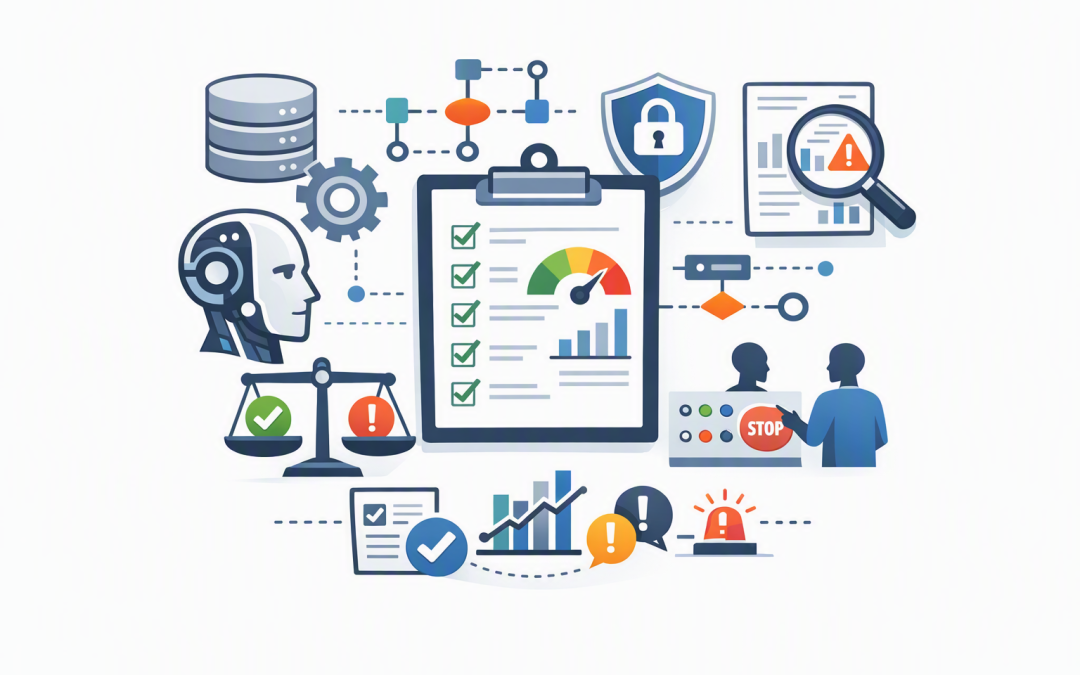
In this blog post How to Build an AI Audit Framework Your Executives Can Trust we will explain how to turn scattered AI policies, system logs and risk reviews into clear evidence that leadership can understand and act on.
Many executives are being asked to approve AI projects without receiving dependable answers to basic questions. What data does the AI access? Who is accountable if it makes a mistake? Is it saving money? Can the business prove that customer information is protected?
An AI audit framework answers those questions consistently. It is not a one-off technical review or a large compliance document. It is an operating system for recording what each AI tool does, measuring whether it works and showing that appropriate controls remain in place.
Start with the decisions executives need to make
A common mistake is building an audit framework around the information available from the technology. This produces dashboards full of response times, model versions and processing statistics that mean little to the executive team.
Start with the business decisions the framework needs to support. Executives usually want to know:
- Is the AI producing a measurable financial or productivity benefit?
- Could it expose confidential, personal or commercially sensitive information?
- Could an incorrect answer harm a customer, employee or business decision?
- Who approved the system and who remains accountable for it?
- Can the AI be stopped, investigated and corrected quickly?
The framework should provide short, evidence-based answers to these questions. If leadership needs a technical specialist in every meeting to interpret the report, the framework is not yet executive-ready.
Understand the technology behind an AI audit
AI systems such as Microsoft Copilot, OpenAI models and Anthropic Claude receive instructions and data, process that information through a model, and produce an answer or action. More advanced AI agents may also search company systems, create documents, update records or trigger workflows.
An audit framework records important events across that process. This may include the approved use case, data classification, model version, user request, information retrieved, output produced, actions taken, cost and whether a person approved the result.
This evidence can come from several places. Microsoft Foundry can evaluate and monitor AI applications, while Azure Monitor records operational activity and alerts. Microsoft Purview can help identify and govern sensitive information, and Wiz can reveal security risks across connected cloud environments.
The goal is not to record every possible detail forever. Logging too much can increase storage costs and create a new privacy risk. The goal is to collect enough evidence to explain important decisions without unnecessarily retaining personal or confidential content.
Build the framework around five practical controls
1. Maintain one register of every AI use case
You cannot audit AI systems that nobody knows exist. Begin with a central register covering approved platforms, experimental tools, embedded software features and AI services purchased directly by business teams.
Each entry should identify the business purpose, owner, users, data involved, supplier, expected benefit and current status. This extends the discovery work discussed in why every business needs an AI audit before scaling.
Ownership matters more than the tool name. Every use case needs a business owner accountable for outcomes and a technical owner responsible for security, monitoring and maintenance.
2. Assign a risk level based on business impact
Not every AI tool needs the same level of oversight. An internal assistant that rewrites meeting notes presents a different risk from an AI system recommending job candidates or responding to customers about financial matters.
Classify each use case as low, medium or high risk. Consider the sensitivity of the data, the people affected, the consequences of an error, the level of automation and whether a person reviews the result.
Australia’s Guidance for AI Adoption centres on accountability, impact assessment, risk management, information sharing, testing and human control. Your audit framework should turn those principles into repeatable checks rather than leaving them as policy statements.
3. Define the evidence every system must produce
Executives trust evidence that is consistent. Create a minimum audit record that applies across Microsoft, OpenAI, Claude and other approved platforms.
{
 "use_case_id": "AI-017",
 "business_owner": "Customer Operations Director",
 "risk_level": "Medium",
 "data_classification": "Internal",
 "human_approval_required": true,
 "quality_threshold": "90 percent",
 "critical_security_findings": 0,
 "monthly_cost_limit": 2500,
 "last_review": "YYYY-MM-DD"
}
For an AI agent that performs several steps, the evidence should also show which systems it accessed, which tools it used and what action it completed. Our article on building audit-ready AI agents explores this evidence trail in more detail.
4. Test against agreed business thresholds
Saying an AI system is accurate is not enough. Leaders need to know what was tested, what passing looks like and what happens when performance falls below that point.
Tests should reflect the actual job. A customer service assistant could be measured on answer accuracy, unsupported claims, privacy leakage, escalation rate and time saved. An invoice-processing agent might be measured on extraction accuracy, duplicate detection and the percentage of transactions requiring manual correction.
Set thresholds before launch. Continue testing after updates because changing a model, prompt, data source or connected business system can change results unexpectedly.
5. Keep people in control of material decisions
Human oversight must be specific. Writing “a person reviews the output” in a policy is not useful if nobody knows which person, what they check or when they can override the AI.
Document the approval point, escalation process and shutdown authority for each medium- and high-risk system. This supports the accountability model covered in what boards need to know about AI governance.
It also reduces downtime during an incident. Instead of debating who has authority while a problem continues, the team can pause the system, preserve evidence and begin an investigation immediately.
Connect AI controls to existing security practices
Your AI audit framework should not sit apart from cybersecurity. Connect it to identity management, access reviews, data protection, incident response and the Essential Eight, the Australian government’s baseline framework for reducing common cyber risks.
The Essential Eight does not replace AI governance, but controls such as multi-factor authentication, restricted administration and timely software updates help protect the systems and data AI relies on. Microsoft Intune, which manages and secures company devices, and Microsoft Defender, which detects threats across users and systems, can provide supporting evidence.
Privacy also needs a dedicated check. Australian organisations should confirm why personal information is being used, where it is stored, who can access it and when it will be deleted. Publicly available information should not automatically be treated as unrestricted training data.
Give executives a one-page view
A useful executive report should show active AI systems, risk ratings, unresolved issues, incidents, monthly costs and measurable benefits. It should also identify systems awaiting approval or overdue for review.
For example, a composite 200-person professional services business had several AI pilots but could not tell leadership which systems accessed client documents. After creating a register, assigning owners and introducing monthly control reporting, it retired duplicate tools, restricted two high-risk integrations and redirected spending towards the use cases delivering verified time savings.
The result was not simply better compliance. The company reduced unnecessary subscriptions, lowered the chance of client data exposure and gave leaders enough confidence to approve the next stage of AI investment.
Build trust through evidence rather than promises
An executive-ready AI audit framework does not need to be complicated. It needs clear ownership, risk-based controls, reliable evidence, meaningful testing and human authority over important outcomes.
CloudProInc brings more than 20 years of enterprise IT experience to this work. As a Melbourne-based Microsoft Partner and Wiz Security Integrator, we take a practical approach across Azure, Microsoft 365, OpenAI, Claude and cloud security rather than handing clients a generic policy pack.
If you are not sure whether your current AI controls would stand up to an executive, customer or compliance review, we are happy to take a practical look at the gaps with you — no strings attached.
Discover more from CPI Consulting
Subscribe to get the latest posts sent to your email.