
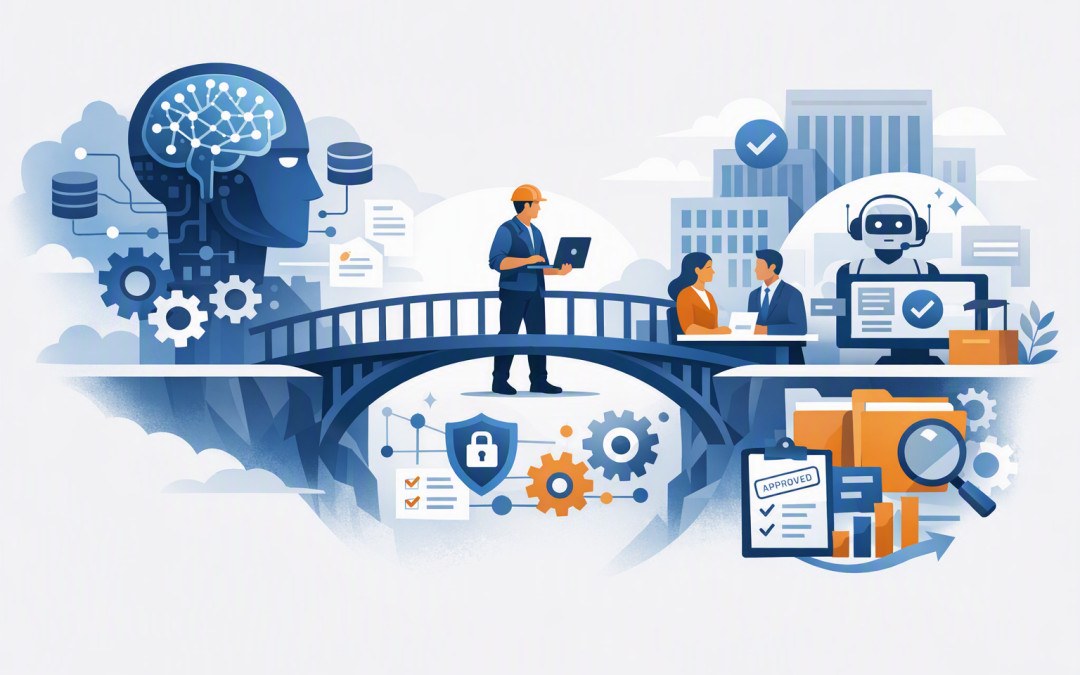
In this blog post How Forward Deployed Engineers Build Custom AI Agents That Work we will explain how a forward deployed engineer turns a costly, repetitive business process into a secure AI system that produces measurable results.
Many businesses already have access to powerful AI, but their employees still copy information between systems, search through old documents and spend hours preparing routine reports. The problem is rarely a lack of AI tools. It is the gap between a general-purpose AI model and the way your business actually operates.
A forward deployed engineer closes that gap. They are a senior engineer who works directly with business leaders, employees and internal IT teams to understand a problem, build a tailored AI agent and improve it using feedback from the people doing the work.
What a custom AI agent actually is
A custom AI agent is software that uses an AI model to understand a request, find relevant information and complete approved steps. Unlike a public chatbot, it is designed around a particular business process, set of data and security policy.
For example, an internal service agent might read a support request, search approved technical documents, check the user’s device details and prepare a recommended response. It could then create a ticket, but only after an employee reviews the proposed action.
The difference between an agent and a basic chatbot is its ability to use tools. Modern agent platforms can connect AI models to document search, business applications, code and approved external services. The AI decides which available tool is relevant, while the surrounding application controls what information and actions are permitted.
The technology behind a business AI agent
The technology can sound complicated, but most business agents contain six understandable parts.
1. The AI model
The model is the reasoning engine. It interprets questions, works with written information and decides which approved step to take next.
Depending on the requirements, this could involve OpenAI, Anthropic Claude or a model available through Microsoft Foundry, which provides managed services for building and operating AI applications and agents in Azure. The best model is not automatically the largest or most expensive one. It is the model that provides acceptable accuracy, speed and cost for the task.
2. Clear instructions
Instructions define the agent’s role, boundaries and expected output. They might tell it to answer only from approved documents, use plain English and ask an employee for approval before changing a customer record.
This is more than writing a clever prompt. A forward deployed engineer converts business rules, exceptions and escalation paths into instructions the system can apply consistently.
3. Trusted business knowledge
An agent often needs access to policies, product information, contracts, customer records or operating procedures. Rather than trying to train a new AI model on everything, the system can retrieve relevant information when a request is received.
This approach is commonly called retrieval-augmented generation. In plain English, the agent searches approved company information first and gives that material to the model before it answers.
4. Tools and integrations
Tools allow the agent to perform useful work. A tool might search SharePoint, read a record from a customer relationship management system, check stock availability or create a draft service ticket.
Integrations are where much of the real engineering happens. The engineer must deal with unreliable data, duplicate records, old application interfaces and processes that contain undocumented exceptions.
5. Identity and security controls
The agent should not receive unlimited access simply because it uses AI. It needs a verified identity, minimum necessary permissions and controls that respect the access rights of the signed-in employee.
This also supports the Essential Eight, the Australian government’s cybersecurity baseline. Controls such as multi-factor authentication, restricted administrator access, application control, patching and reliable backups remain relevant when AI agents connect to business systems.
6. Monitoring and evaluation
Production agents need logs showing what information was accessed, which tools were used and whether an action succeeded. They also need regular testing for accuracy, security and unexpected behaviour.
Without monitoring, an agent can appear successful while quietly producing incomplete answers or creating extra work for employees.
How a forward deployed engineer builds the agent
The process starts with the workflow, not the model. This builds on the approach described in how forward deployed engineers align business and technology teams.
Step 1. Define one measurable problem
“We want an AI agent” is not a useful project goal. “Reduce the time required to prepare a first response to support requests from 20 minutes to five minutes” is measurable.
The engineer observes how the work is currently completed, including delays, manual checks and exceptions. This prevents the business from automating a process that should have been simplified first.
Step 2. Set a safe boundary
The next decision is what the agent can do by itself and what requires human approval. An agent may be allowed to search documents and draft responses, while sending emails, approving refunds or changing financial records remains with an authorised employee.
Starting with a narrow boundary reduces risk and makes it easier to prove value. More autonomy can be added after the system has demonstrated reliable performance.
Step 3. Build the connections
The engineer connects the agent to the smallest possible set of trusted data and tools. A simplified agent definition might look like this:
{
 "goal": "Prepare an accurate first response to support requests",
 "knowledge": ["approved support guides", "product policies"],
 "tools": ["search_documents", "create_draft_ticket"],
 "approval_required": ["send_email", "update_customer_record"],
 "access": "use the signed-in employee's permissions"
}
The real implementation requires authentication, error handling, security testing and detailed business rules. However, this simple structure shows that the model is only one component of the complete system.
Step 4. Test with real work
A polished demonstration proves very little. The agent needs to be tested against real requests, incomplete documents, unusual customer situations and attempts to make it ignore its instructions.
The engineer records where it succeeds, where it fails and when employees override its recommendation. This practical feedback loop is also central to improving AI project delivery.
Step 5. Release gradually and measure results
The first production release might involve five employees rather than the entire company. Results can then be measured against the original baseline before wider access is approved.
Useful measures include time saved per request, error rates, employee adoption, customer response times, cost per completed task and the percentage of outputs requiring correction.
A practical business scenario
Consider a 180-person professional services company where 12 operations employees each spend about 45 minutes a day searching project folders, checking procedures and preparing status updates.
That adds up to roughly 198 hours each month. At an employment cost of $60 per hour, the process consumes nearly $11,900 in staff time monthly.
A forward deployed engineer could build an internal agent that searches approved project documents, retrieves current information and prepares a standard update for employee review. If it reduced the task by only half, the company could recover around 99 hours each month while improving consistency.
The agent would not need permission to edit contracts, send client communications or view every company folder. Its access would be limited to the information required for that specific job.
Why the forward deployed approach matters
Traditional software projects often move through separate discovery, design, development and support teams. Important context is lost at every handover, and employees may not see the solution until late in the project.
A forward deployed engineer stays close to the work. They can change an instruction, integration or approval rule as soon as real users reveal a problem.
This is why the role has become valuable for companies trying to move beyond AI experiments. Our guide to why businesses are hiring senior forward deployed engineers explains the wider delivery gap they address.
What a successful agent should deliver
- Lower operating costs by reducing repetitive searching, data entry and document preparation.
- Faster service by giving employees relevant information when they need it.
- Lower security risk through restricted permissions, approval steps and activity logs.
- Better consistency by applying approved policies and formats across repeated tasks.
- Measurable productivity based on completed work rather than impressive demonstrations.
CloudPro Inc brings more than 20 years of enterprise IT experience to this work. As a Melbourne-based Microsoft Partner and Wiz Security Integrator, the team combines hands-on knowledge of Azure, Microsoft 365, OpenAI, Claude, identity and cybersecurity rather than treating the agent as an isolated AI project.
The goal is not to give AI control of the business. It is to give employees a carefully designed system that removes low-value work while keeping important decisions, permissions and accountability in the right hands.
If you have an AI idea but are unsure how it would connect to your data, systems and security requirements, CloudPro Inc is happy to help assess it. A short review can often show whether the opportunity is worth pursuing before you commit serious time or budget.
Discover more from CPI Consulting
Subscribe to get the latest posts sent to your email.