
In this blog post How an Enterprise LLM Gateway Controls Claude Costs and Usage we will explain how to stop Claude usage from becoming an unmanaged and unpredictable business expense.


The problem often starts quietly. One team builds a Claude-powered application, another creates an internal assistant, and several developers receive separate API keys. The pilots work, but finance cannot see which department is spending money, security cannot confirm what data is being sent, and IT has no reliable way to stop a runaway workload.
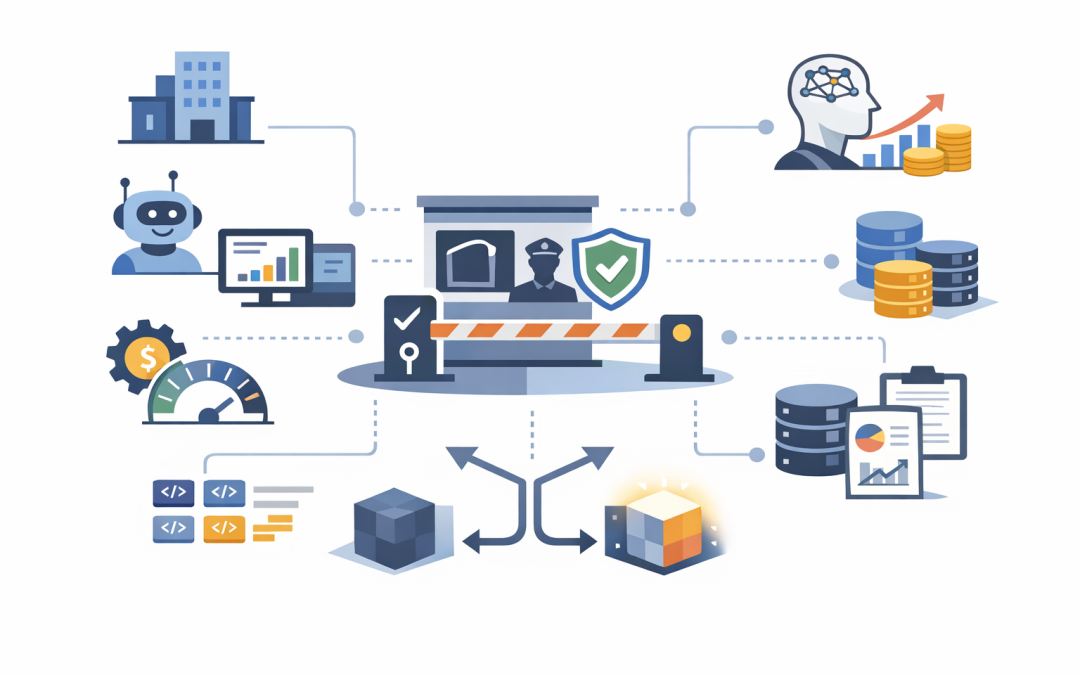
An enterprise large language model gateway solves this by placing one controlled checkpoint between your business applications and Claude. Instead of every application connecting directly to Anthropic, requests pass through the gateway first, where your organisation can check identity, apply limits, record usage and decide which Claude model may be used.
What an enterprise LLM gateway actually does
An LLM gateway is similar to a reception desk for your AI traffic. Every request arrives at the same place, is checked against company rules and is then passed to the approved AI service.
The gateway does not replace Claude. It controls how your applications use Claude through its API, which is the secure connection software uses to send instructions and receive responses.
For Microsoft-based organisations, Azure API Management is one practical gateway option. It can sit in front of the Anthropic Messages API and apply policies for authentication, token limits, quotas, routing and monitoring.
Tokens are the small units used to measure the text Claude reads and generates. Longer documents, larger conversation histories and detailed responses consume more tokens, which generally means higher costs.
Why direct Claude connections become difficult to manage
Direct connections are convenient during a pilot. A developer creates an API key, adds it to an application and starts testing within hours.
The difficulty appears when that pattern is repeated across ten or twenty applications. You may end up with different keys, inconsistent security settings and no common way to answer basic management questions.
- Which department is using the most Claude capacity?
- Which application caused yesterday’s usage spike?
- Are teams using expensive models for routine work?
- Can we stop one application without affecting every other service?
- Are prompts or responses being stored in logs?
- Will we know before the monthly budget is exceeded?
Anthropic’s own account limits remain useful, but an enterprise gateway lets you apply your organisation’s rules across departments, applications and business units. It also gives you a consistent control point if you later use Claude through multiple cloud or service arrangements.
Five controls that keep Claude spending predictable
1. Give every application its own identity
Do not let several applications share one Claude API key. If they do, usage becomes difficult to separate and a leaked credential can affect every connected service.
The gateway should identify each application, department or workload before forwarding its request. This gives you an audit trail and allows access to be removed from one service without disrupting the rest of the business.
User access inside Claude should also be governed separately. Our guide to governing Claude Enterprise with SSO and the Compliance API explains how to control employee access and create a suitable audit trail.
2. Set token quotas by department or application
A request count is not an effective budget control. One request might ask Claude to rewrite a short email, while another could process a large contract and produce a detailed report.
Token quotas provide a more useful measure because they reflect how much text the service processes. A gateway can apply a monthly quota to each application and a shorter per-minute limit to reduce sudden spikes caused by software errors or misuse.
For example, the marketing assistant might receive a moderate monthly allowance, while an approved document-processing system receives a larger one. A prototype can have a deliberately low quota until its business value and expected cost are proven.
Token limits are not exact dollar limits because prices can differ by model, provider arrangement, caching and response type. The gateway should therefore combine quotas with cost reporting and alerts based on current pricing.
3. Route routine work to the right model
The most capable Claude model is not automatically the right choice for every task. Using a premium model for basic classification, summarisation or formatting can increase costs without producing a meaningful business benefit.
A gateway can expose approved service levels. Routine work can use a cost-effective model, while complex analysis or high-value decision support is allowed to use a more capable model.
This decision should be based on testing rather than assumptions. Compare response quality, speed and cost using real business tasks, then document which model is approved for each workload.
Model routing also reduces application changes. Your software connects to the gateway, while the model selected behind it can be updated after testing without distributing new provider credentials throughout the organisation.
4. Track usage in business terms
A useful dashboard should show more than total token consumption. CIOs and finance teams need to see usage by department, application, model, environment and business owner.
For example, a monthly report might show that the customer service assistant used 35 per cent of the AI budget but reduced average case preparation time by eight minutes. That connects spending to a measurable result instead of treating AI as an unexplained technology bill.
Set alerts at practical thresholds, such as 50, 75 and 90 per cent of the approved monthly allowance. The workload owner then has time to investigate before a hard limit interrupts a business process.
5. Log carefully without creating a privacy problem
Detailed logs can help investigate errors, but storing every prompt and response may create a new security and privacy risk. Claude requests may contain employee information, customer records, commercial documents or other sensitive data.
Start by recording metadata such as the application identity, model, token count, response time and result. Only log prompt or response content when there is a clear, approved reason, and apply suitable access controls, masking and retention periods.
This is particularly important for Australian organisations handling personal information under the Privacy Act and Notifiable Data Breaches scheme. An AI gateway supports oversight, but it does not automatically satisfy privacy obligations or the Essential Eight, the Australian government’s cybersecurity framework that many organisations use to reduce common attacks.
A practical Azure API Management example
The following simplified policy shows the basic idea. It gives each API Management subscription a per-minute token limit and an illustrative monthly quota before forwarding requests to Claude.
<policies>
 <inbound>
 <base />
 <llm-token-limit
 counter-key="@"
 tokens-per-minute="60000"
 token-quota="5000000"
 token-quota-period="Monthly"
 estimate-prompt-tokens="true"
 remaining-quota-tokens-header-name="x-ai-tokens-remaining" />
 </inbound>
 <backend>
 <base />
 </backend>
 <outbound>
 <base />
 </outbound>
 <on-error>
 <base />
 </on-error>
</policies>
The numbers above are examples, not recommended production limits. Your quotas should be based on expected transaction volumes, acceptable monthly costs and the importance of the business process.
Applications also need to handle limit responses properly. A customer-facing system should not simply fail without explanation because its quota has been reached. It may need to retry later, use an approved lower-cost route or notify the service owner.
If Claude is being added to a Microsoft application, our article on integrating the Claude API into .NET and ASP.NET Core safely covers the wider application design considerations.
What this looks like in a 200-person business
Consider a professional services firm with three Claude projects. Marketing uses it for first drafts, operations summarises internal documents, and a development team is testing an agent that can perform tasks across business systems.
Without a gateway, all three workloads use separate keys and report costs differently. When spending rises, IT has to inspect each application manually and cannot easily tell whether the increase came from genuine demand, an overly long prompt or a software loop.
With a gateway, each workload receives its own identity and monthly allowance. Marketing is restricted to an approved standard model, operations receives a larger document-processing quota, and the agent is placed in a tightly controlled test environment.
The business can now see cost by use case, detect unusual spikes and stop one workload without disabling the others. More importantly, management can compare each project’s cost with the hours saved or service improvement delivered.
Agents and connected business systems need additional controls because they can take actions, not just generate text. See our guides to designing secure tool use for Claude agents and connecting Claude to business systems with MCP safely.
A sensible implementation plan
- Find every Claude connection. Identify applications, scripts, agents, API keys, owners and current monthly usage.
- Define business owners. Every workload needs someone accountable for its purpose, budget and data handling.
- Create separate gateway identities. Do not group unrelated applications under one credential or quota.
- Set conservative starting limits. Use actual pilot data, then adjust quotas as demand becomes clearer.
- Build dashboards and alerts. Report both consumption and the business result each workload is expected to produce.
- Test failure conditions. Confirm what users see when a rate limit, monthly quota or provider outage occurs.
- Review quarterly. Remove abandoned pilots, adjust model choices and confirm that logging still matches privacy requirements.
Control does not have to slow AI adoption
An enterprise LLM gateway is not about placing unnecessary barriers around Claude. It gives teams a safe and financially responsible path from experimentation to production.
The business outcome is straightforward: clearer AI spending, fewer surprise bills, faster investigation of problems and better evidence that each Claude workload is producing value.
CloudPro Inc brings more than 20 years of enterprise IT experience to this work as a Microsoft Partner and Wiz Security Integrator. We help organisations design practical controls across Azure, Microsoft 365, Claude, OpenAI, Microsoft Defender and Wiz without turning a useful AI project into a giant governance exercise.
If you are not sure how many applications are connecting to Claude, who owns the spending or whether your current limits are meaningful, we are happy to take a practical look at the setup with you — no strings attached.
Discover more from CPI Consulting
Subscribe to get the latest posts sent to your email.