
In this blog post Why Google AlphaEvolve Changes Complex Business Optimisation we will explain how Google’s new optimisation agent works, where it may deliver measurable business value, and what CIOs and CTOs should check before approving a pilot.


If your organisation has a planning, scheduling or computing problem that keeps consuming money despite years of improvement work, the issue may not be staff performance. You may be dealing with too many possible combinations for people and conventional software to test efficiently.
Google made AlphaEvolve generally available on its Gemini Enterprise Agent Platform on 9 July 2026. It is designed to search through possible algorithms—the step-by-step rules software follows—and find versions that perform better against measurable goals.
What AlphaEvolve does in plain English
AlphaEvolve is not another chatbot for writing emails or summarising meetings. It is an AI agent built for complex problems where the answer can be expressed as computer code and objectively tested.
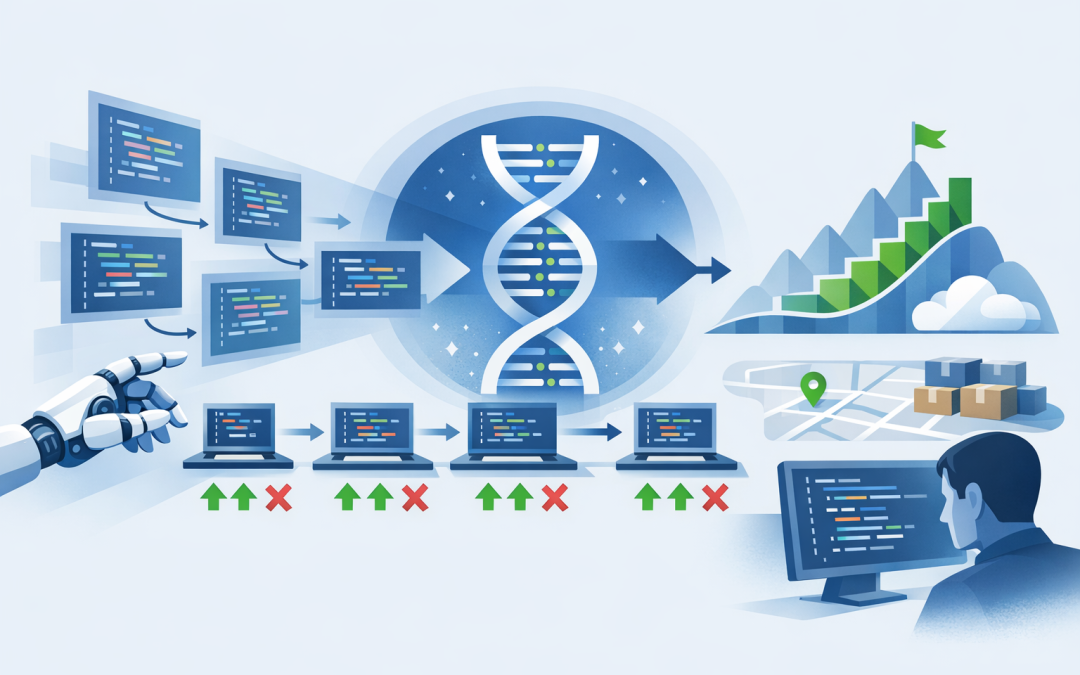
You give it an existing algorithm, define what “better” means, and establish rules that every proposed solution must follow. AlphaEvolve then creates many variations, tests them and uses the strongest results to produce another generation of candidates.
This approach is called evolutionary optimisation. It is similar to selective breeding: retain the candidates with useful characteristics, modify them, test the next generation and repeat the process.
Under the hood, Gemini models generate possible programs. Automated evaluators then run and score those programs, while an evolutionary system decides which candidates are worth developing further. The result is human-readable code rather than a recommendation that cannot be inspected.
Why general availability matters
AlphaEvolve began as a Google DeepMind research project and later entered private preview on Google Cloud. General availability moves it closer to a product organisations can assess for production workloads rather than an interesting laboratory demonstration.
That does not make it a plug-and-play optimisation button. Your team still needs a clear problem, reliable historical data, an existing baseline and a trustworthy way to score each proposed solution.
Google describes the process in four stages:
- Define: Supply a starting algorithm and explain the business problem.
- Measure: Create a scoring function covering accuracy, speed, cost and operating constraints.
- Optimise: Let AlphaEvolve generate and test alternative code.
- Apply: Validate the winning algorithm before introducing it into production.
The evaluator is the most important part. If your business measures the wrong outcome, the system can produce an impressive answer to the wrong question.
Where businesses could find practical value
Supply chain and inventory planning
A distributor may need to balance customer demand, warehouse capacity, delivery times, supplier delays and the cost of holding stock. Improving one measure can easily make another worse.
AlphaEvolve could search for planning rules that reduce excess inventory without damaging order fulfilment. The outcome is not simply “better AI”; it could mean less cash tied up in stock and fewer urgent freight costs.
BASF Agricultural Solutions used AlphaEvolve to help model a supply network involving 180 production sites and more than 5,000 value chains. The system used historical demand, inventory and production information to develop algorithms that more closely represented real operational decisions.
Workforce and job scheduling
Field service, healthcare, construction and maintenance businesses frequently schedule people across locations while accounting for qualifications, travel, availability and service commitments.
A better scheduling algorithm could reduce overtime and travel while increasing the number of jobs completed each day. However, employee safety, industrial agreements and human approval must remain firm constraints rather than optional scoring preferences.
Cloud and software performance
Some organisations spend heavily on cloud infrastructure because a small number of calculations run millions of times. Even a modest improvement in those calculations can reduce cloud consumption or shorten processing windows.
This is where AlphaEvolve differs from general AI coding tools. Products such as those discussed in our article on preparing engineering teams for AI coding agents can help developers complete everyday work. AlphaEvolve focuses on searching for a measurably better algorithm.
What the scoring process looks like
The following simplified example is not production AlphaEvolve code. It shows how a company might express its priorities when assessing a delivery-planning algorithm.
def score(candidate_plan):
 if not passes_safety_rules(candidate_plan):
 return {"valid": 0, "business_score": 0}

 delivery_cost = calculate_delivery_cost(candidate_plan)
 late_orders = count_late_orders(candidate_plan)
 overtime_hours = calculate_overtime(candidate_plan)

 return {
 "valid": 1,
 "cost_reduction": baseline_cost - delivery_cost,
 "service_quality": -late_orders,
 "overtime_control": -overtime_hours
 }
This example prevents the AI from declaring success simply because it found the cheapest plan. Late deliveries and excessive overtime are also measured, while safety rules act as a hard gate.
Google’s guidance similarly requires an evaluation process that securely runs candidate code and returns clear metrics. The sharper your definition of success, the more useful the search process becomes.
A realistic mid-market scenario
Consider a hypothetical Australian distributor with 200 employees, two warehouses and a national delivery network. Its planners spend hours adjusting routes and stock transfers, yet the company still pays for urgent transport and regularly holds too much slow-moving inventory.
AlphaEvolve should not begin with the entire supply chain. A sensible pilot might focus on one state, one warehouse or one product category.
The company could compare the existing planning algorithm with AlphaEvolve candidates using six months of historical data. Success would be defined before the pilot begins: for example, lower freight cost and stock levels without reducing on-time delivery.
This creates a defensible investment decision. If the improved algorithm cannot produce meaningful savings after implementation and governance costs, the company stops. If it can, the pilot expands gradually.
The risks Australian leaders should address
AlphaEvolve generates code, and generated code should never move directly into production. Candidate programs need isolated testing, security review, source control, approval records and a rollback plan.
The Essential Eight—the Australian Government’s baseline cybersecurity framework—remains relevant. Application control, patching, restricted administrative access and multi-factor authentication can help protect the environment surrounding an AI optimisation project, although Essential Eight alignment alone does not make an AI system safe.
Privacy also needs early attention. Historical workforce, customer or operational datasets may contain personal or commercially sensitive information. The Office of the Australian Information Commissioner advises organisations to assess privacy risks before placing personal information into commercial AI products.
Australian organisations should also confirm where information is stored and processed rather than assuming local data residency. Product availability, regional controls and account access may differ, so these questions belong in the initial architecture and procurement review.
How to decide whether AlphaEvolve is worth a pilot
- Choose a costly bottleneck: Start where delays, cloud consumption, inventory or manual planning already have a measurable financial impact.
- Confirm the problem can be coded: AlphaEvolve needs an algorithmic problem, not a vague goal such as “improve operations”.
- Create a trusted baseline: Record current cost, speed, accuracy and service outcomes before testing alternatives.
- Set hard constraints: Security, safety, compliance and customer commitments should not be traded away for a higher score.
- Require human approval: Specialists must understand, test and approve the resulting code.
- Calculate total cost: Include cloud resources, integration, testing, governance and ongoing monitoring—not just the AI licence.
This assessment should also form part of a broader platform decision. Our practical AI vendor selection framework explains why security, deployment fit and exit options matter as much as headline model performance.
The business case comes before the technology
AlphaEvolve is potentially valuable because it targets problems where small algorithmic gains can create large financial results. But it will not repair poor data, unclear objectives or weak governance.
CloudPro Inc brings more than 20 years of enterprise IT experience across cloud, AI and cybersecurity. As a Melbourne-based Microsoft Partner and Wiz Security Integrator, we can also help technology leaders assess how a Google optimisation service would fit alongside Azure, Microsoft 365, OpenAI, Claude, Defender and existing security controls.
If you have a complex planning or computing problem but are unsure whether AlphaEvolve is practical, we are happy to help define a small, measurable pilot—or tell you when a simpler solution would deliver a better return.
Discover more from CPI Consulting
Subscribe to get the latest posts sent to your email.