
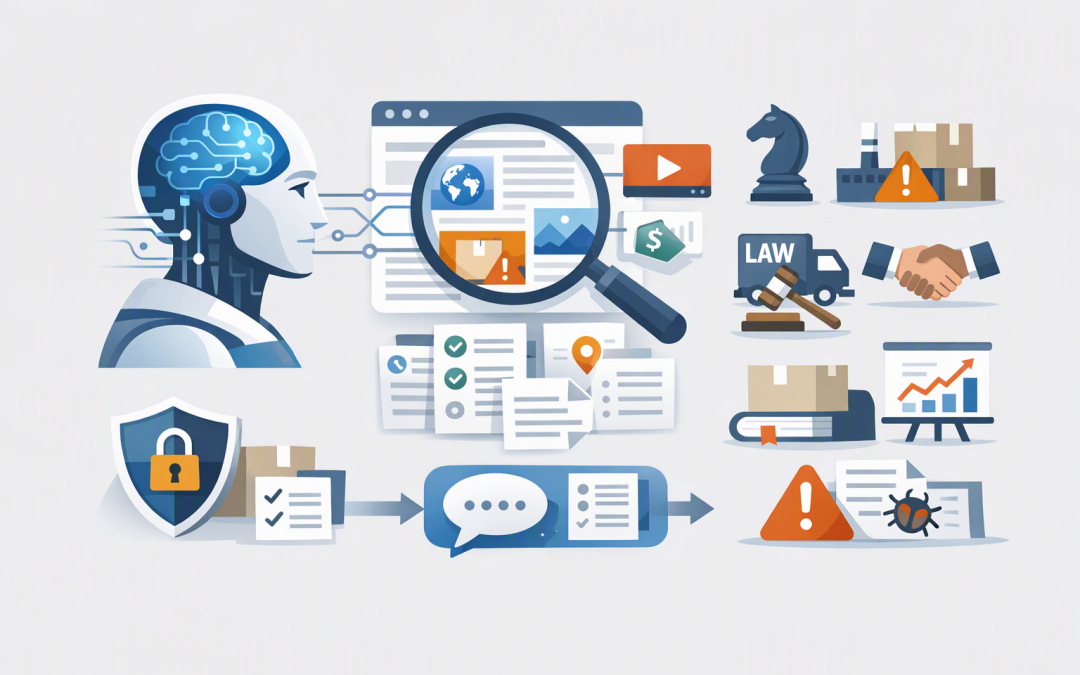
In this blog post Grounding AI Agents with Web IQ Five Use Cases CIOs Should Know we will explain where live web information can improve business AI, where it can create risk, and what CIOs should ask before approving it.
Many AI agents perform well in demonstrations but struggle in day-to-day business. They can summarise internal documents, yet give outdated answers when asked about a competitor, regulation, supplier disruption or recent market change.
Web IQ addresses this gap by giving an AI agent access to current information from public web pages, news, images and videos. Instead of relying only on what the AI model learned during training, the agent can retrieve relevant evidence when a question is asked.
How Web IQ grounding works
Web IQ is a set of search and grounding services built for AI applications. Grounding simply means giving an AI model reliable information to use before it produces an answer.
CPI Consulting helps organisations design, build and secure Azure AI solutions, from Azure OpenAI and Microsoft Foundry to agents, governance and production deployment.
Visit CPI ConsultingThe agent first identifies what information it needs. Web IQ searches for relevant material and returns structured results, including the source, publishing details and the most useful sections of content. The AI model then uses that evidence to prepare its response.
Importantly, Web IQ is not the AI model itself. It is the information layer sitting between the open web and models such as those from OpenAI, Microsoft or Anthropic Claude.
This distinction matters. You still need controls around which websites can be searched, what information can be sent in a query, how sources are displayed and whether the agent is allowed to act on what it finds.
Our earlier guide explains how Web IQ gives business AI agents trusted live web information. The next question is where that capability creates enough business value to justify the cost and governance effort.
1. Competitive and market intelligence
Quarterly competitor reports often start becoming outdated the moment they are published. Product launches, price changes, acquisitions and new partnerships may happen weeks before the next formal review.
A Web IQ-grounded research agent can monitor selected competitor websites, product documentation, industry publications and public announcements. It can compare new findings with previous reports and flag meaningful changes for review.
For example, a 200-person software company could use an agent to prepare a weekly summary of competitor pricing and product changes. Its product team would spend less time searching and more time deciding whether a change actually affects the roadmap.
Governance questions for the CIO
- Which sources are approved, and should searches be limited to selected domains?
- Can employees open and verify the evidence behind each claim?
- How will the agent separate confirmed announcements from speculation?
- Could confidential product plans accidentally be included in search queries?
The outcome should be faster research and better decisions, not an automated stream of unverified competitor rumours.
2. Regulatory and compliance monitoring
Regulatory change is difficult to track because information is spread across government websites, consultation papers, regulator announcements and industry updates. Missing one material change can create expensive remediation work later.
A grounded agent can monitor nominated sources and alert legal, risk or IT leaders when relevant guidance changes. An Australian organisation might track privacy developments, sector regulations and cybersecurity guidance from the Australian Signals Directorate.
The agent could also compare new guidance with internal policies and identify areas requiring human review. It should not declare the organisation compliant, but it can reduce the manual work needed to identify possible gaps.
Governance questions for the CIO
- Are official government and regulator sources given priority?
- Who confirms whether an update actually applies to the business?
- Is there an audit trail showing what the agent found and when?
- Can alerts be routed to the accountable policy owner rather than a general inbox?
This can support programs such as the Essential Eight, the Australian Government’s cybersecurity framework for reducing common security risks. However, web monitoring does not replace a proper Essential Eight assessment or legal advice.
3. Supplier and operational risk monitoring
Operations teams often learn about supplier problems after delivery dates have already slipped. The warning signs may have appeared earlier in weather notices, port updates, product recalls, security advisories or company announcements.
A Web IQ-grounded agent can monitor external developments affecting key suppliers and compare them with internal purchasing or delivery data. It might identify that a major shipment is linked to an affected port, then ask an operations manager to investigate alternatives.
Consider an Australian distributor waiting for equipment from three overseas vendors. An agent could prepare a morning exception report covering shipping disruptions, vendor announcements and relevant security alerts, rather than asking staff to check dozens of websites.
Governance questions for the CIO
- Which suppliers and risk events are important enough to monitor?
- How fresh must the information be before it becomes useful?
- What happens when reliable sources disagree?
- Can the agent recommend an action without automatically placing orders or contacting suppliers?
The first rollout should normally inform people rather than act independently. Human approval is essential when an agent’s recommendation could affect contracts, spending or customer commitments.
4. Customer service using current external information
Customers expect support teams to know about live delivery conditions, product recalls, service outages and policy changes. Yet many service agents only have access to internal knowledge articles that may be days or months out of date.
Web grounding can help a customer service agent combine approved internal information with current external facts. For example, it could check a carrier’s public service notice before explaining why a delivery is delayed.
This can reduce handling time and unnecessary escalations. It also creates risk if the AI treats a search result as company policy or provides advice based on an unreliable source.
Governance questions for the CIO
- Which external sources can be used in customer-facing responses?
- Should the agent draft a response for approval or send it automatically?
- How will personal information be kept out of public web searches?
- What wording is required when information comes from a third party?
Australian privacy obligations still apply when AI is involved. Customer names, order details, health information and other personal data should not be placed into external searches without a clearly assessed and approved reason.
5. Sales and account preparation
Sales teams regularly spend hours preparing for meetings, only to find that their account notes do not include a recent acquisition, leadership change or strategic announcement.
A grounded sales agent can combine approved customer records with current public information. It could produce a short briefing covering recent announcements, likely discussion points and questions the salesperson may want to ask.
The business outcome is not simply faster research. Better preparation can improve the quality of customer conversations while reducing the administrative work that pulls salespeople away from customers.
Governance questions for the CIO
- Can the agent access only the accounts assigned to that employee?
- Are public facts clearly separated from internal sales notes?
- Could the agent create unfair or sensitive profiles of individuals?
- How will inaccurate information be corrected and recorded?
Access controls are particularly important when external intelligence is combined with CRM records, emails or internal documents. Our CIO guide to governing enterprise AI agents explains how identity, permissions and auditability fit together.
The governance controls every use case needs
CIOs do not need a separate governance framework for every agent. A consistent set of controls can cover most Web IQ use cases.
- Approved sources. Decide whether the agent can search the open web or only an approved list of websites.
- Data protection. Prevent confidential or personal information from being included in web queries.
- Evidence and audit logs. Record the sources used, the response produced and any action taken.
- Human approval. Require a person to approve decisions affecting customers, money, legal obligations or operations.
- Security testing. Test how the agent responds to misleading or malicious instructions hidden on web pages.
- Cost controls. Monitor search volume, model usage and repeated queries so a useful agent does not become an uncontrolled monthly expense.
These controls should sit within the organisation’s broader AI operating model. Microsoft Foundry can provide a central place to manage models, agents and policy, as covered in our guide to Microsoft AI Foundry governance and AI risk.
Start with one decision, not the entire web
The best first use case is usually narrow, measurable and easy to supervise. Choose one recurring decision where outdated information creates obvious cost, delay or risk.
Define the approved sources, expected output, accountable owner and human approval point before connecting the agent. Then measure time saved, answer quality, source reliability, operating cost and the number of corrections required.
CloudProInc brings more than 20 years of enterprise IT experience to this work. As a Microsoft Partner and Wiz Security Integrator, we help organisations connect AI services to Azure and Microsoft 365 while maintaining practical security, identity and governance controls.
If you are unsure which Web IQ use case is worth funding, or whether an existing agent is searching the web safely, our Melbourne-based team is happy to take a practical look with you — no strings attached.