
In this blog post Microsoft Agent Framework Release Cadence and Version Governance we will explain how to keep production AI agents stable while Microsoft continues to release new features, fixes and security improvements.
The problem is familiar. An AI agent works well in testing, reaches production, and then a framework update changes how it uses tools, stores conversations or completes a workflow. The update may be valuable, but applying it without controls can turn a routine software change into a business interruption.
What Microsoft Agent Framework actually does
Microsoft Agent Framework is the software layer used to build and operate AI agents in .NET and Python. It connects the AI model to business instructions, company data, software tools, approval steps, memory and multi-agent workflows.
In plain English, the model provides the intelligence, while the framework controls how the agent gets work done. It can decide when to search a knowledge base, call a business system, ask a person for approval or hand work to another agent.
CPI Consulting helps organisations design, build and secure Azure AI solutions, from Azure OpenAI and Microsoft Foundry to agents, governance and production deployment.
Visit CPI ConsultingThis makes the framework a critical production dependency. A change can affect more than the wording of an answer. It may alter tool selection, stored conversation data, permissions, workflow recovery or the way one agent communicates with another.
Frequent releases do not require frequent production upgrades
Microsoft Agent Framework has been moving quickly. As of October 2026, its Python and .NET editions have separate version streams, with new releases often arriving within days or weeks of the previous release.
For example, Python 1.22 and .NET 1.25 were released on 15 October 2026. That does not mean every production agent needed to be upgraded on 16 October.
Your team should monitor every release but adopt changes on a timetable that suits the business. For many organisations, a monthly review window works well, supported by an urgent process for serious security or reliability fixes.
This builds on the broader controls covered in our Microsoft Agent Framework release and upgrade governance guide. The extra step is creating a complete, traceable version for each production agent.
Version the whole agent rather than one software package
An agent’s framework package is only one part of its behaviour. The model, instructions, tools, permissions and business data can all change the result.
A production release should therefore record:
- The exact Agent Framework package versions.
- The model deployment and configuration.
- The approved system instructions and prompts.
- Every tool, connector and API version.
- Permissions and human approval rules.
- The data source or search index version.
- The evaluation tests the agent passed.
- The format used to store sessions, messages and workflow progress.
This creates a reproducible release. If an incident occurs, the team can identify exactly what changed instead of asking whether someone edited a prompt, upgraded a package or replaced the model.
A simple release manifest might look like this:
{
 "agentRelease": "service-assistant-3.4.0",
 "framework": {
 "python": "1.22.0"
 },
 "modelDeployment": "approved-model-2026-10",
 "instructionsVersion": "7.2.1",
 "toolBundle": "service-tools-2.8.1",
 "evaluationPack": "service-evals-v12",
 "stateSchema": "4",
 "approvedChange": "CHG-4821"
}
The numbers matter less than consistency. Every deployed agent should have one record showing what is running, who approved it and how it can be restored.
Do not trust version numbers on their own
Agent Framework follows semantic versioning, commonly written as major.minor.patch. This helps indicate the likely size of a software change, but it should not be your only risk test.
AI systems are less predictable than conventional applications. A small framework fix can change when an agent calls a tool, how streamed answers are combined or how provider information is interpreted.
Release notes must be reviewed for four business risk areas:
- Behaviour changes that may affect response quality or tool use.
- Security changes involving permissions, approvals or data handling.
- Dependency changes affecting Microsoft Foundry, Azure OpenAI or other connected services.
- Stored-state changes affecting saved conversations and unfinished workflows.
The October Python 1.22 release demonstrates the last point. Newer workers can read older stored records, but older workers may not understand records written using certain new fields.
For a decision-maker, the practical message is simple. You may not be able to run old and new versions against the same stored conversations during an upgrade, and rolling back may require restoring or isolating that data.
Use controlled release rings
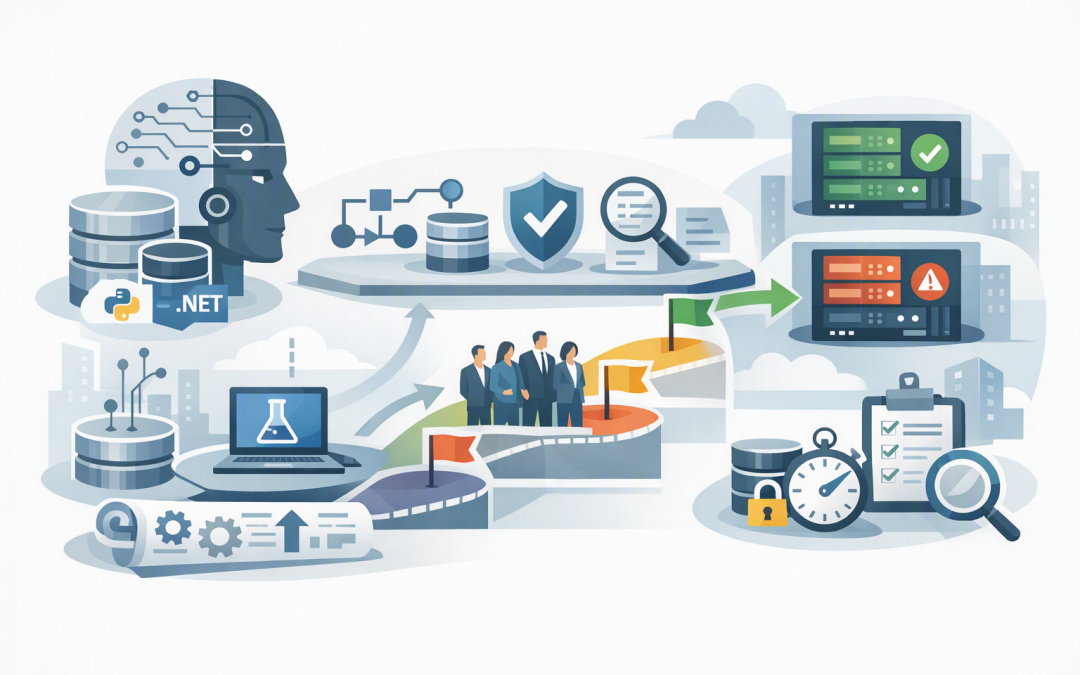
A production upgrade should move through several rings rather than reaching every user at once.
- Development where engineers confirm the agent starts, connects and completes basic tasks.
- Automated evaluation where repeatable tests measure accuracy, safety, cost and tool use.
- Business pilot where a small group tests realistic work with production-like data.
- Limited production where a controlled percentage of work reaches the new version.
- Full production after results remain within approved limits.
This is sometimes called a canary release because a small deployment provides early warning. The business outcome is straightforward: fewer employees and customers are affected if something goes wrong.
Where an update changes stored data, use separate environments or a blue-green deployment. This means keeping the current production version intact while the replacement runs independently, making recovery safer.
Test business outcomes, not just technical availability
An agent responding successfully does not prove it is working correctly. It could provide a convincing but inaccurate answer, select the wrong customer record or bypass an intended approval step.
Your release gate should measure:
- Successful completion of important business tasks.
- Accuracy against approved reference answers.
- Correct tool and data-source selection.
- Compliance with human approval requirements.
- Protection of confidential or personal information.
- Response time and cost per completed task.
- Recovery from interrupted or long-running work.
Security testing should also align with Essential 8, the Australian government’s cybersecurity framework that many organisations use for reducing common attacks. Relevant controls include prompt patching, multi-factor authentication, restricted administrator access and application control, which limits what software can run.
Organisations using agent-to-agent communication or Model Context Protocol, which provides a standard way for agents to access tools and data, should also review our production guide for A2A and MCP governance.
A practical upgrade timetable
For most 50–500 employee organisations, the following model balances speed with control:
- Weekly monitoring of new releases, known issues and security notices.
- Monthly planned upgrades for valuable fixes and stable capabilities.
- Quarterly baseline reviews covering models, prompts, tools, permissions and operating costs.
- Emergency upgrades for serious security or production issues, using an accelerated but documented test process.
Preview packages should normally remain outside critical production workloads. If a preview feature is essential, isolate it, limit its permissions and obtain a written acceptance of the additional risk.
Python and .NET releases should also be governed separately. Their version numbers do not necessarily match, and a capability available in one language may still be experimental or implemented differently in the other.
What unmanaged upgrading looks like in practice
Consider a 200-person professional services business using an agent to classify support requests, search internal procedures and create service tickets. The development team allows packages to update automatically during deployment.
A new framework version changes stored message handling. New servers write records that the older servers cannot read, leaving some requests stuck when traffic moves between versions.
No data breach occurs, but employees return to manual processing while the issue is investigated. The business loses time, service levels fall and the technical team spends days reconstructing which combination of code, prompts and packages was deployed.
Exact version pinning, separate state stores and a limited production ring would have contained the problem. More importantly, a complete release manifest would have made rollback a planned action rather than an emergency experiment.
Governance should make upgrades easier
Good governance is not a committee that delays every release. It is a repeatable process that tells the team what evidence is required, who can approve a change and how to recover if results deteriorate.
Assign a named business owner and technical owner to every production agent. Keep the previous working release available, retain the evidence from each evaluation and require a change record for modifications to models, prompts, tools or permissions.
CloudProInc combines more than 20 years of enterprise IT experience with practical work across Microsoft Azure, Microsoft 365, Microsoft Defender, Microsoft Foundry, OpenAI and Claude. As a Melbourne-based Microsoft Partner and Wiz Security Integrator, we help organisations connect AI release controls with their wider cloud, cybersecurity and Essential 8 obligations.
If you are not sure whether your production agents can be safely upgraded or rolled back, we are happy to review the current setup and identify the highest-risk gaps — no strings attached.