
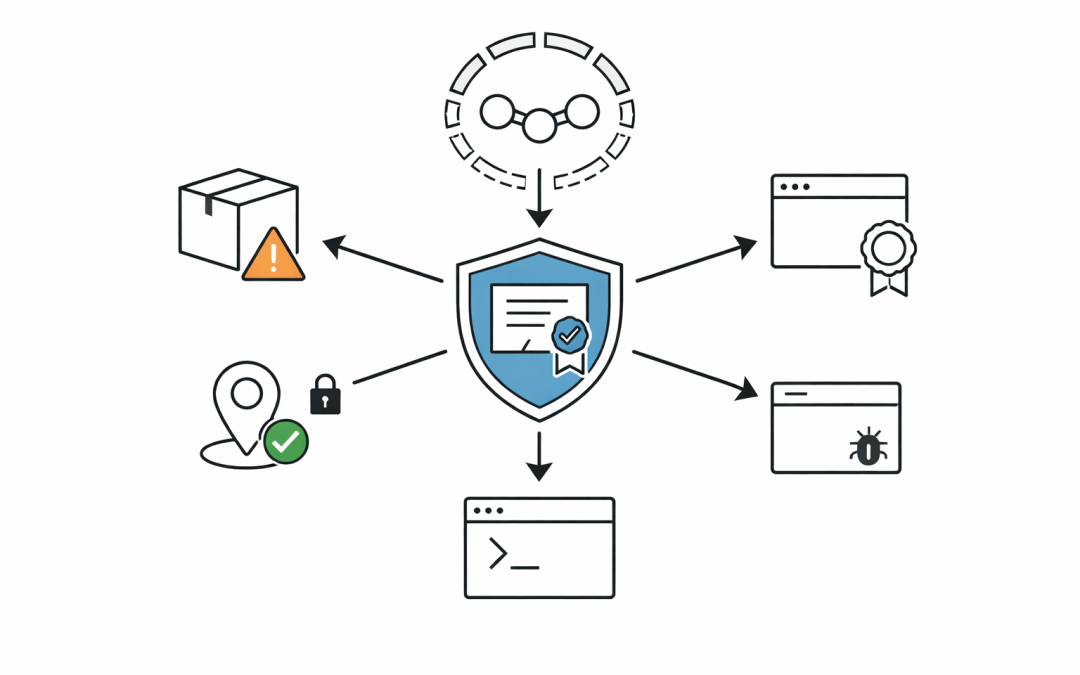
When a North Korean state actor compromised the Axios npm package on March 31, 2026, the blast radius did not stop at developer laptops. It reached OpenAI’s macOS code-signing pipeline — the system that certifies ChatGPT Desktop, Codex, Codex CLI, and Atlas as legitimate OpenAI software.
If a supply chain attack can hit one of the most well-resourced AI companies on the planet, the question for every Australian organisation is not whether this could happen to them. It is whether their dependency governance would detect it before real damage occurs.
What Happened to OpenAI
On March 31, a GitHub Actions workflow used in OpenAI’s macOS app-signing process downloaded and executed a malicious version of Axios (version 1.14.1). Microsoft Threat Intelligence attributed the compromise to Sapphire Sleet, a North Korean state actor that injected a fake dependency, plain-crypto-js@4.2.1, into the Axios package. That dependency ran an install-time hook that connected to attacker command-and-control infrastructure and deployed a remote access trojan.
The compromised workflow had access to the certificate and notarisation material OpenAI uses to sign its macOS applications. If that certificate had been successfully exfiltrated, an attacker could sign their own malicious software to appear as legitimate OpenAI products.
OpenAI disclosed on April 10 that their analysis found the certificate was likely not exfiltrated, due to the timing and sequencing of the payload execution. But they are treating it as compromised regardless. The certificate is being revoked, all affected macOS apps are being re-signed, and older versions will stop working after May 8, 2026.
The Root Cause Was a Configuration Gap, Not a Zero-Day
OpenAI identified the root cause as a misconfiguration in their GitHub Actions workflow. Two specific problems enabled the attack:
The workflow used a floating tag instead of a pinned commit hash. This meant the CI/CD system would pull whatever version was tagged as current, rather than a specific, verified release. When the malicious Axios version appeared, the pipeline fetched it automatically.
There was no configured minimumReleaseAge for new packages. This meant freshly published packages — including ones pushed minutes before by an attacker — were eligible for immediate consumption in production workflows.
These are not exotic misconfigurations. They are common patterns in GitHub Actions workflows across organisations of every size. Most teams default to floating tags because pinning to commit hashes feels like unnecessary overhead. Until an incident like this demonstrates the cost.
Why This Matters Beyond OpenAI
The OpenAI incident turns an abstract supply chain risk into a concrete business scenario that boards and executive teams can understand.
Code-signing certificates are high-value targets. A compromised signing certificate allows an attacker to distribute software that operating systems treat as trusted. For organisations that ship desktop applications, browser extensions, or internal tools, this is a direct path to customer compromise.
CI/CD pipelines are now the primary attack surface for supply chain events. The Axios compromise did not require a vulnerability in the application itself. The malicious code executed during a routine npm install in a build pipeline. Any environment that automatically resolves and installs dependencies during build is exposed to the same pattern.
The attack was attributed to a nation-state actor. Microsoft’s attribution to Sapphire Sleet means this was not opportunistic. North Korean threat actors targeted a widely adopted package to achieve maximum downstream impact. Organisations that assume supply chain attacks are rare or theoretical are operating on outdated assumptions.
Four Dependency Governance Gaps This Incident Exposed
The Axios–OpenAI incident highlights governance failures that are present in many mid-market Australian organisations.
Version pinning is treated as optional. Most teams still use caret or tilde versioning (^1.14.0 or ~1.14.0), which allows automatic resolution to any new minor or patch release. This is the exact mechanism that pulled the malicious version into affected environments. Exact version pinning for critical dependencies — and npm overrides for transitive dependencies — should be standard policy, not an emergency response measure.
CI/CD workflows are not reviewed as security-critical infrastructure. GitHub Actions, Azure DevOps Pipelines, and similar systems routinely have access to secrets, signing certificates, deployment credentials, and cloud environments. A workflow that uses a floating tag reference for a third-party action is accepting the same risk as running unreviewed code with production credentials.
Install-time script execution is broadly allowed. The malicious plain-crypto-js dependency used npm’s postinstall lifecycle hook to launch its payload. Many organisations still allow postinstall scripts by default because parts of the JavaScript ecosystem depend on them. Disabling or sandboxing install-time scripts should be a standard build hardening practice.
Security monitoring does not cover developer tooling. Traditional endpoint detection is tuned for phishing payloads and downloaded malware, not for malicious behaviour triggered by npm install. Network monitoring may not flag outbound connections from build runners to attacker infrastructure because those systems are often treated as trusted internal resources.
What Australian Organisations Should Do Now
The immediate response guidance from Microsoft and OpenAI is clear: check for axios@1.14.1, axios@0.30.4, and plain-crypto-js@4.2.1 across all environments. Roll back to safe versions. Rotate secrets and credentials exposed to any affected system. Review build logs for unexpected package resolution.
The longer-term response is governance reform.
Audit CI/CD pipeline dependencies. Every third-party action, plugin, and package consumed during build should be inventoried. Floating references should be replaced with pinned commit hashes or exact versions. New package versions should require a minimum age before they are eligible for consumption in production workflows.
Segment build system access. Build pipelines should not hold standing access to signing certificates, production deployment credentials, and cloud secrets simultaneously. Adopt short-lived credentials, just-in-time access, and strict scope boundaries for CI/CD runners.
Restrict lifecycle scripts. Where builds do not require postinstall execution, disable it with npm config set ignore-scripts true or use –ignore-scripts during CI. Where lifecycle scripts are necessary, isolate those builds and monitor them aggressively.
Extend security monitoring to build and development environments. Anomalous install-time activity, unexpected outbound connections from build runners, and unusual package resolution patterns should be treated as first-class detection signals.
Map Essential 8 controls to the software supply chain. The ACSC Essential 8 already addresses application control, restricting administrative privileges, and patch management. The Axios incident is a practical test case for whether those controls extend meaningfully to developer tooling and CI/CD infrastructure. In many environments, they do not.
The Governance Question Every Organisation Should Be Asking
OpenAI responded to this incident with transparency, a thorough forensic investigation, certificate rotation, and clear remediation guidance. Most mid-market organisations would struggle to match that response.
The real question is not whether your organisation uses Axios. It is whether you have formal policies governing which dependencies can auto-update, which build workflows can access signing credentials, and how package-origin anomalies are detected and investigated.
If the answer is uncertain, that is a useful starting point for the next security review.
Our team works with Australian organisations to strengthen CI/CD security, dependency governance, and software supply chain controls. If this incident raised questions about how much trust your build pipeline currently assumes, we can help you close those gaps before the next supply chain event.
*CloudProInc is a Microsoft Partner and Wiz Security Integrator, working with Australian organisations on cloud, AI, and cybersecurity strategy.*