
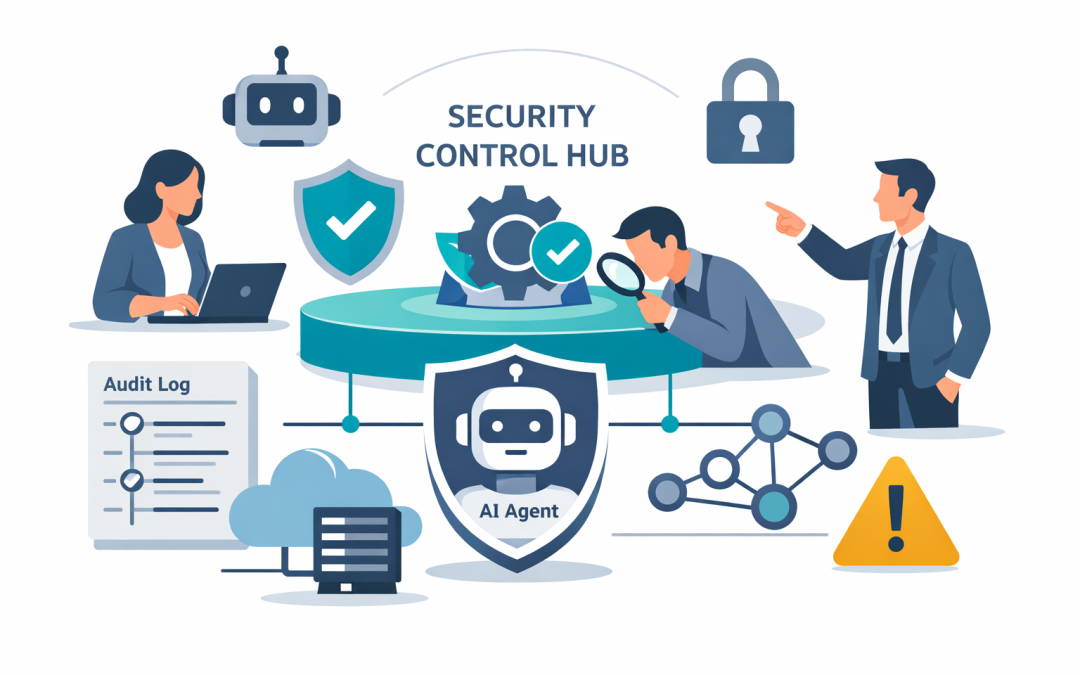
AI agents are moving from pilot projects to production workflows. The organisations that get agent security right early will have a significant competitive advantage. The ones that don’t will learn the hard way why governance can’t be an afterthought.
The Agent Adoption Curve Is Steepening
The shift happened faster than most predicted. Twelve months ago, the enterprise AI conversation was about chatbots and copilots — tools that assist humans with specific tasks. Today, the leading SaaS platforms are building autonomous agent capabilities directly into their products.
Salesforce is deploying Agentforce for service, sales and marketing workflows. ServiceNow is building Autonomous Workforce AI Specialists. Atlassian is embedding agentic AI into Jira and Confluence. SAP is enabling custom agents through Joule Studio. Adobe is building long-running creative and marketing agents.
These aren’t separate products organisations need to buy. They’re capabilities being woven into the platforms mid-market organisations already use every day. Agent adoption isn’t a choice anymore. It’s arriving inside existing software.
Why Security Is the Bottleneck
The capability is there. The governance isn’t.
Traditional security tools were designed for a world where humans use software and software follows deterministic rules. AI agents break both assumptions. They decide what to do based on context. They use tools, access data, make API calls, and can run for extended periods without oversight.
The attack surface is fundamentally different. A chatbot that answers a question incorrectly is an inconvenience. An autonomous agent that leaks customer data to an external model, executes an unauthorised API call, or installs an unverified package is a security incident.
For mid-market organisations, the challenge is acute. Large enterprises can build custom governance layers with dedicated platform engineering teams. Organisations with 50 to 500 employees typically can’t. They need governance that comes built into the platform.
Where NemoClaw Fits
NVIDIA announced NemoClaw at GTC 2026 to address exactly this gap. It’s an open source stack that adds enterprise-grade security and privacy controls to autonomous AI agents.
The core component is OpenShell — a runtime that sits between the agent and the organisation’s infrastructure. It enforces three categories of control that map directly to the security concerns business leaders raise most often.
Access control. Every action an agent attempts is evaluated against a policy engine before execution. File access, network requests, tool usage, and process execution are all governed at a granular level. The default is deny-all. This is the principle of least privilege applied to autonomous software.
Data privacy. A privacy router determines where AI processing happens. Sensitive workloads stay on local hardware using open models. Cloud-based frontier models only receive data when organisational policy explicitly permits it. For Australian organisations operating under the Privacy Act, this hybrid approach addresses data residency concerns directly.
Auditability. Every allow and deny decision is logged. When a compliance team, auditor, or incident responder needs to understand what an agent did and why, the complete decision trail is available. This isn’t model logging. It’s action-level governance.
The Security Vendor Signal
The clearest indicator that agent security is becoming a business priority isn’t NVIDIA’s announcement. It’s who else showed up.
Cisco AI Defense is adding agent governance controls through OpenShell. CrowdStrike unveiled a Secure-by-Design AI Blueprint that embeds Falcon platform protection into NVIDIA agent architectures. Microsoft Security and TrendAI are both building OpenShell compatibility.
When the major security vendors simultaneously prioritise a new category, it’s because their enterprise customers are asking for it. The demand signal is already there. The governance infrastructure is catching up.
What Mid-Market Organisations Should Do Now
The temptation is to wait until agent security tools mature before adopting agents. That’s a mistake. Agents are arriving inside existing SaaS platforms whether organisations are ready or not. The better approach is to prepare the governance framework now.
Audit current AI usage. Understanding which AI tools and models are already in use across the organisation is the foundation. Shadow AI — where teams adopt AI tools without IT oversight — is the agent equivalent of shadow IT, and it’s already happening.
Define data classification for agent access. Which data categories can an AI agent process? Which must stay on-premises? Which require human approval before being sent to a cloud model? These decisions need to be made before agents are deployed, not after an incident.
Engage security vendors. If the organisation uses CrowdStrike, Cisco, or Microsoft security tools, understanding their agent security roadmaps is now a procurement conversation. Ask how they plan to govern agent behaviour within existing security investments.
Assess governance readiness. Can the organisation demonstrate, in an audit, what an AI agent did with customer data on a specific date? If the answer is no, a governance layer — whether NemoClaw, a custom build, or a managed solution — needs to be on the roadmap.
The Competitive Advantage of Early Governance
Organisations that establish agent governance early don’t just reduce risk. They accelerate adoption. When the security team can approve agent deployments because the governance framework is in place, business units can move faster. When the compliance team can demonstrate agent auditability to regulators, the organisation can deploy in regulated use cases that competitors avoid.
Agent security isn’t a cost centre. It’s the enabler that makes the productivity gains accessible.
CloudProInc is a Microsoft Partner and Wiz Security Integrator helping mid-market Australian organisations build AI governance frameworks that enable safe, scalable agent adoption. Whether the starting point is a governance assessment or a full architecture review, getting the foundations right now pays dividends as agent capabilities accelerate.