
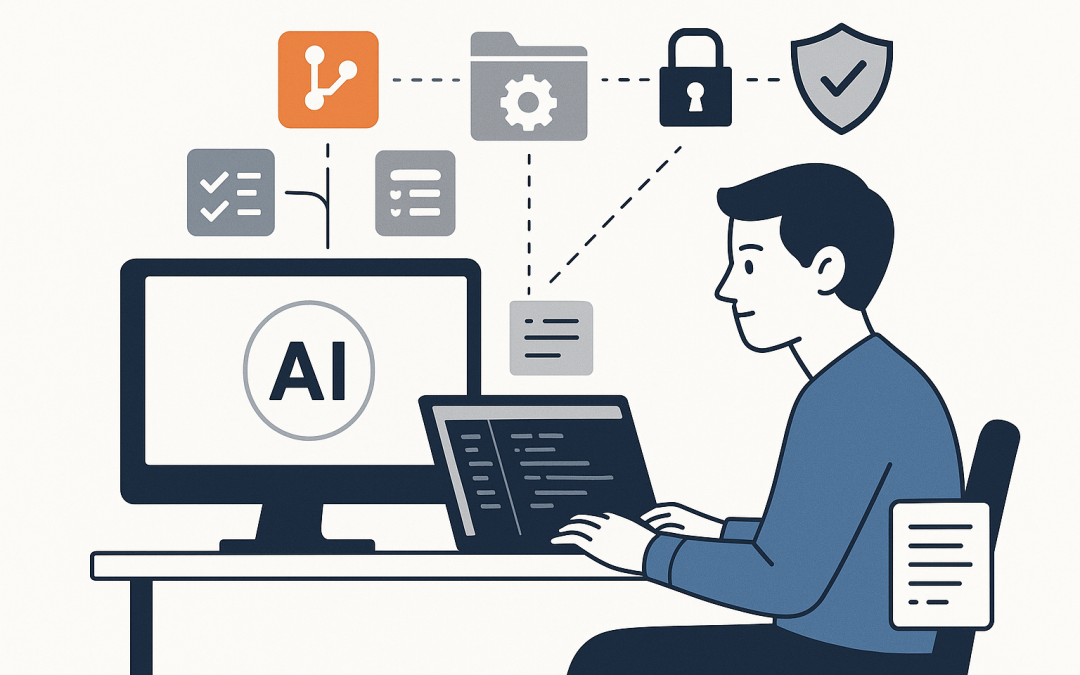
In this blog post What Business Leaders Should Know About AI Driven Engineering we will explain what AI-driven engineering actually means, why it matters now, and how business leaders can adopt it without creating new cost, security or compliance problems.
Most leaders are hearing the same message right now. AI will help developers move faster, reduce backlog, and get more value from existing teams. That is true in part, but it is also incomplete. The real shift is not just faster coding. It is a new way of building software where AI can draft, test, document and even troubleshoot work that used to sit entirely with human engineers.
If your business relies on software in any form, this matters. That could mean your customer portal, internal apps, reporting tools, warehouse systems, integrations between platforms, or the automations your team depends on every day. AI-driven engineering is changing how those systems are built and maintained, which means it affects cost, speed, quality and risk at the same time.
What AI-driven engineering means in plain English
At a high level, AI-driven engineering means software teams are no longer using AI only for small suggestions on a screen. They are starting to use AI as a working assistant that can take on bigger tasks. For example, it can read a ticket, understand the codebase, suggest a fix, run checks, write documentation and prepare a proposed change for human review.
That is a big jump from the first wave of AI tools, which mostly helped with basic code completion. Over the past year, major platforms have moved toward AI agents for engineering. In plain English, an agent is an AI tool that can carry out a sequence of steps, not just answer a single question.
That is why this shift matters to leaders. You are not just buying a smarter typing tool for developers. You are changing how engineering work gets delegated, reviewed and governed.
How the technology actually works
The main technology behind this shift is the large language model. That sounds technical, but the idea is simple. It is an AI system trained on massive amounts of text and code so it can predict useful next steps, generate content and follow instructions in natural language.
On its own, a large language model is helpful but limited. To make it useful for engineering, vendors connect it to tools and data sources. That usually includes the code repository, which is the central storage location for your software code, issue trackers, documentation, test systems and security controls.
Modern AI engineering tools now combine four things:
A language model that can understand instructions and generate code or explanations.
Context from your own systems, such as existing code, tickets and technical documents.
Tool access so the AI can search files, run tests, propose changes and sometimes open a proposed update for review.
Guardrails such as approvals, permissions and logging so humans stay in control.
Many of the newest tools also use a sandbox, which is an isolated work area where the AI can do its job without being given unrestricted access to everything. That matters because the more capable these tools become, the more important it is to control what they can see and do.
The result is an AI system that behaves less like a chatbot and more like a junior team member working at speed. It can do a lot of useful work, but it still needs direction, boundaries and review.
What business leaders should pay attention to
1. AI will change team structure more than team size
The biggest win is usually not reducing headcount. It is freeing skilled engineers from repetitive work so they can focus on architecture, security, integration and business-critical decisions. Things like drafting test cases, updating documentation, cleaning up old code and preparing first-pass changes can increasingly be delegated.
That creates a clear business outcome. You get more output from the same team, faster turnaround on business requests, and less time lost to low-value manual work.
2. Better systems matter more than better prompts
There is a lot of hype around writing clever prompts. In practice, the companies seeing the best results usually have something more basic in place: cleaner code, clearer documentation, sensible processes and well-managed environments.
Recent industry research is pointing to the same conclusion. AI tends to amplify whatever is already there. If your engineering process is disciplined, AI can speed it up. If your process is messy, AI often helps you make mistakes faster.
For leaders, the lesson is simple. Do not treat AI as a shortcut around engineering discipline. Treat it as a force multiplier for teams that already know how to work well.
3. Human review is still non-negotiable
One of the biggest misconceptions is that AI-generated code is ready to ship just because it looks convincing. It often gets you 70 to 90 percent of the way there. That sounds impressive, but the last 10 to 30 percent is usually where security, edge cases, performance and business logic live.
That is why experienced teams keep humans in the loop. AI can draft. People approve. AI can suggest. People remain accountable.
The business outcome here is risk reduction. You move faster without sacrificing reliability or creating expensive rework later.
4. Security and compliance cannot be bolted on later
This is where many mid-market businesses get caught out. An AI engineering tool may need access to code, cloud settings, internal documents, support tickets and sometimes customer data. If those controls are loose, you are not just testing a productivity tool. You are expanding your risk surface.
In Australia, that matters for both security and privacy. Essential 8, which is the Australian Government’s cybersecurity framework that many organisations are now expected to align with, still matters. So do your privacy obligations under the Privacy Act if personal information is being entered into or generated by AI tools.
A sensible rollout should include access controls, approval workflows, audit logs, device security and clear rules on what data can and cannot be used. Public AI tools are not the place for sensitive information unless you have done the due diligence properly.
The business outcome is straightforward. You reduce the chance that a productivity project becomes a security incident or a compliance headache.
5. Start with one workflow that actually matters
The worst way to adopt AI-driven engineering is to announce a broad company initiative and hope teams figure it out. The better approach is to choose one or two high-friction workflows where the value is obvious.
Good starting points include test generation, documentation updates, codebase search, first-draft bug fixes, migration planning or summarising complex technical changes for non-technical stakeholders. These use cases are easier to govern and easier to measure.
The business outcome is faster proof of value. Instead of debating AI in theory, you can see whether it reduces delivery time, lowers external contractor spend or improves service quality.
A real-world scenario
A common example we see in the mid-market is a company with around 200 staff, one small internal technology team and a long list of software requests from the business. Every change takes too long. Documentation is outdated. Senior engineers spend hours reviewing simple fixes and answering the same questions repeatedly.
In that environment, AI-driven engineering can help in very practical ways. The AI drafts routine changes, writes test cases, prepares release notes and explains older parts of the system in plain English. The senior engineer still reviews the output, but they are no longer starting from a blank page every time.
The result is not magic. It is operating leverage. The same team can clear more backlog, support more internal stakeholders and spend more time on the work that actually protects or grows the business.
What a sensible rollout looks like
Pick the right use case. Start where there is repeated effort, low ambiguity and clear business value.
Set rules early. Decide what data the tool can access, who can approve changes and where logs are stored.
Keep humans accountable. AI should assist the process, not replace ownership.
Measure outcomes. Track time saved, backlog reduced, defects avoided and developer capacity returned to higher-value work.
Review monthly. These tools are changing quickly, so governance and cost settings should not be a set-and-forget exercise.
The bottom line for leaders
AI-driven engineering is real, and it is moving quickly. But the winners will not be the organisations that rush out and buy the most tools. They will be the ones that combine AI capability with clear process, strong security, sensible governance and a sharp eye on business outcomes.
That is especially true for Australian businesses that need to balance speed with privacy, cybersecurity and compliance expectations. If your developers are already experimenting with tools like GitHub Copilot, OpenAI Codex or Claude Code, now is the time to put structure around that activity rather than pretend it is not happening.
At CloudPro Inc, we help organisations take that practical approach. As a Melbourne-based Microsoft Partner and Wiz Security Integrator with more than 20 years of enterprise IT experience, we work hands-on with businesses that want the benefits of AI without the usual guesswork, sprawl or security blind spots.
If you are not sure whether your current engineering setup is ready for this shift, or whether your team is already using AI without the right guardrails, we are happy to take a look and give you a clear view of the risks and opportunities with no strings attached.