
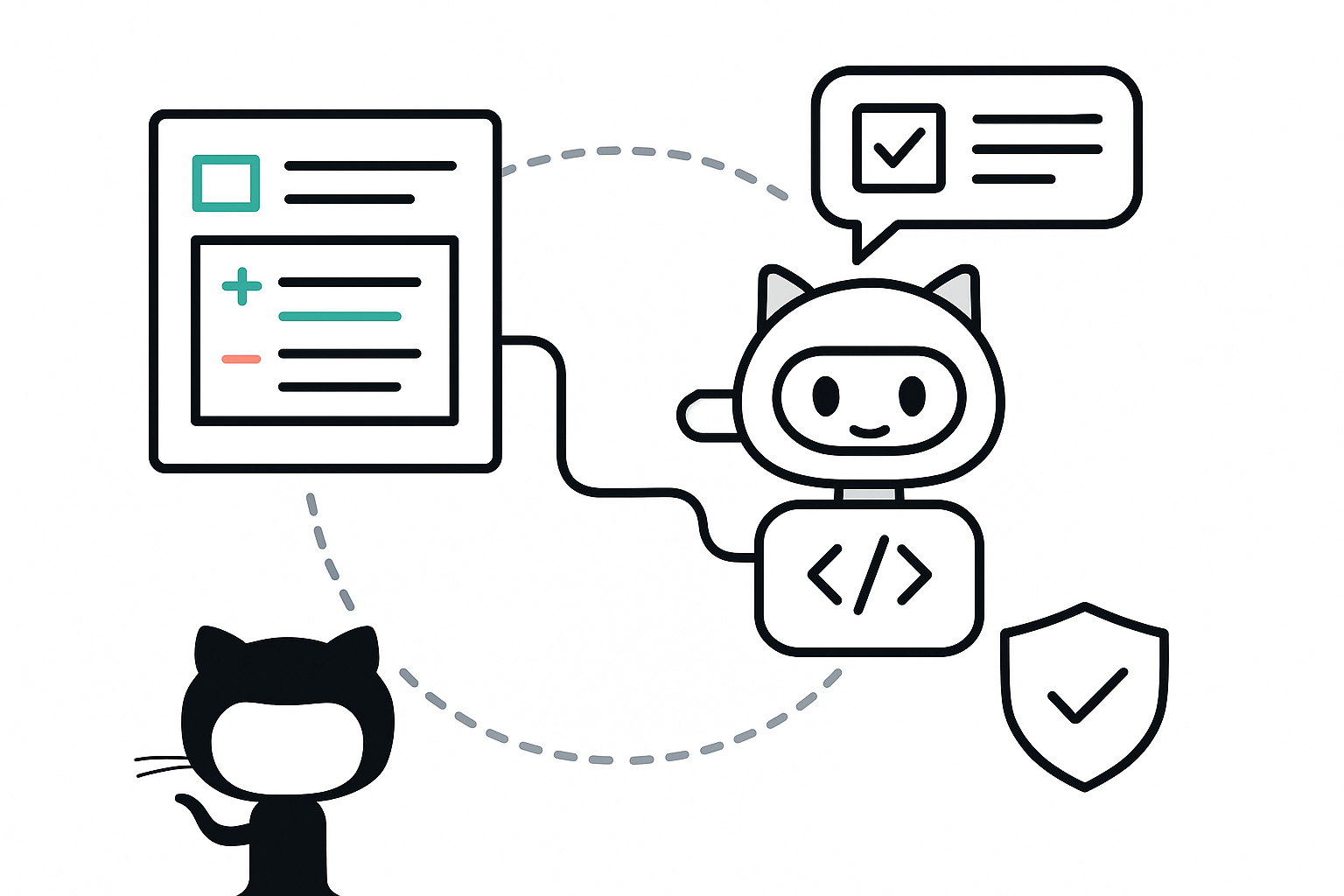
In this blog post GitHub Agents with Codex and Claude Cut PR Rework and Security Bugs we will walk through what “GitHub Agents” are, how Codex and Claude Code fit into pull requests (PRs), and the practical ways they reduce rework and security bugs without slowing your team down.
If your PR process feels like a pinball machine—review comments, fixes, new comments, more fixes—you’re not alone. Even strong teams lose hours to avoidable back-and-forth: missing tests, inconsistent patterns, “we don’t do it that way here,” and security issues that only get noticed right before release.
The good news is you can now add AI “agents” directly into the PR workflow, so the first pass of review (and a chunk of the remediation work) happens automatically. Think of it as adding a tireless assistant reviewer who checks the basics, flags risky patterns, and can even implement straightforward fixes—before a senior engineer has to spend brainpower on it.
A high-level view of what this is (without the hype)
A GitHub Agent is an AI helper that can be asked to perform a specific job inside GitHub—like reviewing a PR, writing tests, summarising changes, or applying a small fix. You interact with it much like a teammate: you request a review, mention it in a comment, or trigger it automatically when a PR is opened.
Codex (from OpenAI) and Claude Code (from Anthropic) are AI coding assistants that can read code, reason about changes, and produce patches. When you connect them into GitHub, they become practical PR “workers”: they read what changed, compare it to your standards, run checks, and leave comments (or propose edits) in plain English.
Why PR rework happens (and why it’s expensive)
Most teams don’t suffer from “too many PR comments.” They suffer from late discovery—issues are found after the developer has mentally moved on, or after the change has already triggered downstream work.
Here are the common sources of rework we see when helping Australian organisations modernise their engineering and security practices:
- Inconsistent patterns (naming, folder structure, error handling) that reviewers have to police manually.
- Missing tests or tests that don’t actually cover the risky parts of the change.
- Security gaps (secrets in code, unsafe input handling, overly-permissive access) that are hard to spot when reviewers are scanning quickly.
- Unclear PR descriptions that force reviewers to reverse-engineer intent.
Every round-trip adds cost. Not just developer time—also delays to delivery, more context switching, and higher risk that something slips through when everyone’s tired.
What GitHub Agents change in the PR workflow
GitHub Agents make a subtle but powerful shift: they move a chunk of review work from “human-only and manual” to “automatic and consistent.”
In practical terms, agents can:
- Review PRs quickly and leave structured feedback (bugs, style, performance, security).
- Suggest exact code changes, often with copy-and-apply patches.
- Implement fixes for well-scoped items (e.g., add missing null checks, refactor duplicated logic, add a unit test).
- Standardise review quality so “good enough” doesn’t depend on who happened to review the PR.
This doesn’t remove the need for human review. It makes human review higher value: architecture decisions, product intent, and edge cases—rather than arguing about formatting or chasing missing tests.
The core technology behind it (in plain English)
1) LLMs that can read and write code
At the heart of Codex and Claude Code are large language models (LLMs). They don’t “compile code in their head,” but they are very good at recognising patterns, understanding intent from context, and producing changes that match the existing style of a codebase.
In a PR setting, that means the agent can look at the diff (what changed), surrounding files (what the system expects), and your instructions (what your team standards are), then produce targeted feedback.
2) Tool access inside GitHub (so it can act, not just chat)
Agents become useful when they can take actions: read files, comment on PRs, open issues, create commits, or open a follow-up PR. This is usually done via official integrations (apps/plugins) or workflows that run in GitHub Actions.
In plain terms: instead of a developer copying code into a chat window, the agent works where the code already lives, under controlled permissions.
3) Guardrails: permissions, secrets, and “least access”
Any time an automated tool can write code or comment on PRs, you need guardrails. The safe pattern is:
- Only run on trusted events (e.g., PRs from internal branches, not random forks).
- Use the minimum permissions needed (read-only where possible; write only when required).
- Store API keys securely in GitHub secrets, not in code.
- Log what happened so humans can audit the agent’s actions.
Where Codex and Claude Code help most in PRs
1) Catching “obvious in hindsight” bugs early
Agents are excellent at pointing out common foot-guns: unchecked null values, off-by-one errors, incomplete error handling, and logic that doesn’t match the function name or comments.
Business outcome: fewer regressions reaching production, less on-call pain, and fewer emergency fixes that disrupt planned work.
2) Reducing security bugs before they ship
Security issues often look “fine” at a glance—especially when a reviewer is skimming between meetings. Agents can be instructed to look specifically for risky patterns such as:
- credentials or tokens accidentally added to code
- unsafe handling of user input
- overly-permissive access rules
- dependency changes that introduce known risky packages
Business outcome: reduced likelihood of incidents that trigger customer notifications, downtime, reputational damage, or compliance headaches.
3) Enforcing your engineering standards consistently
Most organisations have standards, but they’re scattered: a wiki page nobody reads, a senior dev’s memory, and “we’ve always done it this way.” Agents can be given clear instructions so they check for the same things every time.
Business outcome: more predictable code quality, faster onboarding for new developers, and less reliance on a couple of key people to catch everything.
4) Turning review feedback into actual changes
The real time sink isn’t the comment—it’s the fix, the retest, and the follow-up review. Modern agent workflows can take feedback and implement it, then open an updated PR or commit to the branch.
Business outcome: shorter PR cycle time (idea to merged), and fewer interruptions for senior reviewers.
A real-world scenario we see often (anonymised)
A Melbourne-based software business (around 120 staff, with a small internal dev team) told us their biggest frustration was “review churn.” PRs were technically fine, but they kept bouncing for small issues: missing tests, inconsistent error handling, and occasional security concerns raised late in the process.
We helped them trial a two-step approach:
- Step 1: an automated agent review on every PR to catch baseline issues early (tests, obvious bugs, risky patterns).
- Step 2: a human review focused on intent, edge cases, and maintainability.
Within a few sprints, the change was noticeable: fewer “please fix the basics” comments, faster approvals, and fewer late-stage security surprises. The dev lead also reported less reviewer fatigue—people were spending attention where it actually mattered.
Practical ways to implement this (without boiling the ocean)
1) Start with a single job to automate
Pick one pain point that causes repeated PR churn. Good starters:
- PR summaries that explain what changed and why
- baseline code review comments (readability, obvious bugs)
- test gaps (suggesting or generating tests)
- security-focused review pass
2) Write “review rules” in plain English
Agents are only as useful as the instructions you give them. Keep it short and specific, for example:
- “Flag any code that logs sensitive customer data.”
- “If a new API endpoint is added, ensure authentication is required.”
- “If a new feature is added, ensure at least one unit test is included.”
3) Put guardrails around where the agent can write
Many teams start with “comment-only” mode (agent reviews and suggests). Once confidence is built, allow it to create a small fix PR for low-risk changes.
That staged rollout keeps trust high and avoids the “AI made a huge change overnight” fear.
4) Treat it like a junior reviewer, not an authority
Agents can be wrong. The right mindset is: it catches a lot of things early, but humans own the decision to merge.
This is also how you avoid tool backlash. Developers keep control, while still getting the speed benefit.
A lightweight example workflow (so it’s concrete)
Below is a simplified example of how teams structure agent-driven PR help. This is intentionally high-level—you’ll tailor it to your repo, security model, and preferred tooling.
# Example concept (pseudocode / simplified)

On PR opened or updated:
 1) Run automated checks (tests, linting, security scanning)
 2) Ask AI agent to:
 - Summarise the PR in plain English
 - Flag likely bugs and risky patterns
 - Suggest tests if coverage looks thin
 3) Post results as PR comments

Optional (later phase):
 4) If agent finds low-risk fixes:
 - Create a commit or a follow-up PR implementing them
 - Re-run tests
The key is sequencing: let your existing automated checks run first, then have the agent interpret results and the code changes together. That’s where the review comments become much more useful than generic “looks good” feedback.
How this connects to security and compliance in Australia
If you’re aligning to the Essential 8 (the Australian Government’s baseline cybersecurity framework that many organisations are now expected to follow), PR hygiene matters more than ever. Not because PRs are a compliance checkbox—but because PRs are where insecure changes slip in quietly.
Agent-assisted reviews can support that by making secure patterns the default: fewer secrets in code, fewer risky shortcuts, and more consistent review attention on security-relevant changes.
Where CloudPro Inc fits (if you want this to work in the real world)
Getting value from agents isn’t about turning them on and hoping for the best. It’s about choosing the right use cases, setting guardrails, and aligning the workflow with your engineering culture.
At CloudPro Inc (Melbourne-based, Microsoft Partner, and Wiz Security Integrator), we help teams roll this out pragmatically—often alongside broader work in Azure, Microsoft 365, and security uplift. Our focus is reducing rework, reducing risk, and keeping developers shipping smoothly, not adding process for the sake of it.
Summary and a low-pressure next step
GitHub Agents using Codex and Claude Code are most valuable when they remove the repetitive parts of PR review: baseline bugs, missing tests, and common security pitfalls. Done well, they shorten PR cycle times, reduce production issues, and free senior engineers to focus on the hard problems.
If you’re not sure whether agents would help your team—or you suspect your PR workflow is quietly costing you more than it should—we’re happy to take a look at your current setup and suggest a practical starting point. No hard sell, just a clear plan you can choose to run with.