
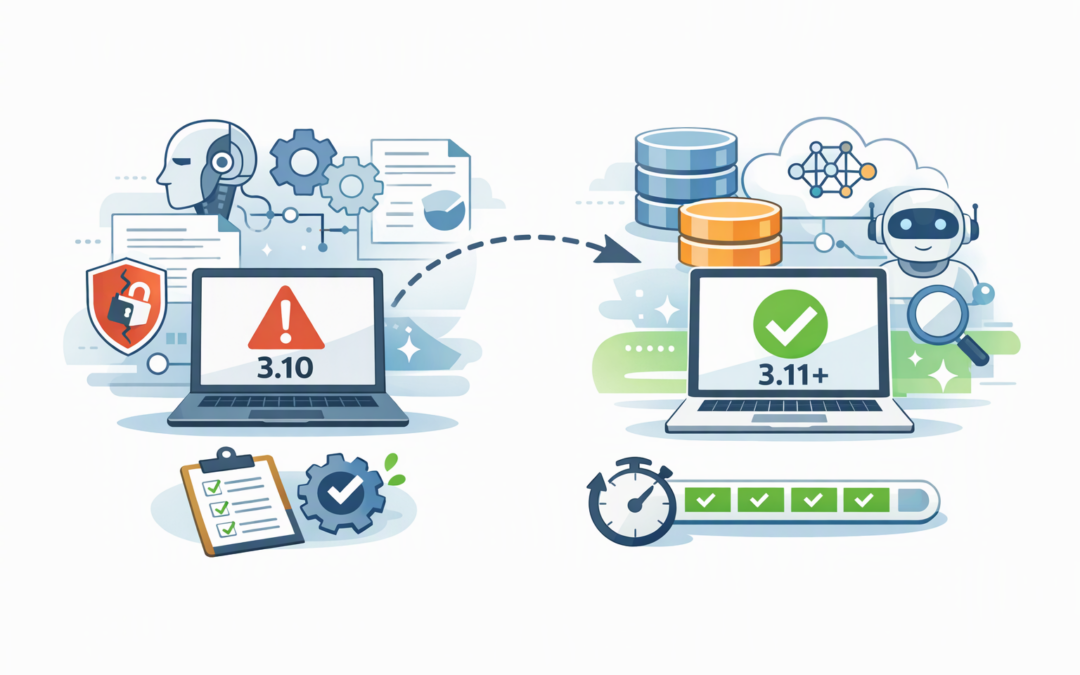
In this blog post Microsoft Agent Framework Python 3.10 Removal and Upgrade Plan we will explain why a routine-looking platform change could create security, delivery and support problems for engineering teams that do not prepare.
Microsoft Agent Framework is a software foundation for building AI agents. These agents connect AI models such as Azure OpenAI, OpenAI and Anthropic Claude with company data, business systems and approved tools so they can complete tasks rather than simply generate text.
For a CIO or CTO, the important point is that Agent Framework may sit underneath customer service assistants, document-processing tools, internal knowledge systems and automated workflows. A change to its supported Python version can therefore affect real production services, not just a developer’s laptop.
What is changing with Python 3.10
Python is the programming language used by many Agent Framework applications. Python 3.10 reached the end of its official lifecycle on 1 October 2026, which means it no longer receives security updates from the Python maintainers.
CPI Consulting helps organisations design, build and secure Azure AI solutions, from Azure OpenAI and Microsoft Foundry to agents, governance and production deployment.
Visit CPI ConsultingMicrosoft Agent Framework Python 1.24, released on 30 October 2026, moved its supported baseline to Python 3.11 or later. Python 3.10 may still install because the package information temporarily allows it, but Microsoft no longer tests or guarantees that combination.
This distinction matters. “It still installs” does not mean “it is safe and supported.” A future release is expected to block installation on Python 3.10 completely.
For businesses following the Essential 8, the Australian government’s cybersecurity framework, continuing to run unsupported software also conflicts with the principle of patching applications promptly. An AI service running on an outdated foundation can become an unnecessary security and audit concern.
Why this is more than a developer upgrade
1. Your application may fail during an unrelated update
An engineering team might update Agent Framework to fix a bug or add a security control, only to discover that the new package will not install in its existing environment. This can delay a planned release or force an urgent Python migration.
The hidden cost is rarely the installation command. It is the testing of database connections, AI model integrations, authentication, monitoring, storage and every external tool the agent is allowed to use.
2. Unsupported does not always fail immediately
Python 3.10 applications may continue running for weeks or months. That creates a dangerous sense that nothing needs to change.
The failure may appear later when another dependency drops Python 3.10, a cloud image is updated or a security scanner flags the unsupported runtime. By then, the business may be dealing with an urgent production problem rather than a controlled upgrade.
3. The release cadence changes your operating model
Agent Framework’s recent Python 1.x releases have arrived roughly weekly, although engineering leaders should not treat this as a guaranteed schedule. Versions 1.20 through 1.24 were released across October 2026, with meaningful changes appearing in quick succession.
This pace is useful because fixes and capabilities arrive quickly. It also means the traditional approach of reviewing the framework once or twice a year is no longer adequate.
Our earlier guide to Microsoft Agent Framework 1.x October changes covers the broader security, stored-data and integration changes. The Python 3.10 decision reinforces the same message: production AI platforms need an active maintenance plan.
The real-world business risk
Consider a 200-person organisation running an internal AI assistant that searches policies, prepares customer responses and opens service requests. The application works reliably, so its small engineering team focuses on new business features rather than its Python runtime.
A security review then identifies Python 3.10 as unsupported. At the same time, the team needs a newer Agent Framework release to fix an integration issue.
Instead of completing a planned two-day update, the team must rebuild its container images, retest model connections, validate identity permissions and confirm that stored agent conversations remain readable. A manageable maintenance task becomes an urgent project competing with customer commitments.
The lesson is not that rapid releases are bad. It is that unmanaged dependencies turn predictable changes into expensive surprises.
What engineering leaders should do now
1. Find every Agent Framework environment
Ask your team to identify development, testing and production environments, including containers, scheduled jobs and experimental AI projects. Pilot systems are often forgotten even when they can access real company data.
python --version
python -m pip show agent-framework
python -m pip check
These basic commands show the active Python version, the installed Agent Framework package and obvious dependency conflicts. Your team should also inspect deployment images and build pipelines rather than relying only on local machines.
2. Choose a supported Python baseline
Do not automatically jump to the newest Python release. First confirm that your databases, AI connectors, security tools and other packages support it.
Agent Framework currently supports Python 3.11 through 3.15, but some integrations have version-specific limits. For many organisations, testing Python 3.12, 3.13 and 3.14 before choosing a standard will be safer than making assumptions.
3. Separate runtime and framework upgrades
Changing Python and Agent Framework simultaneously makes failures harder to diagnose. Where possible, test the existing framework on the new Python version first, then upgrade Agent Framework in a separate step.
This gives the engineering team a clear rollback point. It also reduces the time spent working out whether a problem came from Python, Agent Framework or another package.
4. Pin production versions
Production builds should use approved versions rather than automatically downloading whatever was released most recently. Version pinning means recording the exact software versions that have passed your tests.
# Example only — use versions approved by your team
python==3.13.x
agent-framework==1.24.*
Pinning does not mean ignoring updates. It means reviewing them deliberately, testing them and promoting them through development, staging and production in a controlled way.
For more detail on safe deployment checks, see our Agent Framework production guide.
5. Introduce a release review rhythm
Assign someone to review Agent Framework release notes weekly or fortnightly. Classify each update as security-related, breaking, operationally useful or safe to defer.
Your team does not need to install every weekly release. It does need to know what changed, whether the change affects production and how long an upgrade can reasonably wait.
What CIOs and CTOs should ask
- Are any production or pilot AI services still running Python 3.10?
- Do we know which Agent Framework version each service uses?
- Can we rebuild and test an agent without relying on one developer’s laptop?
- Are framework updates tested against identity, data access and tool permissions?
- Who reviews security and breaking changes, and how often?
- Can we roll back quickly if an update changes agent behaviour?
If your provider cannot answer these questions clearly, the issue is not simply Python 3.10. It may indicate that your organisation lacks a repeatable operating model for production AI.
Turn rapid releases into a business advantage
The removal of Python 3.10 is a reasonable security decision, but it is also a useful test of engineering maturity. Teams with documented environments, automated tests and controlled releases should be able to manage it without major disruption.
Teams without those controls may face avoidable downtime, rushed security exceptions and growing support costs. The business outcome is straightforward: planned maintenance costs less than emergency remediation.
CloudPro Inc combines more than 20 years of enterprise IT experience with practical work across Microsoft Azure, Agent Framework, OpenAI, Claude and cloud security. As a Melbourne-based Microsoft Partner and Wiz Security Integrator, we help organisations connect AI upgrade decisions with the wider security and governance picture rather than treating them as isolated developer tasks.
If you are unsure which Python or Agent Framework versions your AI services are running, or whether your release process can keep up safely, we are happy to review the setup with you — no strings attached.