
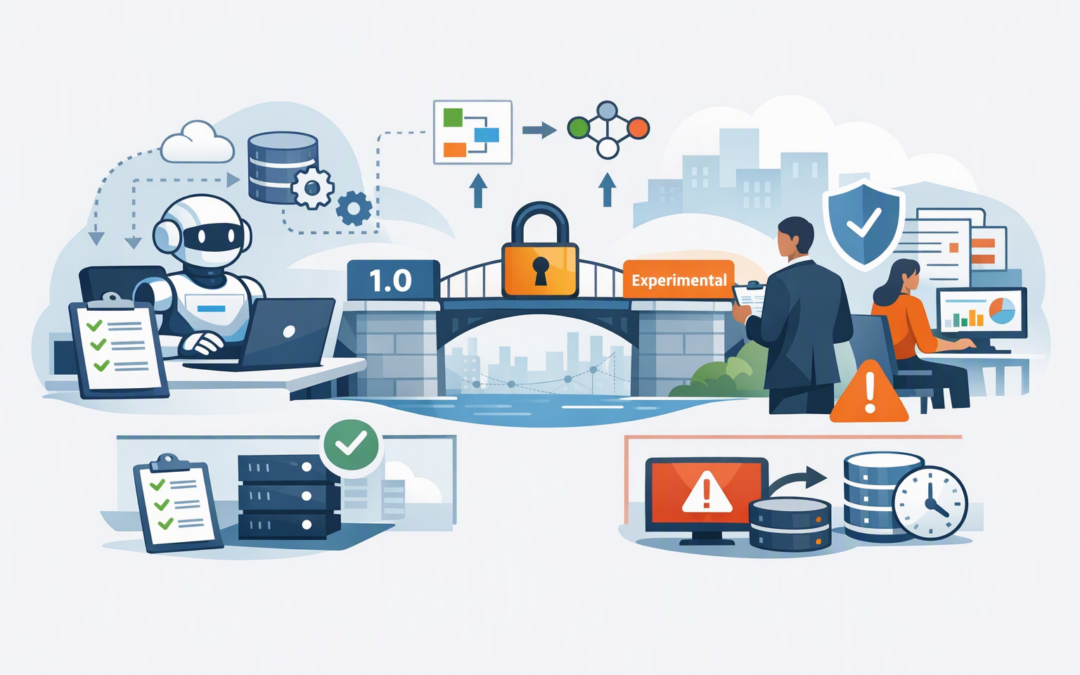
In this blog post Microsoft Agent Framework 1.x Stability and Production Risk Guide we will explain what Microsoft’s fast release cycle means for production systems, budgets and business continuity.
Your development team may say an AI agent is “production-ready”, yet a framework update can still change how it remembers information, connects to business systems or asks for approval. For a CIO, the real question is not whether version 1.x is stable. It is whether your organisation can absorb regular change without disrupting employees, customers or critical processes.
What Microsoft Agent Framework actually does
Microsoft Agent Framework is an open-source foundation for building AI agents in Python and .NET. An AI agent is software that can interpret a request, decide what steps to take and use approved tools to complete work.
For example, an agent could read a customer email, check a CRM record, prepare a response and ask an employee for approval before sending it. The framework manages the instructions, conversation history, tool connections, approvals and workflows behind that process.
CPI Consulting helps organisations design, build and secure Azure AI solutions, from Azure OpenAI and Microsoft Foundry to agents, governance and production deployment.
Visit CPI ConsultingIt also supports MCP, or Model Context Protocol, which gives agents a standard way to connect with tools and data. A2A, meaning agent-to-agent communication, allows separate agents to exchange work across systems.
Version 1.x does not mean change has stopped
Microsoft announced Agent Framework 1.0 for Python and .NET in April 2026, describing it as ready for production with stable core interfaces. This was an important milestone, but it was not a promise that every package, connector and behaviour would remain unchanged.
By late October 2026, Python had reached version 1.24 and .NET had reached version 1.27. Several Python releases arrived roughly one week apart during September and October.
This pace brings security fixes, reliability improvements and useful capabilities into the framework quickly. It also means that treating every update as routine maintenance can expose the business to avoidable risk.
Microsoft documents significant changes and provides upgrade guidance, including cases where teams must adjust code, stored state or connected components. In plain English, the 1.x label provides a more dependable foundation, but it does not remove the need for testing and change control.
The main production risks CIOs should understand
1. Automatic updates can create unplanned outages
If a production build accepts any newer 1.x release, a routine deployment may install a version your team has never tested. The agent might still start correctly while behaving differently during a less common workflow.
That can result in failed approvals, missing context or an inability to reach a business system. The cost is not just developer time; it can include delayed customer service, manual rework and lost confidence in the AI project.
2. Stable and preview components can sit side by side
The core framework may be stable while a specific connector, hosting option or newer capability remains in preview. Preview means it is still changing and may not have the same support or compatibility guarantees as the production-ready components.
CIOs should therefore ask for a component-level inventory rather than accepting a blanket statement that “we use version 1.x”. Every package should be labelled as stable, preview or experimental, with a business owner who has accepted the risk.
3. Stored memory can become incompatible
Agents often retain conversation history, workflow checkpoints or business context. A framework update can change the structure used to store that information.
Recent releases have included migration warnings for particular context-storage components. If this risk is missed, an upgraded agent may lose access to existing information or require data to be reprocessed.
Backup and recovery tests must therefore cover agent state, not just source code. Our Agent Framework version governance guide explains how to protect stored state during upgrades.
4. Tool permissions may change behaviour
The most useful agents can update records, run reports, create files or send messages. These actions also carry the highest risk.
A security improvement may introduce a new approval step, while a poor configuration could allow an agent to act too freely. Testing must confirm both sides: authorised work should continue, and sensitive actions should still be blocked or require human approval.
This becomes particularly important when using MCP or A2A connections. Our production guide to A2A and MCP governance covers these boundaries in more detail.
5. The framework is only one dependency
An agent may depend on Azure, Microsoft Foundry, Azure OpenAI, OpenAI, Anthropic Claude, databases and third-party tools. Each service has its own updates, limits and security settings.
A framework release can therefore be technically sound but still cause problems when combined with your exact model, connector or hosting environment. Production testing must cover the complete service, not only whether the application compiles.
A practical risk model for production upgrades
Consider a 200-person professional services business using an agent to classify client requests and create jobs in its service platform. An update that affects an internal experiment may have little consequence, but the same update applied to the client-request agent could delay billable work across the company.
The sensible approach is to group agents by business impact:
- Low risk: Internal demonstrations and experiments using test data.
- Moderate risk: Employee assistants that prepare content but cannot change business records.
- High risk: Agents that access sensitive data, communicate with customers, approve transactions or update operational systems.
Higher-risk agents need longer testing, named business approval, a tested rollback process and monitoring after release. This keeps governance proportional instead of burying every small experiment in paperwork.
What a safe release process looks like
First, pin the exact framework version used in production. Pinning means specifying one approved version rather than automatically accepting whatever release is newest.
# Python example
agent-framework==1.24.0

<!-- .NET example -->
<PackageReference Include="Microsoft.Agents.AI" Version="1.27.0" />
Second, test complete business journeys. Confirm that the agent can retrieve data, call tools, request approval, save its progress, recover from failure and produce an acceptable result.
Third, release to a small user group before rolling out broadly. Monitor error rates, response quality, costs and the number of tasks employees must correct manually.
Finally, keep the previous version ready for rollback. Our guide to upgrading Agent Framework without production disruption provides a more detailed deployment approach.
Questions CIOs should ask their team or provider
- Which exact Agent Framework versions are running in production?
- Are any preview or experimental packages supporting critical processes?
- Who reviews release notes and decides whether an update is required?
- Which business workflows are tested before deployment?
- Can we restore the previous version and its stored state?
- Are tool actions logged and sensitive actions independently approved?
- How quickly can we apply an urgent security fix?
If these questions cannot be answered clearly, the organisation does not yet have release governance. It has a development process that happens to produce AI software.
Connect AI governance with Australian security obligations
Microsoft Agent Framework is not itself an Essential 8 compliance product. However, controlled updates, restricted administration, reliable backups and strong monitoring support the same risk-reduction goals as Essential 8, the Australian Government’s baseline cybersecurity framework.
AI agents should sit inside your wider security program, including Microsoft Defender, identity controls and cloud-security monitoring such as Wiz. This is especially important when agents can reach personal information, financial records or systems covered by Australian privacy obligations.
Move quickly without making production fragile
Microsoft Agent Framework 1.x is mature enough for serious production use, but the release number should not replace due diligence. The safest organisations pin versions, separate stable components from previews, test business outcomes and maintain a rehearsed rollback path.
CloudProInc brings more than 20 years of enterprise IT experience to this work as a Microsoft Partner and Wiz Security Integrator. Our Melbourne-based team helps organisations across Australia and internationally assess Azure, Microsoft 365, AI and cybersecurity environments without the overhead of a giant, faceless provider.
If you are unsure whether your current Agent Framework release process is protecting the business or quietly adding risk, we are happy to take a practical look with you — no strings attached.