
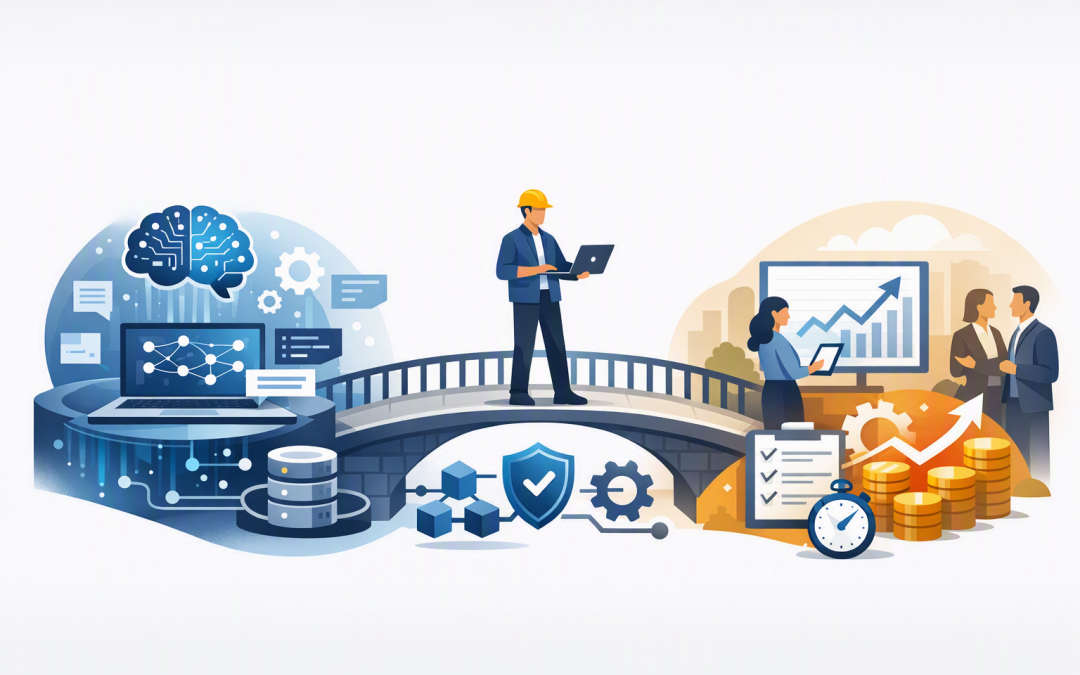
In this blog post How Forward Deployed Engineers Turn AI Into Measurable Value we will explain why many promising AI projects fail to produce a financial return, and how a hands-on engineering approach turns them into useful business systems.


Most organisations do not have an AI access problem. Employees are already experimenting with ChatGPT, Microsoft Copilot, Claude and other tools. The real problem is that these experiments often sit outside normal workflows, rely on manual copying and produce results nobody can confidently measure.
A forward deployed engineer fixes that gap. They work closely with business leaders, employees and internal IT teams to identify a valuable problem, build the right system and keep improving it until it delivers a measurable result.
What a forward deployed engineer actually does
A forward deployed engineer is a senior technical specialist who works inside the business problem rather than building from a distant requirements document. They combine consulting, software engineering, AI knowledge and practical delivery.
The word “forward” means they work close to the people using the system. “Deployed” means their responsibility extends beyond a demonstration. They help move the solution into daily operations, where reliability, security and employee adoption matter.
This role has become important because AI systems behave differently from traditional software. A normal application follows fixed rules. An AI model interprets language and generates answers, which means its output can vary even when the request appears similar.
The system therefore needs testing, boundaries, monitoring and human review. A forward deployed engineer designs these controls while keeping attention on the business outcome.
They start with value rather than an AI tool
A common mistake is to buy an AI product and then search for somewhere to use it. That approach can create impressive demonstrations without reducing costs, improving service or removing work.
A forward deployed engineer starts with questions such as:
- Where are employees losing the most time?
- Which delays affect customers or revenue?
- What repeated mistakes create financial or compliance risk?
- Which tasks require information from several systems?
- What result could be measured within 60 to 90 days?
For example, “use AI in customer service” is too broad. A better target might be reducing the time required to prepare an accurate response to a support request from 20 minutes to eight minutes.
That target guides every later decision. It also gives the CIO or operations director a clear way to decide whether further investment is justified.
This discovery process complements the role described in our guide to how forward deployed engineers align business and technology teams. Alignment is important, but measurable value requires the team to stay connected through testing, deployment and adoption.
The technology behind a useful AI system
The technology does not need to be mysterious. Most business AI systems contain a small number of understandable parts working together.
The AI model
A large language model, such as an OpenAI or Anthropic Claude model, is the reasoning and language component. It can interpret requests, summarise information, prepare drafts and decide which approved action should happen next.
The largest model is not always the best choice. A forward deployed engineer compares accuracy, response time, privacy requirements and operating cost before selecting a model.
Approved business information
The model may need access to company policies, product documents, support records or project information. A technique commonly called retrieval allows the system to find relevant approved information when answering a question.
In plain English, the AI is not expected to remember everything. It searches the information it is permitted to use, places the relevant material into context and then prepares an answer based on that material.
Connections to existing systems
Real value usually appears when AI connects to tools employees already use, such as Microsoft 365, Teams, SharePoint, a customer management platform or a service desk.
These connections allow the system to do more than produce text. It might find a customer record, prepare a document, classify a request or create a task. Important actions can still require employee approval.
Identity, permissions and monitoring
An AI system should not give every employee access to every document. It must recognise who is making the request and apply the same access rules used elsewhere in the business.
It should also record what happened, what information was accessed and whether the result was accepted or corrected. This creates accountability and gives the delivery team evidence for improving the system.
Platforms such as Microsoft Azure can provide these building blocks in a managed environment. Microsoft Intune, which manages and secures company devices, and Microsoft Defender, which detects and responds to security threats, can also support the wider security environment around the AI service.
They test business performance instead of relying on a demo
An AI demonstration is normally tested with a few carefully chosen questions. A production system must handle unclear requests, incomplete records, unusual exceptions and users who do not follow the expected process.
Forward deployed engineers create evaluation sets, which are collections of realistic test cases with expected outcomes. These tests measure whether the system produces accurate, safe and useful results before changes are released.
They also track business measures such as:
- Minutes saved per transaction
- Reduction in rework or manual data entry
- Faster customer response times
- Percentage of outputs accepted without major editing
- Cost per completed task
- Number of security or policy exceptions
This is where AI moves from an interesting capability to an investment that can be managed. If the numbers are not improving, the engineer changes the workflow, instructions, data source or model rather than declaring the pilot successful.
A practical example of value creation
Consider a 180-person professional services business where consultants spend several hours each week preparing client updates. Information is spread across emails, meeting notes, project systems and SharePoint documents.
The initial request might be to “automate client reporting”. A forward deployed engineer would narrow that request, map the current process and calculate how much time it consumes.
The first release might collect approved project information and prepare a draft update for a consultant to review. It would not send anything to the client automatically.
During testing, the team might discover that missing project notes are a bigger problem than report writing. The engineer could then add a check that identifies missing information before generating the draft.
The outcome is not simply an AI-generated report. It is less administrative work, more consistent communication and earlier identification of project issues. Those results can be measured against the old process.
For workflows requiring the AI to complete approved steps, our article on how forward deployed engineers build custom AI agents explains the agent approach in more detail.
Security and compliance are built into delivery
AI can introduce risk when employees paste sensitive information into unapproved tools or when a system receives broader access than it needs. Waiting until launch to review security can result in expensive redesign work.
A forward deployed engineer considers data access, retention, permissions, human approval and logging from the beginning. For Australian organisations, this should fit within existing privacy obligations and cybersecurity controls.
The Essential Eight, the Australian Government’s recommended cybersecurity framework, remains an important foundation. It helps protect devices, accounts and business systems, although AI also needs additional controls covering model access, business data and generated outputs.
CloudProInc brings this security perspective through its work as a Microsoft Partner and Wiz Security Integrator. Wiz provides visibility into cloud security risks, while Microsoft security tools can help protect identities, devices, information and cloud services.
How to know whether you need this role
A forward deployed engineer may be valuable if your business has several AI pilots but no production results, employees are using unapproved tools, or internal teams cannot agree on which use case should come first.
The role is also useful when an AI project depends on several business systems, handles sensitive information or needs to demonstrate a financial return to the board.
You do not necessarily need to hire a permanent employee immediately. A practical engagement can begin with one high-value workflow, clear measures and a limited delivery period. The goal should be to prove value while creating patterns your internal team can reuse.
Turn AI interest into an accountable business result
Forward deployed engineers help businesses avoid the expensive space between an exciting AI demonstration and a reliable operational system. They connect the model to real information, existing tools, security controls and measurable business outcomes.
With more than 20 years of enterprise IT experience, CloudProInc takes a practical, hands-on approach across Azure, Microsoft 365, OpenAI, Claude, Defender and Wiz. We are based in Melbourne and work with organisations across Australia and internationally without the layers of a large, faceless provider.
If your AI projects look promising but are not yet saving time, reducing costs or improving service, we are happy to help you identify what is missing and whether a forward deployed engineering approach makes sense.