
In this blog post AI Export Controls Are a Board-Level Risk for Australian Firms we will explain why AI export controls have moved from “someone else’s problem” to a real board-level risk, and what Australian IT and engineering leaders can do about it.


If you’re building AI features, fine-tuning models, sharing models with customers, or just relying heavily on US-based cloud and AI services, AI Export Controls Are a Board-Level Risk for Australian Firms isn’t a headline to skim past. It can directly affect what you can buy, what you can ship (including digitally), and what your suppliers will allow you to do.
This is not about panic. It’s about avoiding the kind of surprise that lands in a board paper: “Our AI roadmap is blocked”, “Our key vendor won’t renew unless we change our architecture”, or “We accidentally shared restricted technology with an overseas contractor.”
High-level what is happening and why it matters
Export controls are laws that restrict how certain technology can be supplied to other countries, companies, or individuals. Historically, most leaders thought about export controls as “shipping physical equipment overseas.”
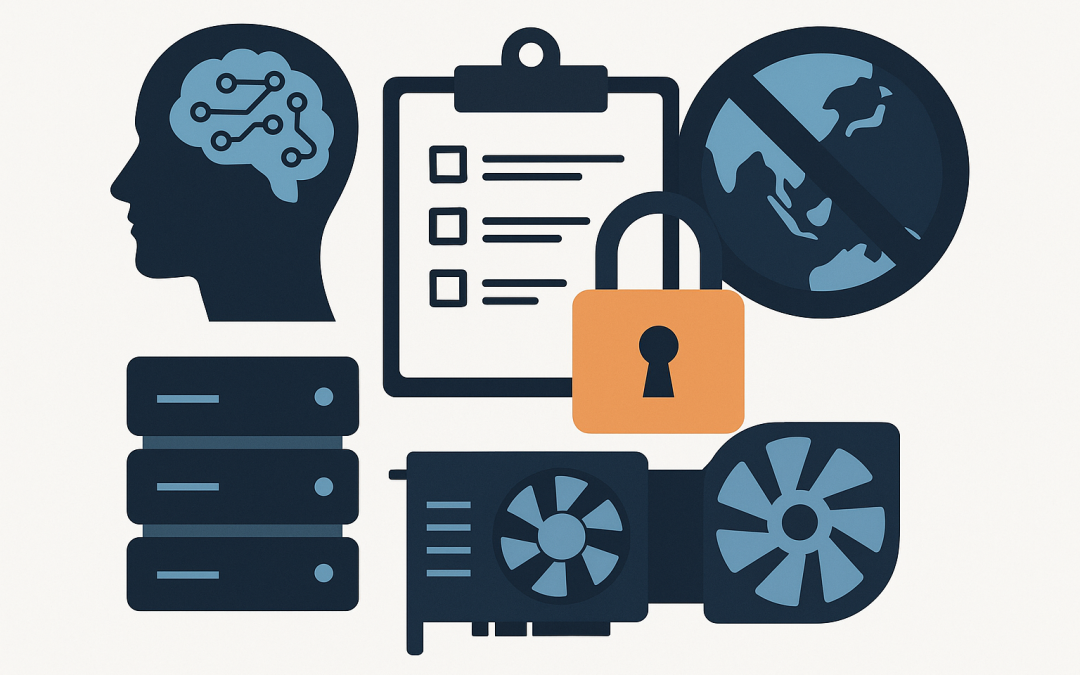
AI broke that mental model. Today, the thing that can be controlled might be a GPU (AI chip), a cluster of computing capacity, or even AI model weights (the “trained brain” of an AI model). And transfers can happen over the internet in seconds.
For Australian firms, the risk often shows up indirectly: US or global vendors adjust what they will sell you, what they will host for you, where data can be processed, and what security conditions you must meet. Even if you never “export” anything yourself, your providers might be forced to treat parts of your AI stack as controlled.
The technology behind the risk in plain English
To make good decisions, it helps to demystify the core technology involved. Three building blocks matter most.
1) Advanced computing chips and GPU capacity
Modern AI (especially generative AI) is powered by specialised processors called GPUs. Think of GPUs as “math engines” that can run millions of calculations in parallel. The more GPU power you have, the faster you can train or run large AI models.
Export controls often focus on these chips because they can be used for both commercial innovation and military or intelligence purposes. Even when you don’t buy chips directly, you may be consuming the same capability through cloud services.
2) Model weights (the ‘learned brain’ of an AI model)
An AI model is a program that produces outputs (answers, summaries, code, images) based on inputs (prompts, data). The model weights are the numeric parameters the model learns during training. They’re effectively the distilled “knowledge” of the model.
If you train or fine-tune a model, the weights can become a valuable asset. In some regulatory frameworks, closed (non-public) model weights for very advanced models can be treated like controlled technology.
3) Training compute thresholds (how “big” the training was)
Some controls are defined by the amount of compute used to train a model (a way of measuring how intensive the training process was). This matters because it’s an attempt to regulate the capability of a model, not just the brand name of the model.
Practically, that means policy and procurement teams may ask questions like: “How was this model trained?”, “Where was it trained?”, and “Who can access the resulting weights?”
Why this is now a board-level issue (not just legal or procurement)
Boards care about operational continuity, risk, and reputation. AI export controls touch all three.
1) Your AI roadmap can be blocked by a supplier decision
A common scenario: you build a product plan around a specific model or cloud setup, then your vendor updates their terms, geographic availability, or security requirements because their compliance position changed.
Business outcome: avoiding expensive rework and missed revenue targets because your AI feature can’t be shipped as designed.
2) “Digital exports” are still exports
Many teams still think: “We’re not exporting anything.” But if you share a model, weights, code, or even provide certain technical services to an overseas entity, regulators may treat it as a transfer of controlled technology.
Business outcome: reduced risk of accidental non-compliance caused by everyday engineering workflows (Git access, CI/CD pipelines, overseas contractors, offshore support).
3) Security requirements become contractual requirements
Even when you’re allowed to access a capability, suppliers may require stronger controls around how you store and access models and sensitive data. This shows up as: stricter identity checks, logging requirements, encryption requirements, and limits on who can administer systems.
Business outcome: fewer security incidents and smoother vendor audits (especially for regulated industries and government-adjacent organisations).
4) It intersects with Australian compliance pressures (Essential 8 and privacy)
In Australia, many organisations are working toward the Essential 8, the Australian government’s cybersecurity framework that focuses on practical controls like application control, patching, multi-factor authentication, and backups. Export-control-driven security requirements often overlap with what Essential 8 is already pushing you toward.
Separately, privacy obligations can bite when AI workloads push data into new services or regions without clear governance.
Business outcome: one governance uplift that supports multiple compliance goals (security, privacy, supplier assurance).
A real-world scenario we see in mid-market Australian firms
Consider a 200-person professional services firm (anonymised). They built an internal AI assistant to speed up proposal writing and client Q&A. The assistant used Microsoft 365 data (SharePoint and Teams) plus a third-party AI service for summarisation.
Two things happened quickly:
- The vendor introduced tighter restrictions about where certain AI processing could occur and who could access model outputs and logs.
- The firm realised several contractors based overseas had broad access to the repository and deployment pipeline, including configuration that connected to AI services.
No one was “doing anything wrong” on purpose. But the governance hadn’t caught up to the reality that AI is now treated like sensitive infrastructure.
By tightening access (who can deploy and who can administer), improving logging, and moving to a more controlled architecture aligned to Microsoft’s identity and device controls, they reduced their exposure and made renewal conversations far easier.
Practical steps for IT and engineering leaders
This is the part you can action without turning your week into a law degree.
1) Build an AI “bill of materials” (what you use, where it lives, who touches it)
Create a simple register for every AI-related component:
- AI providers (OpenAI, Anthropic Claude, Microsoft Copilot services, others)
- Cloud platforms (Azure, AWS, GCP) and regions used
- Where data is stored and processed
- Who has admin access and from which countries they operate
- Whether you train or fine-tune models, and where weights are stored
Business outcome: faster vendor due diligence, faster incident response, and fewer unpleasant surprises in procurement.
2) Treat model weights and prompts like sensitive assets
Even if you never train a frontier model, your fine-tunes, system prompts, retrieval indexes, and evaluation datasets can be strategically valuable.
- Store them like you store secrets (keys and credentials).
- Limit access to only people who need it.
- Log access so you can prove what happened later.
Business outcome: protects IP and reduces the risk of leaking sensitive business logic through AI configurations.
3) Tighten identity and device controls (this is where Microsoft shines)
Most AI risk is not “AI gone rogue.” It’s normal access risk: accounts, endpoints, and overly-broad permissions.
If you’re in Microsoft 365, Microsoft Intune (which manages and secures all your company devices) and strong identity controls can materially reduce exposure. For many mid-market firms, this is the fastest win.
- Require multi-factor authentication for admins and developers.
- Use conditional access (rules that only allow sign-in from trusted devices/locations).
- Separate admin accounts from day-to-day accounts.
Business outcome: fewer account compromises and an easier time meeting supplier security requirements.
4) Decide now how you’ll handle overseas contractors and support
If you use offshore development, support, or contractors travelling frequently, document your approach:
- What systems can they access?
- Can they access production?
- Are they allowed to download datasets or model artefacts?
- Do you have approval workflows for exceptions?
Business outcome: reduces operational friction while staying compliant and audit-ready.
5) Put AI export-control risk into your board reporting rhythm
You don’t need to overwhelm the board with detail. Give them a simple dashboard:
- Top AI suppliers and renewal dates
- Any geography or data residency constraints
- Security posture progress (mapped to Essential 8 where relevant)
- Known dependencies that could block product delivery
Business outcome: fewer last-minute escalations and better funding decisions for security and architecture work.
A small technical example developers can use
If you’re building internal AI apps, one low-effort improvement is to log which model/provider was used, where the request was processed (region, if available), and which dataset was accessed. This makes audits and incident response far easier.
// Pseudocode example: structured logging for AI requests
log.info("ai_request", {
 request_id: uuid(),
 user_id: currentUser.id,
 provider: "azure-openai",
 model: "gpt-4.x",
 data_
 region: env.AI_REGION,
 timestamp_utc: nowUtc(),
 purpose: "proposal_draft"
});

response = ai.generate(prompt, context);

log.info("ai_response", {
 request_id: request_id,
 tokens_in: response.usage.input_tokens,
 tokens_out: response.usage.output_tokens,
 policy_flags: response.safety.flags
});
This isn’t about spying on staff. It’s about being able to answer basic governance questions quickly when a supplier, auditor, or executive asks.
Where CloudProInc fits (without turning this into a sales pitch)
At CloudPro Inc, we sit in the practical middle ground: we understand the moving parts (Azure, Microsoft 365, Intune, Windows 365, OpenAI and Claude integrations), and we also spend time translating them into board-friendly risk and cost decisions.
We’re a Melbourne-based Microsoft Partner and Wiz Security Integrator, and our work is typically with 50–500 person organisations that want the benefits of AI without the hidden compliance and security debt.
Wrap-up and next step
AI export controls are no longer only about shipping hardware overseas. They can shape what AI you can access, what you can build, how you can share it, and what your suppliers will require from your security posture.
If you’re not sure whether your current AI setup, cloud agreements, or contractor model could expose you to export-control or supplier compliance risk, we’re happy to review it with you and provide a plain-English risk snapshot and practical next steps—no pressure, no strings attached.
Discover more from CPI Consulting
Subscribe to get the latest posts sent to your email.